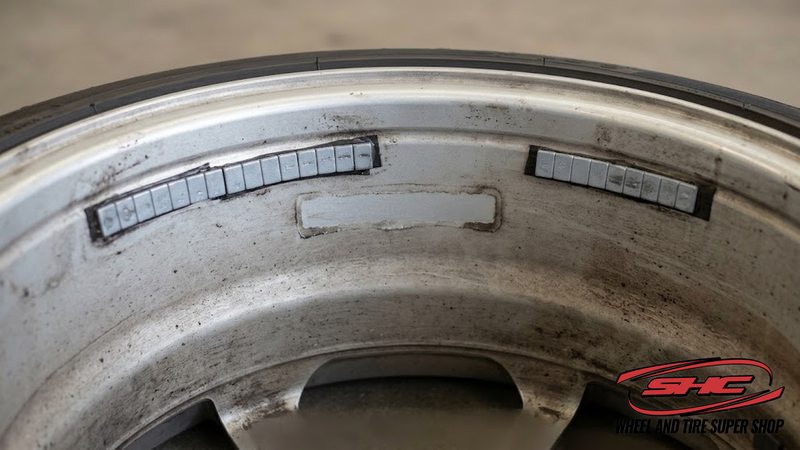
The machine said zero. The car still shakes.
It is one of the more frustrating conversations in this trade, and it happens often enough that it deserves a proper explanation. The balancer reads zero grams. The wheels are perfect on the machine. You drive out and there is still a vibration at 100 km/h.
The balancer is not lying. It is measuring one thing, and the thing causing your vibration is usually something else. Here is the full list of what it can be, roughly in order of how often we find it.
First, what balancing actually measures
Balancing corrects for uneven mass distribution. A wheel and tire assembly has heavy spots; the balancer spins it, works out where they are, and tells us where to add counterweight.
There are two kinds and the difference matters.
Static balance deals with a heavy spot somewhere around the circumference. Uncorrected, it makes the wheel hop up and down. You can find a static imbalance by letting a wheel rotate freely on a spindle and seeing if the same point always settles at the bottom.
Dynamic balance deals with a heavy spot that is off to one side across the width of the tire - closer to the inner face than the outer, say. That does not make the wheel hop, it makes it wobble, trying to steer itself side to side twice per revolution. You cannot detect this by hand at all, and on a wide wheel it is the more common problem.
Any modern spin balancer corrects both, which is why it puts weights on the inside and the outside of the rim rather than all in one place. If someone balanced your wheels with weights on one side only, that is a static-only correction and it is not enough for a wide wheel.
So a "zero" reading means the mass is evenly distributed. It says nothing about the four things below.
1. The tire is not perfectly round, or not uniformly stiff
This is the big one, and it is what road-force balancing exists to find.
A tire is a hand-built object made of rubber, steel and fabric. Two things can be slightly off even when the mass is perfectly distributed:
- Radial runout: the tire is fractionally out of round.
- Stiffness variation: the tire is round, but one section of the sidewall or belt package is stiffer than the rest, usually where the belt plies overlap.
That second one is the killer, because it is invisible to a normal balancer. Unloaded, the tire is round and balanced. Under the weight of the car, the stiff section deflects less than the rest, so the rolling radius changes as it goes round. The axle rises and falls once per revolution - which feels exactly like an imbalance and cannot be fixed with weight.
A road-force balancer presses a loaded roller against the tire while it spins, simulating the road, and measures the force variation. It reports a road-force number in kilograms or pounds as well as the balance weights.
And critically, it can often fix the problem: it identifies the tire's stiff spot and the wheel's low spot, and tells us how to rotate the tire on the rim so the two cancel out. That is called match-mounting, and it will resolve a large proportion of vibrations that ordinary balancing cannot touch.
If a road-force reading is high and match-mounting does not bring it down, the tire itself is the problem. That is a warranty conversation, and having a number rather than a description makes it a much shorter one.
2. The wheel is bent, or out of round
Sometimes the tire is fine and the wheel is not.
A wheel can be bent at the rim flange from a pothole - and our roads supply plenty - or have runout in the mounting face. A wheel with a bend can still balance perfectly, because bending does not necessarily move mass around. It just is not round any more.
Signs pointing this way:
- The vibration followed a specific wheel when the tires were rotated.
- It started after a specific impact.
- The tire needed an unusual amount of weight to balance.
We check this with a dial indicator on the rim, and in a lot of cases a bent wheel can be straightened - it is part of the curb rash and wheel refinishing work we do in-house.
Low-profile tires make this far more common. A 35-series sidewall has almost nothing to absorb an impact, so the energy goes into the rim. That is one of the real costs of a large wheel and we cover it in our article on 18, 19 or 20 inch.
3. The wheel is not centred on the hub
Very common on aftermarket wheels, and it produces a vibration that no amount of balancing will fix - because the assembly is balanced perfectly around the wrong centre.
Most factory wheels are hub-centric: the wheel's centre bore fits closely over a machined register on the hub, and that register locates the wheel precisely. The lug nuts only clamp it.
Many aftermarket wheels are made with a larger bore so one wheel can fit several vehicles. Those need hub-centric rings to take up the gap. Without them the wheel is located only by its lug seats, which is far less precise. A fraction of a millimetre off centre is enough to feel at highway speed.
The fix is inexpensive - rings cost very little and any decent supplier will include them. The test is simple: if the vibration appeared when you fitted aftermarket wheels and the balance is good, this is the first thing to check. Our article on bolt pattern, centre bore and hub-centric fitment covers the mechanism in more detail.
Related and worth checking at the same time: corrosion or debris on the mounting face. A wheel cannot sit flat on a hub with a ridge of rust or a piece of grit on it, and a wheel that is not flat against the hub will wobble no matter what the balancer said. We clean hub faces as a matter of course.
4. It was never the wheels
If the balance is good, the road force is low, the wheels are straight and everything is centred, the vibration is coming from somewhere else. The common candidates:
- Worn suspension or steering components. A tired ball joint, tie rod end or bushing lets the wheel move in ways it should not. Often this presents as a vibration that is worse under braking or over bumps.
- Brake rotor runout or thickness variation. Classic signature: the car is smooth until you brake, then the pedal pulses and the steering wheel shakes. If the vibration only happens under braking, it is not the tires.
- Driveshaft or CV joints. Usually felt through the floor rather than the steering wheel, and often changes with power rather than speed.
- A wheel bearing. Typically noise before vibration, and it changes as you load the bearing by swaying the car gently side to side at speed.
The useful diagnostic question is what makes it change. A tire or wheel vibration tracks road speed and nothing else. If it changes when you brake, when you accelerate, or when you turn, look elsewhere.
Where in the car you feel it
A rough guide, not a rule:
- Through the steering wheel: usually a front wheel.
- Through the seat or floor: usually a rear wheel.
- A speed-specific window - appears at 95, gone by 115 - is characteristic of a rotating imbalance or road-force problem. It comes and goes because you are passing through a resonance.
- Gets steadily worse with speed and never improves: more suggestive of a bent wheel or a mechanical problem.
What we do when a car comes in shaking
In order: check pressures, look for obvious damage and uneven wear, check that the wheels are seated and the hub faces are clean, balance and read the numbers, check rim runout if the weight required looks wrong, and road-force if it is available and the case calls for it.
If all of that is clean, we say so rather than adding weight until something changes. A car that balances perfectly and still shakes is telling you something, and the answer is usually in the suspension or the brakes rather than in the corner we are standing at.
One last thing: weights fall off
Worth checking before assuming anything complicated. Stick-on weights on the inside of a rim can let go, particularly on a salty winter road or a wheel that was not cleaned properly before they were applied - and we have written separately about what salt air does to wheels here.
If a vibration appears suddenly on a car that was fine, look for a clean adhesive stripe on the inner rim barrel where a weight used to be. It takes thirty seconds and it saves a diagnosis.
The short version
- Balancing corrects mass distribution. It cannot correct shape, stiffness, centring or wear.
- Static imbalance makes a wheel hop; dynamic imbalance makes it wobble. A proper spin balance corrects both.
- Road-force balancing finds tires that are round but not uniformly stiff, and can often fix them by re-indexing the tire on the rim.
- A bent wheel can balance perfectly and still shake. Low-profile tires make bent wheels much more common.
- Aftermarket wheels without hub-centric rings are a frequent cause of unfixable vibration.
- If it only shakes under braking, it is the brakes. If it tracks road speed alone, it is the wheels.
About SHC Auto
We have been fitting wheels and tires in Victoria since 1991, out of the same shop at 474 Bay Street. Alongside wheels and tires we do suspension and lift work, window tint, paint protection film, vinyl wraps, ceramic coating, paint correction and detailing, caliper painting, chrome delete, and vehicle graphics and signage. We also do the things most shops send out: curb rash repair and wheel refinishing, TPMS sensor supply and fitting, tint removal, and re-torque after install.
The catalogue on our website is a fraction of what we can actually order. We are an authorized dealer for more than three hundred aftermarket brands, and a good number of them never made it onto the site because there is no data feed for them. That includes most of the lift and levelling kit market. If you cannot find something, ask us rather than assuming we cannot get it.
SHC Autographx and Tires
474 Bay Street, Victoria, BC
Monday to Friday, 9:00 to 5:30. Closed weekends.
Free shipping anywhere on Vancouver Island.
Not sure what you need? Bring the vehicle by 474 Bay Street. It is much faster to look at what you have and tell you what will work than to sort it out over email.