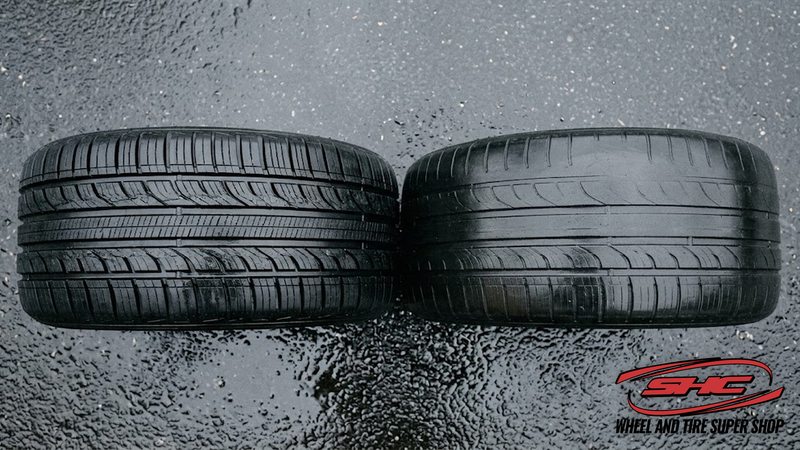
Where the money goes, and where it does not
A premium tire can cost two to three times what a budget tire in the same size costs. That is a large enough gap that it deserves a real answer rather than "you get what you pay for," which is both true and useless.
Here is what the extra money is actually buying, in rough order of how much it matters, plus an honest section on where the budget tier is genuinely fine.
1. Wet braking. This is most of it.
If you only take one thing from this article: the single largest and most consistent difference between tire tiers is how far the car travels when you brake hard on a wet road.
Not dry braking - dry braking differences between tiers are real but small, because on dry pavement almost any tire can generate enough friction to lock a wheel. Wet is different. On a wet road the tire has to clear water out of the contact patch before it can grip at all, and that is a function of tread design, void ratio, and compound chemistry - all three of which cost money to get right.
The gap between a premium and a budget tire in wet braking from highway speed is commonly measured in car lengths, not metres. On the South Island, where it rains most of the winter, that is the specification you are actually buying.
It is also the one you will never notice until the one time you need it, which is precisely why it gets under-weighted at the point of sale.
2. Compound, which is the expensive part
Rubber compounds are where tire companies spend their research budgets, and it is largely invisible.
A tire compound has to do several contradictory things: grip when cold, grip when hot, not wear out, not tear, and stay flexible for years without hardening. Those goals fight each other. Silica content, polymer blends and curing processes are how manufacturers get further out on that curve, and the difference between a good compound and a cheap one is genuine chemistry rather than marketing.
Practically, you see compound quality in three places:
- Cold weather grip. A cheap all-season compound stiffens faster as the temperature drops.
- Consistency as the tire wears. A good tire at half tread still behaves like itself. A cheap one can change character.
- Ageing. Compounds harden with time regardless of use. Better compounds do it more slowly - which matters a great deal for a second set that sits half the year.
3. Siping density and tread detail
Sipes are the fine slits cut across tread blocks. Each one creates two biting edges, and they are what give a tire grip on snow, ice and wet surfaces.
They are also difficult and expensive to mould well, and they work against tread block stability - too many sipes and the blocks squirm, which hurts dry handling and wear. Getting a lot of sipes into a tread while keeping the blocks stable is an engineering problem that costs money to solve. It usually involves three-dimensional sipe geometry that interlocks under load, which a budget tire is unlikely to have.
If you look at a premium and a budget tire side by side, this is one of the few differences you can actually see.
4. Treadwear rating, and how to read it honestly
The treadwear number moulded into the sidewall is part of the UTQG rating. Higher means longer-wearing, roughly.
Two important caveats. First, the rating is self-assigned by the manufacturer relative to their own reference tire, so it is reliable for comparing two tires from the same brand and much less reliable across brands. Second, longer wear is not automatically better - a very high treadwear number usually means a harder compound, which means less grip. A 200-treadwear performance tire and a 700-treadwear touring tire are not competing at the same thing.
Where the tier difference shows up is in how evenly a tire wears and whether it delivers the life it claims. A budget tire that says 500 and gives you 45,000 kilometres has a different cost per kilometre than a premium tire that says 500 and gives you 70,000.
That arithmetic is worth doing, because it sometimes reverses the obvious answer.
5. Noise and comfort
Real, and easy to overweight. Premium tires are generally quieter and ride better, through tread pattern pitch sequencing - varying the size of tread blocks around the circumference so the noise they generate spreads across frequencies rather than concentrating into a hum.
It is a genuine engineering difference. It is also the one that affects your safety least and your enjoyment most, so weigh it according to what you want.
6. Uniformity, which nobody mentions
A tire is a manufactured object and no two are identical. How closely a factory holds its tolerances - for roundness, for uniform stiffness around the circumference, for where the heavy spot falls - determines how easily the tire balances and whether it rides smoothly once balanced.
This is where we see the tier difference most often in the shop, and it is invisible in every spec sheet. A batch of cheap tires will contain more that need a lot of weight, more that need to be rotated on the rim to get them right, and the occasional one that never comes in properly. We have a separate article on why a perfectly balanced wheel can still shake - much of it comes back to uniformity.
You are paying for consistency as much as for performance.
Where the budget tier is genuinely fine
We would rather say this plainly than pretend everyone needs a premium tire.
- Low-mileage vehicles. A car doing 6,000 kilometres a year will age its tires out before it wears them out. Paying for tread life you will never use is not a good trade. Buy adequately and replace on age.
- A second set on a light car. A winter set on a small commuter that sees four months of use is a legitimate place to economise, provided the tire is properly rated for the conditions.
- Trailer tires. Different problem entirely - the specification that matters is load rating, not grip.
- A vehicle you are selling within a year. No sense capitalising 70,000 kilometres of tread into a car that leaves in twelve months.
- Anything where the mid-tier exists. This is the most important one. The choice is rarely premium versus cheapest - most brands run a solid middle tier that captures most of the wet performance at a substantially lower price. That is where a lot of the sensible buying happens, and it is worth asking about instead of framing the decision as two extremes.
Where we would not economise
Also plainly:
- Heavy vehicles. Mass has to be stopped. A three-ton SUV on budget tires in the rain is a meaningfully longer stopping distance than the same vehicle on good ones, and the physics does not negotiate.
- High-mileage commuters. If you are doing 30,000 kilometres a year, you are exposed to wet braking performance constantly and the cost per kilometre arithmetic usually favours the better tire anyway.
- Anything with real power going through the rear wheels. Not for grip in a fun sense - for the wet-road behaviour when you are not trying to.
The one thing that beats the tier question entirely
Tread depth and pressure.
A premium tire at 3 mm of tread is worse in the wet than a budget tire at 8 mm. It is not close. Water clearance depends on the volume available in the grooves, and that volume shrinks as the tire wears.
Same with pressure. An under-inflated premium tire is worse than a correctly inflated budget one in almost every respect that matters, including wet braking, wear and fuel consumption.
So before anyone spends money going up a tier, the free wins are: check your pressures monthly, and replace tires before they are legally bald rather than when. Those two habits are worth more than the tier difference.
What we can get
We sell across all three tiers and we will tell you honestly where we think the money makes a difference for your vehicle and your driving, and where it does not. The website shows a fraction of what we can order.
If you tell us your annual kilometres, what you drive and where, we can usually narrow it to two or three sensible options quite quickly - and often the answer is the middle tier rather than either end.
The short version
- Wet braking distance is the biggest and most consistent difference between tiers. It is the thing you are buying.
- Compound chemistry is where the research money goes and it is invisible on the shelf.
- Treadwear ratings are self-assigned and only reliable within a brand.
- Manufacturing uniformity - how easily the tire balances and rides - is a real tier difference nobody advertises.
- Budget is genuinely fine on low-mileage cars, light second sets, and vehicles you are selling.
- The mid-tier captures most of the benefit for much less than the top. Ask about it.
- Tread depth and correct pressure matter more than tier. Both are free.
About SHC Auto
We have been fitting wheels and tires in Victoria since 1991, out of the same shop at 474 Bay Street. Alongside wheels and tires we do suspension and lift work, window tint, paint protection film, vinyl wraps, ceramic coating, paint correction and detailing, caliper painting, chrome delete, and vehicle graphics and signage. We also do the things most shops send out: curb rash repair and wheel refinishing, TPMS sensor supply and fitting, tint removal, and re-torque after install.
The catalogue on our website is a fraction of what we can actually order. We are an authorized dealer for more than three hundred aftermarket brands, and a good number of them never made it onto the site because there is no data feed for them. That includes most of the lift and levelling kit market. If you cannot find something, ask us rather than assuming we cannot get it.
SHC Autographx and Tires
474 Bay Street, Victoria, BC
Monday to Friday, 9:00 to 5:30. Closed weekends.
Free shipping anywhere on Vancouver Island.
Not sure what you need? Bring the vehicle by 474 Bay Street. It is much faster to look at what you have and tell you what will work than to sort it out over email.