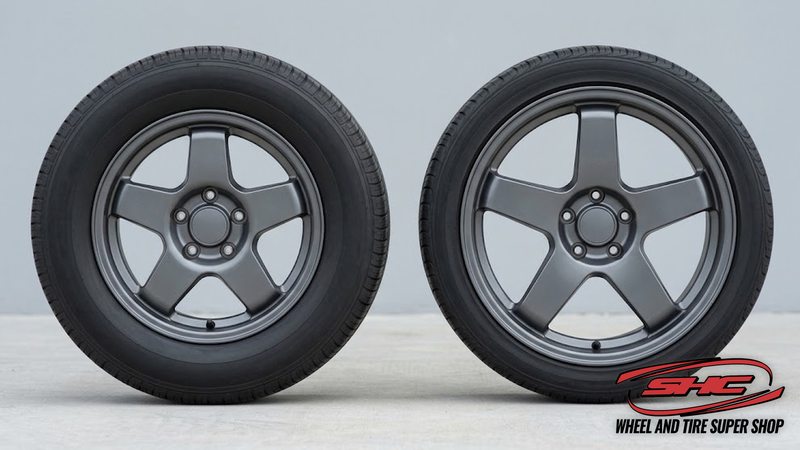
The one time in car modification where smaller is the upgrade
Everything else about wheels pushes in one direction. Bigger looks better, fills the arch, and is what the manufacturer put on the expensive trim.
Winter wheels go the other way, and there are three good reasons. This is about sizing the set, not about whether to have one - we have a separate piece on the economics of a second set, and this assumes you have decided.
What minus-sizing means
Going down a wheel diameter while keeping the overall tire diameter the same. An 18 inch wheel with a 45-series tire becomes a 17 inch wheel with a taller 55-series tire, and the whole assembly stays the same height.
That last part is not optional. Overall diameter has to stay within about two or three percent of stock or your speedometer reads wrong, your odometer reads wrong, and on modern cars the ABS and stability systems are working from wheel speeds that no longer mean what the software thinks they mean. On an all-wheel-drive car it also puts a permanent load through the centre differential.
So minus-sizing is a trade of wheel diameter for sidewall height, at constant overall height. We work the sizes out for you - it is a standard calculation and there is no guesswork in it.
Reason one: a narrower tire is better in snow and slush
This is the one that sounds wrong. Wider tires grip better, surely?
On dry pavement, broadly yes. In snow and slush, no - and the reason is that they are different problems.
On dry pavement you want the largest possible contact patch, because grip comes from rubber touching road.
In snow and slush you want pressure, because grip comes from cutting down through the loose layer to the firmer surface underneath, and from the tread biting into snow. Same vehicle weight over a narrower tire means higher pressure per square centimetre, which means the tire knifes through instead of floating on top.
In slush the same logic applies with more urgency. A wide tire has more frontal area pushing against a wall of wet slush and is more prone to being lifted off the road by it - slush planing, which is hydroplaning's more unpleasant cousin. A narrow tire cuts through.
There is a limit. Too narrow and you lose braking performance on the cleared, cold, wet pavement that makes up most of a Victoria winter. Which is why the answer is usually one size narrower than stock, sometimes two, rather than the narrowest thing that will fit.
Reason two: more sidewall survives our roads
A 55-series sidewall has a great deal more rubber between the rim and the pothole than a 40-series does.
In winter that matters more than usual, for reasons that compound:
- Potholes multiply over winter as water gets into pavement cracks and freezes.
- They fill with water and you cannot see how deep they are.
- Cold rubber is less compliant, so an impact is transmitted harder.
- You are more likely to hit one, because you are avoiding something else.
A bent rim is a real cost - sometimes repairable, sometimes not - and a taller sidewall is the cheapest insurance against it. We do wheel straightening and refinishing in-house and we see distinctly more of it in February than in July.
The taller sidewall also rides better, which is not nothing on a car you are driving in miserable conditions.
Reason three: it is cheaper, in two places
The tires cost less. A 225/55R17 is meaningfully cheaper than a 245/40R19 and it is not a small gap. Winter tires are already a second purchase; this takes some of the sting out.
The wheels cost less. A 17 inch wheel costs less than a 19, and for a winter set you want a plain, tough, unglamorous wheel anyway - not a polished finish that road salt will attack. We have written separately about salt air and wheel finishes; a simple painted wheel is the right tool here and it happens to be the cheap one.
There is also a small ongoing saving: lighter wheels and tires mean less unsprung rotating mass, which helps braking and fuel consumption slightly. Not the main argument, but it points the same way.
The hard limit: brake calipers
This is where minus-sizing stops, and it is not negotiable.
The wheel has to clear the brake caliper. Go down a diameter and the inside of the barrel comes closer to it, and on cars with large brakes there is a minimum wheel diameter below which nothing fits.
Some specifics worth knowing:
- Performance cars with big brakes may have no room at all. A car that came with 19s and a big brake package may not accept an 18, let alone a 17.
- It is not just diameter, it is spoke shape. Two wheels of the same size can differ on whether they clear, because the caliper fouls the inside face of the spokes rather than the rim. This is why "a 17 fits" is not a complete answer - a particular 17 fits.
- Some modern cars are surprisingly limited. Carbon ceramic brakes in particular set a high minimum - on some cars a 19 inch wheel is the smallest that will go on at all.
- The rear can be different from the front. Usually the front is the constraint, but not always.
We check this before ordering, every time. The way to check it properly is against the specific wheel, not the size - which is one of the genuine advantages of buying the set from somebody who will measure rather than from a web form.
The other limits, briefly
Load rating. The smaller wheel and its tire must still carry the vehicle. On a heavy SUV or an EV this can bind before caliper clearance does, and it is not a corner to cut.
Offset. A winter wheel does not have to match the summer offset exactly, but it has to keep the tire inside the arch - BC requires the fender to cover the tread - and it must not put the tire into the strut or the liner. Usually the sensible move on a winter set is to stay close to factory offset, which also keeps scrub radius where the car expects it.
TPMS. A second set needs sensors, or you get a warning light all winter. Sensors can be bought new for the winter wheels or moved across twice a year, and either way they need registering to the car. Our TPMS article covers the options; the short version is that new sensors in the second set is usually the better answer because it removes the swap.
A worked example
Say the car came on 245/40R19, which is 18.4 inches of section width per tire and about 26.7 inches overall.
A common winter answer would be 225/50R17: narrower by 20 mm, a sidewall that is roughly 112 mm tall instead of 98, and an overall diameter within a percent of stock. Cheaper tires, cheaper wheels, better in slush, far more resistant to a pothole.
What you give up is some dry-road steering sharpness, because a taller sidewall flexes more. On a winter set, on wet or snowy roads, in the dark, in February - that is a trade most people take happily.
What we do
Tell us the car and we will work out what the smallest sensible wheel is, check it against the actual brake package rather than against a generic table, and price the set. If the answer is that your car cannot go down a size, we will tell you that too - it is not uncommon on newer performance cars and there is no point pretending otherwise.
The catalogue on our website is a fraction of what we can order, and plain winter wheels in particular are something suppliers rarely bother to list properly. Ask.
The short version
- Minus-sizing swaps wheel diameter for sidewall height while keeping overall diameter the same.
- Narrower tires cut through snow and slush instead of floating on it. One or two sizes down, not as narrow as possible.
- A taller sidewall survives winter potholes, which are worse, more numerous and hidden under water.
- Smaller tires and plain wheels are both cheaper, and a plain painted wheel is the right choice against road salt anyway.
- Brake caliper clearance is the hard limit, and it depends on the specific wheel's spoke shape, not just the diameter.
- Keep the overall diameter within two or three percent, or the speedometer, ABS and AWD system all disagree with you.
- The second set needs TPMS sensors.
About SHC Auto
We have been fitting wheels and tires in Victoria since 1991, out of the same shop at 474 Bay Street. Alongside wheels and tires we do suspension and lift work, window tint, paint protection film, vinyl wraps, ceramic coating, paint correction and detailing, caliper painting, chrome delete, and vehicle graphics and signage. We also do the things most shops send out: curb rash repair and wheel refinishing, TPMS sensor supply and fitting, tint removal, and re-torque after install.
The catalogue on our website is a fraction of what we can actually order. We are an authorized dealer for more than three hundred aftermarket brands, and a good number of them never made it onto the site because there is no data feed for them. That includes most of the lift and levelling kit market. If you cannot find something, ask us rather than assuming we cannot get it.
SHC Autographx and Tires
474 Bay Street, Victoria, BC
Monday to Friday, 9:00 to 5:30. Closed weekends.
Free shipping anywhere on Vancouver Island.
Not sure what you need? Bring the vehicle by 474 Bay Street. It is much faster to look at what you have and tell you what will work than to sort it out over email.