The appointment nobody books
You get your wheels changed. Somebody hands you a card or says "bring it back in a hundred kilometres" and you nod, and then you do not, because the car drives fine and life is busy.
Almost always, nothing happens. The interesting question is why that "almost" exists at all, because it is not superstition and it is not an upsell. There is a real mechanical reason a wheel joint changes tension in the first few hundred kilometres after it is assembled, and once you know what it is, the ten-minute appointment stops sounding like a formality.
What a wheel nut is actually doing
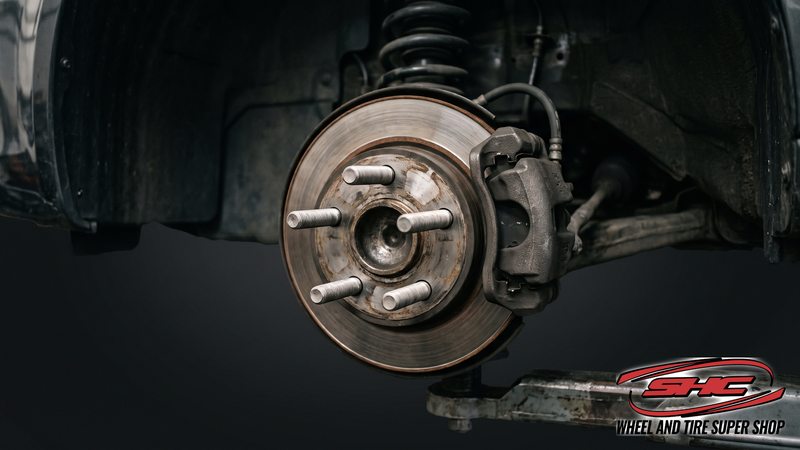
A wheel is not held on by the nuts gripping the studs. It is held on by friction, generated by clamping force, between the back of the wheel and the face of the hub.
When you torque a nut, you are stretching the stud slightly. A stud under tension behaves like a very stiff spring, and that stretch is what presses the wheel against the hub hard enough that the whole assembly behaves as one piece. The nuts are just the mechanism for creating that stretch.
This matters because it tells you what can go wrong. Anything that lets the stud relax even slightly reduces the clamping force, and reduced clamping force means the joint can move microscopically. Once it moves, it wears, and once it wears there is more room to move. That is a process that accelerates rather than stabilising.
Why a new joint loses tension
Three things settle in the first few hundred kilometres.
Surfaces bed in. No two machined faces are perfectly flat. Under clamp load the high spots on the hub face and the wheel's mounting face deform slightly and conform to each other. That conforming takes up a small amount of the stud's stretch, and the tension drops. It is a tiny distance, but the stud is stiff, so a tiny distance is a meaningful percentage of the load.
Seats find their centre. A conical or spherical lug seat has to pull the wheel into alignment as it tightens. With heat cycling and a few hundred kilometres of load reversal, the seats settle into their final position, which again takes up a fraction of the stretch.
Anything between the faces compresses. Paint, powder coat, corrosion, road grime, a fresh coat of finish on a refinished wheel. Any of it in the joint will compress or migrate under clamp load. This is why a freshly powder-coated wheel is one of the higher-risk cases and why we clean hub faces before fitting rather than bolting onto whatever is there.
None of these is a defect. They are what a new clamped joint does, and the fix is to check the tension once after they have happened.
What happens if it keeps going
The failure is progressive and it announces itself, which is worth knowing because most people assume a wheel simply falls off without warning.
First the joint loses enough clamp to allow micro-movement. You will not detect this. Then the movement wears the stud holes in the wheel, which start out round and go slightly oval, and the lug seats wear too. Now there is real clearance, and you will usually get a clicking or a light knock at low speed, most obvious on turns and under braking. Then the wheel is genuinely loose and there is a shimmy that changes with speed and load. Then studs start to fail, one at a time, because each one that goes puts more load on the rest.
The important part is the middle. By the time you have worn stud holes, a re-torque no longer fixes it, because the holes are no longer round and the seats no longer match. At that point the wheel needs replacing, not tightening. That is the actual cost of skipping the appointment: not a wheel departing on the Pat Bay, which is rare, but a wheel that quietly becomes scrap.
Who is most at risk
Some situations settle more than others, and it is worth knowing which one you are in:
- Brand new aftermarket wheels, on their first fitment. New paint or powder coat in the joint, new seats, nothing bedded.
- Freshly refinished wheels. The highest-risk case, because there is new finish on the mounting face by definition.
- Anything with a spacer or adapter. Two clamped joints instead of one, so twice the settling.
- Trucks and heavy vehicles, where the loads are higher and the studs are bigger. This is why commercial operators re-torque as a matter of policy rather than as a courtesy.
- Alloy wheels generally, more than steel. Aluminium is softer than steel and conforms more under clamp load.
- Any wheel fitted by hand at the roadside, including your own spare. Torque by feel with a wrench from under the boot floor is not torque.
What we actually do
Wheels go on in a star pattern, in stages, with a torque wrench, to the vehicle manufacturer's figure. Never with an impact gun as the final step. An impact gun is for removal and for spinning nuts down; it is not a torque tool and it will happily give you four different values on four corners.
We clean the hub face and the back of the wheel before anything is fitted, because whatever is in that joint is going to compress later.
Then you come back after 50 to 100 kilometres and we check every nut with a torque wrench, which takes about ten minutes and costs you nothing. Some will be exactly where we left them. Some will have dropped slightly and get brought back up. That is the whole appointment.
A few things worth knowing
Do not over-torque to avoid the return trip. This is the most common mistake and it is worse than under-torquing. Over-torquing stretches the stud past its elastic range, and a stud that has been stretched past yield does not spring back; it stays long, holds less clamp, and is now weaker than it was. Over-torquing is also the usual cause of a warped brake rotor, because the uneven clamping distorts the hub face and the rotor with it.
Never put anti-seize or oil on wheel studs unless the manufacturer specifies it. A torque figure assumes a dry thread. Lubricating the thread means the same torque produces far more stud stretch, which takes you into over-torque territory without the wrench telling you.
Use the right nuts for the wheel. Factory nuts are often a flat or ball seat and most aftermarket wheels want a 60-degree cone. A nut whose seat does not match the wheel will feel tight and will not be clamping properly. This comes up constantly on Toyota trucks, where the factory nuts frequently will not work on aftermarket wheels.
The torque figure is your vehicle's, not a general one. They range widely: many passenger cars sit around 110 to 130 Nm, a Tesla is 175 Nm. Use the manual and the placard for your specific vehicle. And if your vehicle changed stud size mid-generation, which several recent trucks did, do not carry an old figure forward.
We do it and we do not charge for it
Re-torque is not on our website, which is an oversight rather than a limit on what we do. If we fitted your wheels, bring the vehicle back after 50 to 100 kilometres and we will check them. It takes about ten minutes and there is no charge.
If somebody else fitted them and you are not sure whether they were done properly, bring it by anyway. Checking four wheels is quick, and finding out now is considerably cheaper than finding out later.
About SHC Auto
We have been fitting wheels and tires in Victoria since 1991, out of the same shop at 474 Bay Street. Alongside wheels and tires we do window tint, paint protection film, vinyl wraps, ceramic coating, paint correction and detailing, suspension, caliper painting, chrome delete, and vehicle graphics and signage. We also do several things most shops send out: re-torque after install, curb rash repair and wheel refinishing, TPMS sensor supply and fitting, and tint removal.
The catalogue on our website is a fraction of what we can actually order. We are an authorized dealer for more than three hundred aftermarket brands, and a good number of them never made it onto the site because there is no data feed for them. If you cannot find something, ask us rather than assuming we cannot get it.
SHC Autographx and Tires
474 Bay Street, Victoria, BC
Monday to Friday, 9:00 to 5:30. Closed weekends.
Free shipping anywhere on Vancouver Island.
Had wheels off recently? Drop in at 474 Bay Street. No appointment needed for a re-torque check.