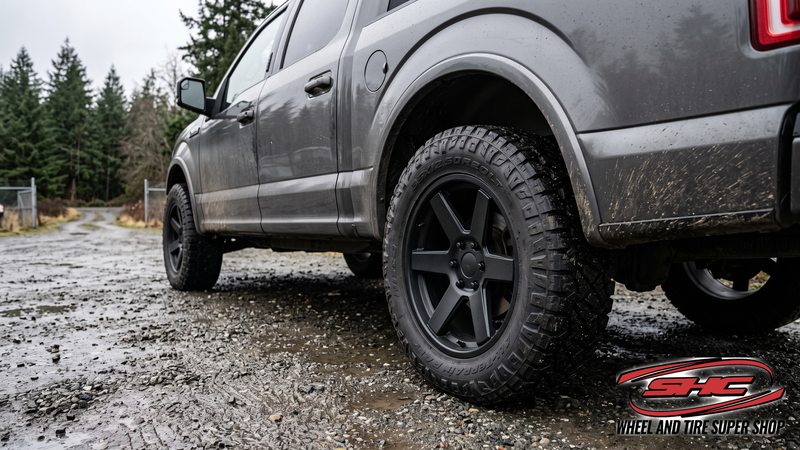
Spacers are not automatically a bad idea, and they are not automatically fine
Ask about wheel spacers online and you will get two answers delivered with equal confidence. One says they are death traps. The other says they are used on factory race cars and anyone worried is a coward. Both are arguments about the wrong thing.
A spacer does one job: it moves the wheel outboard. Whether that is fine depends on how far, on what kind of spacer, on what it does to the geometry, and on whether the thread engagement is still there afterwards. Those are four separate questions with four separate answers.
The two kinds, which are not comparable
Slip-on spacers are a plate with holes that slides over the existing studs. The wheel then bolts to those same studs through the spacer, using the original nuts. Nothing is added; the spacer just sits in between.
This is the type that earns the reputation, and the reason is thread engagement. Your studs are a fixed length, sized for a wheel sitting directly against the hub. Put a 20 mm plate in the way and you have removed 20 mm of usable thread. There may not be enough left for the nut to hold properly, and a nut that looks tight while only engaging a few threads is genuinely dangerous.
Slip-on spacers are reasonable at small thicknesses, typically up to about 5 mm, where they are really being used to clear a brake caliper or a hub lip rather than to change the look. Past that, they are the wrong tool.
Bolt-on spacers are a machined adapter with its own pressed-in studs. It bolts to the hub with one set of fasteners, and the wheel bolts to the spacer with a second set. Each joint gets full thread engagement because each joint has studs sized for it. A good one is hub-centric on both faces: it locates on the car's hub register and provides a new register for the wheel.
This is a real engineering component rather than a shim, and it is what a spacer should be at any meaningful thickness.
The rule on thread engagement
The working standard used in shops is that a stud should have at least as much thread engaged in the nut as the stud's own diameter: about 12 mm of engagement on an M12 stud, 14 mm on an M14. Below that, the load stops being spread across enough threads and starts concentrating on the first two or three.
That is a shop convention rather than a legal requirement, and different manufacturers state it slightly differently. The point is that it is a measurable thing rather than a matter of feel. If you are fitting slip-on spacers, count the threads showing past the nut and do the arithmetic. If you cannot get there, you need extended studs or a bolt-on spacer, not optimism.
What moving the wheel out actually does
This is the part the arguments usually skip, so here is the mechanical version. It comes from a suspension engineer with more than thirty years in the industry, including chassis design work on production cars.
Scrub radius grows roughly one for one with the offset change. In his worked example, a 50 mm spacer took a scrub radius from about plus or minus 15 mm to roughly plus or minus 65 mm. Call it four times larger.
Scrub radius is the lever arm through which forces at the tire contact patch act on your steering. Braking forces, a pothole on one side, one tire finding grip the other has not: all of those get multiplied by that arm before they reach the steering rack and your hands. Make the arm four times longer and those forces are four times larger at the wheel. That is what people are describing when they say the truck tramlines now, or kicks back over ruts, or pulls under braking, or has gone heavy at parking speeds.
Wheel bearing loading moves outside the design envelope. The load path from the contact patch is meant to pass between the two bearing races. Push the wheel outboard and that line moves outboard with it, which converts part of what was a clean radial load into a bending moment the bearing was never sized to carry. Wheel bearings normally last the life of a vehicle. This is the mechanism by which they stop doing that.
And the honest part: this applies equally to a low-offset wheel. The hub does not know whether the wheel centreline moved out because you fitted a spacer or because you bought a wheel with 25 mm less offset. A minus-12 wheel on a truck that came with plus-25 has moved the centreline 37 mm, and the geometry does not care how you got there. The common wisdom that wheels are fine and spacers are bad is, mechanically, only half true.
The one genuine advantage a wheel has over a spacer is that a well-chosen wheel can move the rim outward to clear a bigger tire while keeping the tire centreline closer to stock than a spacer of equivalent visual effect would. That is a real difference, but it is a difference of degree.
When a spacer is the right answer
There are several situations where a spacer is not a styling choice at all but the correct fix:
- Caliper clearance. A wheel that clears everything except the caliper by two or three millimetres. A thin hub-centric spacer is the appropriate solution and always has been.
- Hub lip clearance. Some hubs have a raised lip or a protruding lug ring that stops a flat-backed wheel sitting flush. A thin spacer solves it properly.
- Fitting wheels from a different platform. A bolt-on adapter that also changes bolt pattern or bore is doing real work, and if it is properly made and correctly torqued it is a sound component.
- Clearing an upper control arm on a lifted truck. Moving the tire out to keep it off the control arm at full lock is a legitimate reason, and on many trucks it is the same reason the factory off-road trims run lower offsets than the street trims.
When it is the wrong answer
Large slip-on spacers on original studs. Any spacer that leaves you short on thread engagement. Spacers used to fix a wheel that was simply the wrong offset for the car, where the right answer is a wheel with the offset you actually needed. And spacers on anything with a wheel bearing that is already noisy, because you are about to make that worse.
We will also say plainly that a spacer is not a substitute for measuring. If nobody has measured the clearance you are trying to create, the spacer thickness is a guess.
The BC angle, and it is not the one people expect
There is no provision in the BC Motor Vehicle Act Regulations that names wheel spacers. We looked, and if you go searching for the section that bans them you will not find one, because there is not one.
What there is instead is the mudguard requirement. Section 7.06 of the regulations requires mudguards where they are needed to keep spray down, and the Vehicle Inspection Standards treat a fender that does not cover the full tread width of the tire as grounds for rejection. In plain terms, the tread has to be covered by the fender and the mudflap. If pushing the wheels out has left tread standing outside the bodywork, that is where your exposure is.
A ticket for it runs $109, the same as most improperly-equipped offences. The more expensive outcome is a Notice and Order requiring you to correct it and present the vehicle for a designated inspection, which puts you into inspection fees and a deadline. A vehicle already going for a designated inspection for some other reason will be looked at for this too.
That is the practical rule to carry: in BC, the question is not whether you have spacers. It is whether the tire is still under the fender.
If you are running them, re-torque
Any spacer adds a clamped joint, and clamped joints settle. On a bolt-on spacer there are now two joints to settle instead of one. Both should be checked after the first 50 to 100 kilometres.
This is not a spacer-specific superstition. It applies after any wheel comes off, which is why we re-torque as a matter of course. With spacers it matters more because there is more stack-up to settle and because the consequence of a loose joint is a wheel that is further out on a longer lever than it was designed to be.
What we will and will not do
We fit spacers. We will fit hub-centric bolt-on spacers on a vehicle where the geometry and the thread engagement work out, and we will fit thin slip-on spacers for genuine clearance problems.
What we will not do is fit a thick slip-on spacer on original studs, because we cannot stand behind it. If that is what you want, we will explain why and offer the alternatives, which are usually extended studs, a proper bolt-on spacer, or a wheel with the offset you actually wanted in the first place.
If you already have spacers on and want them checked, bring the vehicle by. Thread engagement, torque, spacer type and whether the tire is still under the fender take about fifteen minutes to establish.
About SHC Auto
We have been fitting wheels and tires in Victoria since 1991, out of the same shop at 474 Bay Street. Alongside wheels and tires we do suspension and lift work, window tint, paint protection film, vinyl wraps, ceramic coating, paint correction and detailing, caliper painting, chrome delete, and vehicle graphics and signage. We also do several things most shops send out: re-torque after install, curb rash repair and wheel refinishing, TPMS sensor supply and fitting, and tint removal.
The catalogue on our website is a fraction of what we can actually order. We are an authorized dealer for more than three hundred aftermarket brands, and a good number of them never made it onto the site because there is no data feed for them. If you cannot find the offset you need, ask us rather than reaching for a spacer.
SHC Autographx and Tires
474 Bay Street, Victoria, BC
Monday to Friday, 9:00 to 5:30. Closed weekends.
Free shipping anywhere on Vancouver Island.
Not sure whether you need a spacer or a different wheel? Send us the vehicle, the wheel you are looking at, and what is not clearing. Most of the time the answer is a wheel that fits, and it is cheaper than the spacer route.