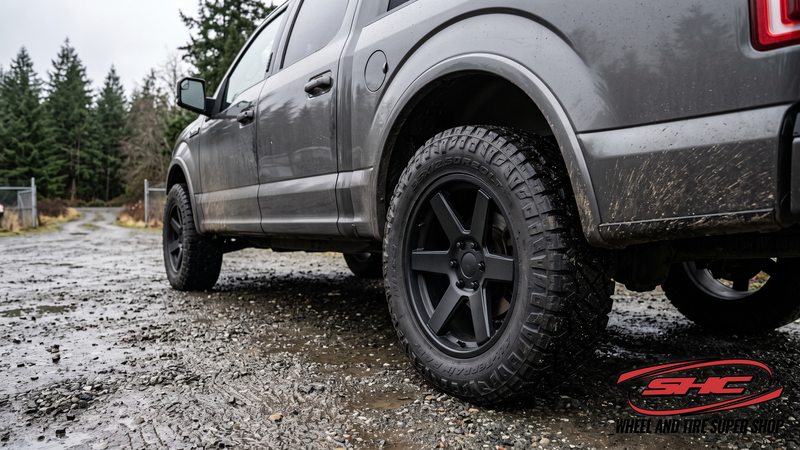
The pattern is not the problem. The nuts are.
Ask anyone about F-150 wheel fitment and you get the five-to-six lug story: the 2003 truck is 5x135, the 2004 truck is 6x135, done. That change is twenty-two years old and it is well covered everywhere.
The two things that actually cost people money on an F-150 are both much quieter than that, and neither one announces itself.
The first is that 2004 is two different trucks. The second is that in 2015 Ford changed the stud thread and changed nothing else, so a wheel off a 2014 truck sits perfectly on a 2016 hub and the lug nuts that came with it will destroy the studs.
The hardware, by generation
| Generation | Years | Pattern | Bore | Stud thread |
|---|---|---|---|---|
| 10th gen and Heritage | 1997-2004 Heritage | 5x135 | 87.1 mm | see below |
| 11th gen (P221) | 2004-2008 | 6x135 | 87.1 mm | M14 x 2.0 |
| 12th gen | 2009-2014 | 6x135 | 87.1 mm | M14 x 2.0 |
| 13th gen | 2015-2020 | 6x135 | 87.1 mm | M14 x 1.5 |
| 14th gen | 2021-2024 | 6x135 | 87.1 mm | M14 x 1.5 |
| 15th gen | 2025+ | 6x135 | 87.1 mm | M14 x 1.5 |
Every F-150 in that table uses lug nuts on studs. None use bolts. The 6x135 circle and the 87.1 mm hub bore have not moved since 2004, which is exactly why the thread change catches people.
2004: the split year
When the new eleventh-generation F-150 launched for 2004, Ford kept building the old body alongside it and sold it as the F-150 Heritage. Same year on the registration, completely different truck underneath.
- 2004 F-150 Heritage - the carried-over 1997-2003 body - is 5x135.
- 2004 F-150 - the new P221 body - is 6x135.
This is not an obscure trivia point. The fitment databases mostly handle it, because they maintain a separate vehicle entry for the Heritage and the aftermarket stud catalogues list it as a distinct application. The problem is the guides written by people, which almost universally say "2004-2008 F-150: 6x135" and never mention the Heritage at all.
We found that error on a Ford dealer's own website, which then added, revealingly, that aftermarket fitment guides and wheel manufacturers treat all 2004 and newer F-150 models as 6x135 trucks. That is precisely how a Heritage owner ends up holding six-lug wheels. A dealer domain is not automatically a correct source.
If your truck is a 2004, count the studs before you order anything. It takes four seconds and it is the only reliable test.
The 2015 thread change, which is the expensive one
Pre-2015 F-150 studs are M14 x 2.0. From 2015 they are M14 x 1.5. Same diameter, finer thread.
We are stating that flatly because we were able to trace it three ways: Ford's own owner's manual for the 2011 truck prints the bolt size as M14 x 2.0 on its wheel torque page; Dorman catalogues its M14-2.0 wheel stud against 2009-2014 F-150 applications and a 1.5-pitch stud against 2015-2018; and the retail fitment guides agree. A parts catalogue listing a thread pitch is a hard physical fact, not a copied table, which is why we weight it heavily.
Now the part that matters. Pre-2015 and 2015-on share the same 6x135 bolt circle and the same 87.1 mm hub bore. An old wheel does not merely bolt up, it centres properly and sits flat. Nothing about the fit warns you. Only the fastener is different.
An M14 x 2.0 nut started onto an M14 x 1.5 stud will thread in most of a turn before it binds, and at that point somebody with an impact gun finishes the job and the stud is scrap. This is the single most common way we see F-150 studs destroyed, and it usually arrives as a set of used wheels bought privately with the seller's nuts included in the box.
Buy the wheels, replace the nuts. They are inexpensive, they are the correct answer regardless of which way you are going, and most aftermarket wheels need a different seat anyway - see below.
Factory offsets: the F-150 is the easy one
After all of that, here is some good news. The F-150's factory offset is remarkably consistent. From 2009 to the current truck, essentially the entire line runs ET44.
| Tire | Wheel | Offset |
|---|---|---|
| 245/70R17 | 7.5Jx17 | ET44 |
| 265/70R17 | 7.5Jx17 | ET44 |
| 275/65R18 | 7.5Jx18 | ET44 |
| LT265/70R18 | 8.5Jx18 | ET44 |
| 275/60R20 | 8.5Jx20 | ET44 |
| 275/50R22 | 9Jx22 | ET44 |
The twelfth-generation truck (2009-2014) sits in an ET42 to ET46 band, nominally +44, and we could not get that broken out reliably per trim - the databases group it by rim size instead. The band itself is corroborated, the individual trim figures are not, so treat +44 as the F-150 number and let us measure yours if it matters.
The exceptions are the Raptor, which runs roughly ET32 to ET36 on its 17x8.5, and one 18-inch fitment reported at ET34. The Raptor band comes from a single source and the ET34 outlier from a single source, so we are flagging both rather than presenting them as settled.
What that means when you go shopping
Factory is +44. The aftermarket truck-wheel market sits mostly between -24 and +20. That is not a small adjustment. Going from a stock +44 wheel to a -12 wheel moves the tire 56 mm further out per side.
That is the trade everybody is actually making when they buy truck wheels, and it is worth understanding rather than discovering:
- Scrub radius grows roughly one for one with the shift. Move the centreline 56 mm out and the scrub radius grows about 56 mm. Scrub radius is the lever arm through which everything at the contact patch acts on the steering, so a pothole, a rut, or one tire biting harder than the other under braking all arrive at your hands multiplied by a much bigger number. This is what people mean when they say the truck tramlines, kicks back, or has gone heavy.
- Wheel bearing loading moves. The load line from the contact patch is meant to pass between the two bearing races. Push the wheel outboard and part of what was a radial load becomes a bending moment the bearing was not sized for.
- Coverage. BC requires the tread to be covered by the fender or flare. A truck with substantial poke and no flares is a fail, and it also throws spray onto everything beside you, which on the Pat Bay in February is not a theoretical concern.
None of this means do not do it. It means pick the smallest offset change that actually gets you the tire you want, rather than the most aggressive one you can find.
Tire sizes by lift height
| Setup | What fits |
|---|---|
| Stock | 33 inch, tight on 4WD |
| 2 to 2.5 inch level | 33 to 34 inch - the most common build by a wide margin |
| 3 inch lift | 33 to 35 inch, minor trimming at 35 |
| 4 to 6 inch lift | 35 inch clean, 37 inch possible |
Two honest caveats on that table. It rests on a single source, and we could not find component-level detail we would stand behind on exactly what contacts first - the lower valance, the inner liner at full lock, or the crash bar - at each step. The fourteenth-generation truck is reported to have roomier wheel wells than the thirteenth, making it the easiest F-150 for big tires, which is consistent with what we see but is also single-source.
This is the part of any fitment article that is worth the least in print and the most in person. Tire clearance on a specific truck depends on the lift, the tire's actual section width as opposed to its label, the wheel offset, and whether the previous owner already trimmed anything. We would rather look at it.
Lug nut seats, and why your factory nuts probably will not work
Ford's factory nuts are not the same seat as most aftermarket wheels expect. Almost every aftermarket wheel is cut for a 60-degree conical seat. Fitting the wrong seat means the nut contacts on an edge rather than clamping on a cone, and the wheel will loosen no matter how carefully it was torqued.
Budget a set of nuts with any aftermarket wheel purchase. It is a normal line item, not a problem, and between the seat question and the 2015 thread change it is the single easiest way to get an F-150 wheel job wrong.
Torque
Ford's owner's manual for the 2011 truck gives 150 lb-ft, with Ford's own qualifiers: retighten within 100 miles of any wheel disturbance, and the figure assumes threads free of dirt and rust. We reached that page through a third-party reproduction of the manual rather than a Ford-hosted file, so we will point you at the placard in your own door jamb and the manual in your own glovebox rather than treat it as settled across every model year.
The re-torque after 100 kilometres is not optional and it is not an upsell. New wheels seat as they are driven and clamping load drops. It is a ten-minute appointment and we do not charge for it on wheels we fitted.
Wheels we can get for a 6x135 F-150
The 6x135 pattern is well served, because it is Ford's truck pattern and nothing else uses it. Everything below is a brand we stock or order regularly:
- Black Rhino - the broadest 6x135 range we deal with, and the one we reach for most on a levelled truck. Multiple widths and offsets in the same wheel, which matters when you are trying to make a modest offset change rather than a dramatic one.
- Fast HD - load-rated truck wheels from Fast, in the sizes that suit a working F-150 rather than a show truck. Good winter-set choice.
- Level 8 - simpler, cleaner designs, and typically the value end without being a cheap wheel.
- Dirty Life - built for the lifted-truck look, mostly in the aggressive negative offsets, so check the coverage question above before committing.
- RTX - a wide catalogue including plain, practical winter-wheel options in 17 and 18 inch.
Two specific wheels, so that none of the above stays abstract. Both are confirmed in 6x135:
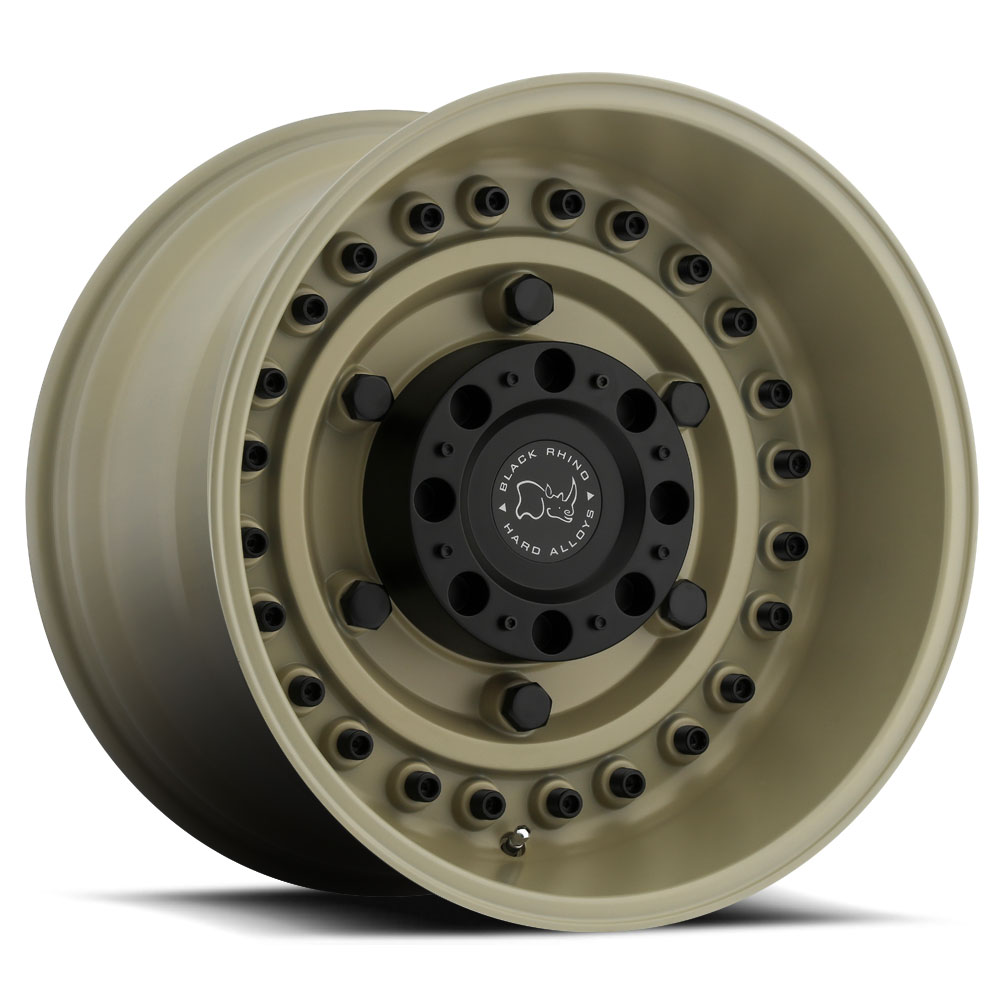
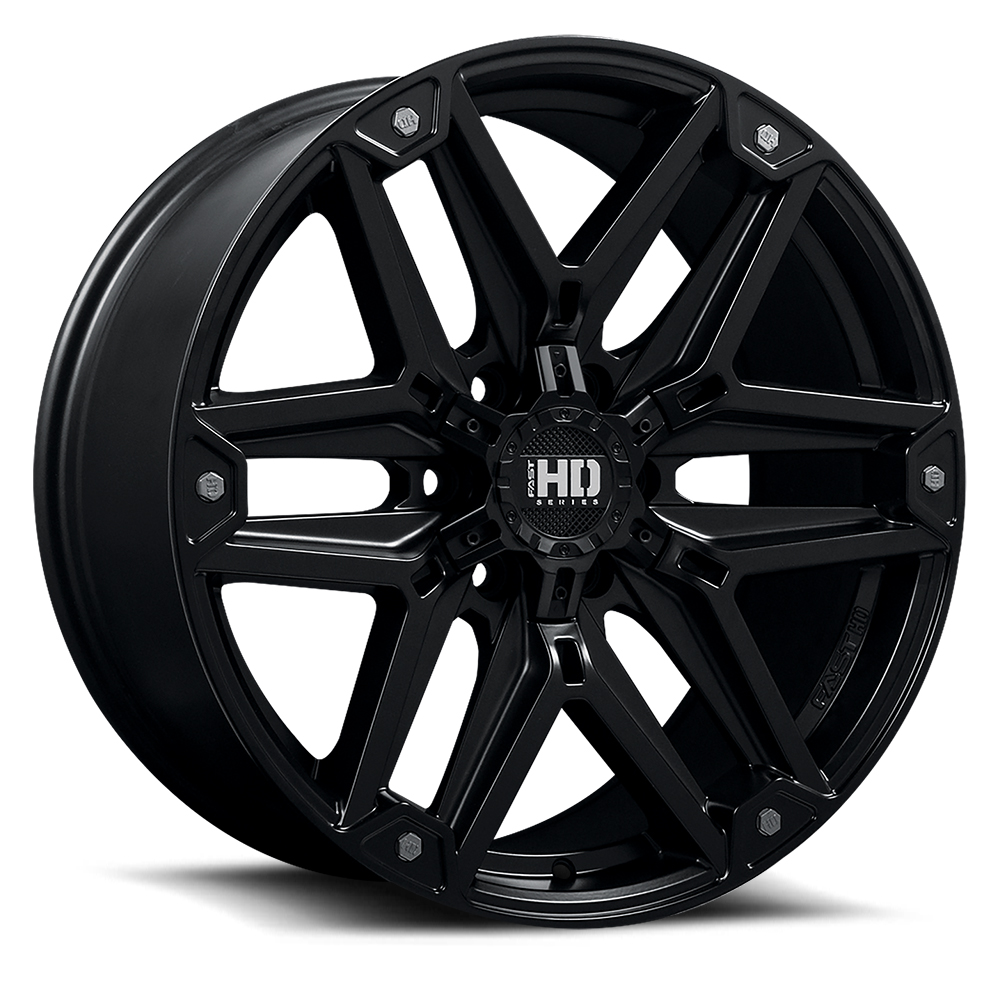
Black Rhino Armory, on the left, is a 17x9.5 in 6x135. The simulated beadlock ring suits a levelled truck on an all-terrain, and it is one of the few genuinely 17 inch choices in this style, which matters if you are trying to keep tire cost down rather than chase diameter.
Fast HD Recon, on the right, comes in 18x9 and 20x9 in 6x135, both at +25. Read that against the ET44 your truck left the factory on. It is a 19 mm move outboard - a real change, but a moderate one, and a good illustration of the point made further up this page: pick the smallest offset change that gets you the tire you want, not the most aggressive one on the shelf.
If you want something that is not on our website, ask. The site shows a fraction of what we can order.
The short version
- 2004 is two trucks. Count the studs.
- 2015 changed the stud thread and nothing else. Wheels interchange, nuts do not.
- Factory offset is +44 across the range, Raptor excepted.
- Most aftermarket truck wheels are 40 to 60 mm further out per side than that. Know what you are buying.
- Buy nuts with the wheels. Every time.
All specifications above are North American market only.
Confirm the fitment with us before you order. Give us the year, model and trim and tell us what tire you want to end up on, and we will tell you what has to happen to the truck to get there.
About SHC Auto
We have been fitting wheels and tires in Victoria since 1991, out of the same shop at 474 Bay Street. Alongside wheels and tires we do suspension and lift work, window tint, paint protection film, vinyl wraps, ceramic coating, paint correction and detailing, caliper painting, chrome delete, and vehicle graphics and signage. We also do the things most shops send out: curb rash repair and wheel refinishing, TPMS sensor supply and fitting, tint removal, and re-torque after install.
The catalogue on our website is a fraction of what we can actually order. We are an authorized dealer for more than three hundred aftermarket brands, and a good number of them never made it onto the site because there is no data feed for them. That includes most of the lift and levelling kit market. If you cannot find something, ask us rather than assuming we cannot get it.
SHC Autographx and Tires
474 Bay Street, Victoria, BC
Monday to Friday, 9:00 to 5:30. Closed weekends.
Free shipping anywhere on Vancouver Island.
Planning a build? Bring the truck by 474 Bay Street. It is much faster to look at what you have and tell you what it will take than to work it out over email.