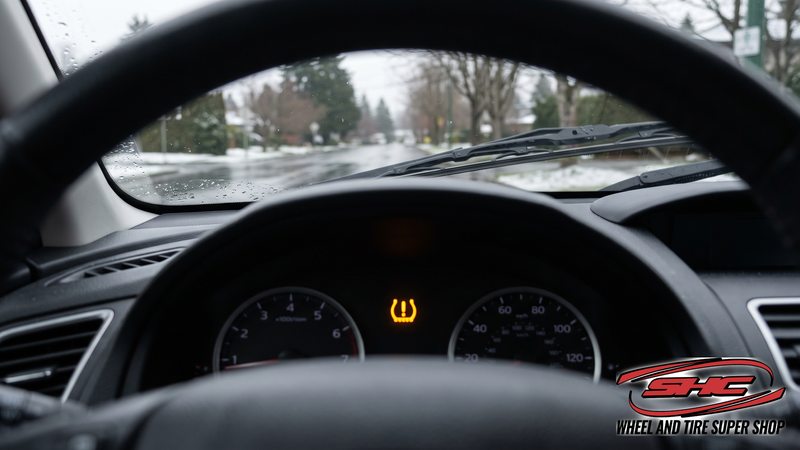
The light that will not go out
You put the winter wheels on in November, the tire pressure light comes on somewhere around Mile Zero, and it stays on until April. Everyone you ask tells you something different: it needs a reset, it needs a tool, it needs a dealer, ignore it.
The reason the advice is contradictory is that there are two completely different systems called TPMS, and which one your car has decides everything that follows. Worse, several manufacturers changed from one to the other mid-model without changing anything you can see.
The two systems
Indirect TPMS has no sensors at all. It reads the wheel speed sensors the ABS already has and works on a simple principle: a tire losing pressure gets slightly smaller in diameter, so it has to turn slightly faster to cover the same ground. The car watches for one wheel consistently turning faster than the others and lights the lamp.
It is cheap, there is nothing in the wheel to fail, and a second set of wheels needs no hardware whatsoever. The catch is that it only detects a difference, so it cannot see all four tires going down together over a winter, and it has to be re-initialised by the driver after any pressure change or tire swap. On most cars that is a button, sometimes in the glovebox, sometimes in the menu, and the procedure is in the manual.
Direct TPMS puts a battery-powered sensor inside each wheel, usually integrated into the valve stem, measuring actual pressure and broadcasting it. It is accurate, it can tell you the real number rather than just that something is wrong, and on most cars it will show you which corner.
The catch is that every wheel needs one, they cost money, and the car has to be told which sensors belong to it.
Which one you have is not obvious
The useful shortcut: if the dash can show you an actual pressure number for each corner, it is direct. If all you get is a warning lamp and there is a reset button somewhere, it is almost certainly indirect.
Be careful with assumptions based on the model, because several manufacturers switched partway through. Mazda is the clearest example on the Island, because those cars are everywhere here:
- Mazda3 2014 to 2018: indirect, no sensors.
- Mazda3 2019 and newer: direct, sensors required.
- CX-5 2013 to 2016: indirect.
- CX-5 2017 and newer: direct.
- CX-30: direct from launch.
Quoting a sensor-free winter package on a 2017 CX-5 because the 2016 did not need one is exactly how a $400 surprise happens. We check what the car actually has before quoting, not after.
Your three options for a second set
One: buy a second set of sensors. The winter wheels get their own sensors, permanently. Swapping wheels becomes a normal wheel swap, and each set keeps its own sensors and its own programming for as long as the batteries last. This is the option we fit most often, because after the first year it makes the seasonal swap a twenty-minute job with nothing to program.
Two: move the sensors across twice a year. Cheaper up front, more expensive over time. It means breaking both beads on all eight wheels every swap instead of just unbolting wheels, which costs labour twice a year, and every dismount and remount is another chance to damage a sensor or its seal. It also means the wheels sitting in your garage have open valve stems.
Three: run without sensors and live with the light. This is legal in BC. There is no requirement that a TPMS be functional for the vehicle to be on the road here. What you lose is the warning, and a permanently lit lamp also masks the next real fault, because you stop looking at it. If you go this way, check your pressures with a gauge monthly. Cold snaps on the South Island drop pressures noticeably, and a tire that is meaningfully under-pressure wears its shoulders, runs hot and costs fuel.
We will fit and balance a set of winter wheels without sensors if that is what you want. We will tell you what the consequence is, then do what you asked.
Cloning, programming and relearning, which are three different things
These words get used interchangeably and they are not the same operation.
Programming is writing a vehicle's protocol into a blank universal sensor so it speaks the right language. Most aftermarket sensors ship blank and cover hundreds of applications once programmed.
Cloning is copying the ID of an existing sensor onto a new one, so the car thinks it is seeing the same sensor it already knows. The advantage is that no relearn is needed: the car never notices anything changed. The limitation is that you need the original sensor working in order to read its ID. It is not a route back from a sensor that has already died.
Relearn is telling the car a new set of IDs. It comes in three flavours depending on the vehicle: an automatic relearn where the car figures it out after you drive it for a while, a stationary relearn done with a tool in the shop, and an OBD relearn where the IDs are written to the car through the diagnostic port.
Some vehicles are genuinely easy. Toyota's newer trucks let the owner do it from the dash: select Tire Rotation, press OK, drive above 40 km/h for ten to thirty minutes. Teslas built from late 2020 use Bluetooth sensors that register themselves with no tool at all after about fifteen minutes of driving. Others need the shop tool every time.
The practical point is that this is a known, solved problem on essentially every vehicle. If a shop tells you your winter wheels simply cannot work with your TPMS, that is a tooling answer, not a vehicle answer.
Sensor batteries, and why yours died all at once
Direct sensors are sealed units with a non-replaceable battery, typically good for somewhere between five and ten years depending on how much the car is driven. They transmit more when moving, so a high-mileage car goes through them faster.
Because all four were fitted on the same day, they tend to fail within the same year or two of each other. The first one is annoying. The second one three months later is when people ask whether to just do all four. Usually yes, if the car is at that age, because the labour is the same tire-off operation each time.
A sensor is replaced as a unit. When a sensor is replaced or a tire is dismounted, the valve service kit, which is the seal, the nut and the core, should be replaced as well. It is a small part and it is the usual cause of a slow leak at the valve after a tire change.
A few things that catch people
The spare counts. Some vehicles carry a fifth sensor in the spare and expect to see it. We have seen a persistent TPMS malfunction traced to a spare having been removed from under the truck, with nothing wrong with any of the four wheels on the ground.
A malfunction light is not a low pressure light. On most cars a steady lamp means low pressure, and a lamp that flashes for a minute at start-up and then stays on means the system itself has a fault, usually a sensor it cannot hear. Those are different problems and the flashing one will not be fixed by adding air.
Aluminium valve stems and salt do not get along. Many direct sensors use an aluminium stem with a separate nut. In a coastal winter those can seize or corrode at the joint. If yours have been on the car for several years, expect them to need the service kit at minimum.
Steel wheels and sensors are perfectly compatible. There is nothing about a steel winter wheel that prevents a sensor from being fitted. Steel winter wheels remain the sensible choice here, and adding sensors does not change that.
We do this in-house
TPMS sensor supply, fitting, programming and relearn are not listed on our website, which is our oversight rather than a limit on what we do. We handle sensors as part of any wheel or tire job at 474 Bay Street, and we will tell you which system your car has before we quote a winter package rather than discovering it at the counter.
About SHC Auto
We have been fitting wheels and tires in Victoria since 1991, out of the same shop at 474 Bay Street. Alongside wheels and tires we do window tint, paint protection film, vinyl wraps, ceramic coating, paint correction and detailing, suspension, caliper painting, chrome delete, and vehicle graphics and signage. We also do several things most shops send out: TPMS sensor supply and fitting, curb rash repair and wheel refinishing, tint removal, and re-torque after install.
The catalogue on our website is a fraction of what we can actually order. We are an authorized dealer for more than three hundred aftermarket brands, and a good number of them never made it onto the site because there is no data feed for them. If you cannot find something, ask us rather than assuming we cannot get it.
SHC Autographx and Tires
474 Bay Street, Victoria, BC
Monday to Friday, 9:00 to 5:30. Closed weekends.
Free shipping anywhere on Vancouver Island.
Putting a winter set together? Send us the year, make, model and trim and we will tell you which TPMS system it has, what sensors it needs, and what the package comes to fitted and balanced.