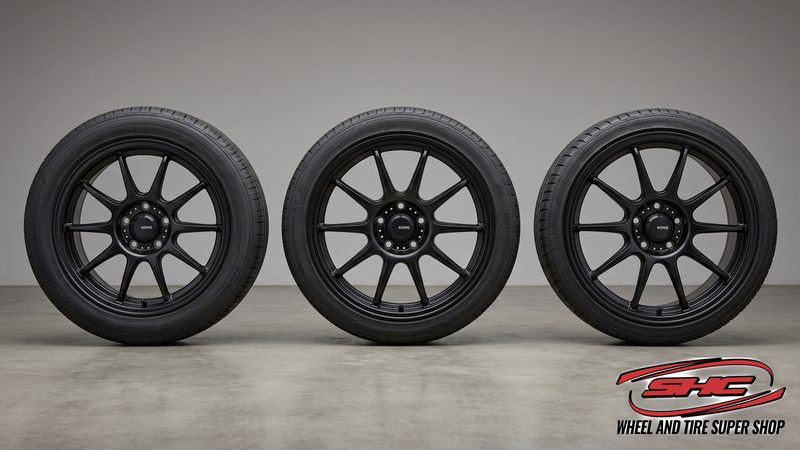
Every inch costs something
Bigger wheels look better. That is not in dispute and it is a perfectly good reason to buy them. What is worth knowing before you do is that the trade is not just money at the point of purchase, and on Island roads a couple of those costs land harder than they would elsewhere.
The overall rolling diameter stays roughly the same as you go up. That is the whole convention: the wheel grows, the sidewall shrinks, the tire stays about the same height so the speedometer stays honest and the gearing does not change. Everything below follows from that one fact.
What you gain
Steering response. A shorter sidewall deflects less under cornering load, so the tire builds grip faster after you turn the wheel. The car feels sharper immediately off-centre. This is a real effect, not a placebo, and it is the main reason manufacturers fit larger wheels to sportier trims.
Brake clearance. Bigger brakes need bigger wheels, which is why performance trims come with them. If you are planning a brake upgrade, wheel diameter is a constraint rather than a choice.
Appearance. More wheel and less rubber fills the arch, and it is genuinely what most people are buying. There is no reason to be coy about it.
What you give up
Ride quality, and here it matters. The sidewall is the first spring in the system, and it works on the small, sharp inputs the suspension is too slow to catch. Take an inch of sidewall away and those inputs arrive at the body instead. On smooth highway you may not notice. On the expansion joints crossing the Malahat, on the frost-heaved sections of West Saanich Road, on the patched stretches through Esquimalt, you will.
Wheel damage. This is the one that costs actual money here. With a tall sidewall, a pothole compresses rubber. With a 35-series sidewall, there is very little rubber to compress and the impact reaches the rim edge. Bent rims and cracked barrels are a low-profile problem, and they happen on roads exactly like ours.
It is worth saying where the crack shows up: on the inboard face of the barrel, where you will not see it walking around the car. If you run 20s and you hit something hard, look at the back of the wheel.
Curb rash. With a tall sidewall the rubber shoulder stands proud of the rim and touches the curb first. On many large-diameter fitments the rim lip is the outermost point of the whole assembly, with nothing protecting it. This is why curb rash is far more common on 19s and 20s than it ever was on 16s.
Tire cost, and tire availability. A 225/65R17 is a volume size. A 245/35R20 is not. Larger and lower-profile sizes cost more per tire, come in fewer models, and are less likely to be on a shelf on the Island when you need one in a hurry. In winter sizes the gap is wider still, because the winter catalogue in exotic sizes is genuinely thin.
Unsprung and rotating mass. A larger wheel is usually heavier, and weight at the rim is the worst place to have it. It slows acceleration slightly, lengthens braking slightly, and makes the suspension work harder to keep the tire on the road over bumps.
What it costs an EV, with real numbers
On an electric car the wheel size question has an answer you can measure, because manufacturers publish certified range figures for the same car on different wheels. Everything except the wheels is identical.
| Vehicle | Change | Range | Loss |
|---|---|---|---|
| Tesla Model 3 Long Range AWD, 2024 | 18 to 19 inch | 342 to 305 mi | 10.8 percent |
| Tesla Model 3 RWD, 2024 | 18 to 19 inch | 272 to 248 mi | 8.8 percent |
| Tesla Model 3 Performance, 2020 | 18 to 20 inch | 322 to 299 mi | 7.1 percent |
| Tesla Model Y Long Range AWD, 2023 | 19 to 20 inch | 330 to 318 mi | 3.6 percent |
Three to eleven percent for one or two inches. That is a real number, and on a winter commute from Langford it is the difference between arriving with a comfortable margin and arriving thinking about it.
One honest caveat: those figures bundle three effects together, and they are not equal. Aerodynamics and tire rolling resistance do most of the work, and wheel weight does the least. The bigger wheel almost always comes with a grippier, higher-rolling-resistance tire, and that tire is the larger part of the penalty. We could not find any credible measured figure for range lost per pound of wheel weight, and every version of that claim we found was retailer copy with no method behind it. Your tire choice will move your range more than your wheel weight will.
Plus sizing, and the number that has to stay put
Going up a wheel size properly is called plus sizing, and the discipline is simple: keep the overall rolling diameter within about three percent of the original. Outside that and the speedometer reads wrong, the odometer accumulates wrong, and on modern cars the stability control and ABS calibration are working from a tire size that is not what is fitted.
Every inch of wheel diameter needs roughly a corresponding drop in aspect ratio and often a step up in section width to hold the diameter constant. A 225/65R17 at about 28.5 inches becomes a 245/50R18 at about 27.6 and a 245/45R19 at about 27.7. Those are all within tolerance. Picking a section width and aspect ratio because they sound right is how people end up four percent out.
Two constraints sit alongside diameter and get forgotten. Load index must meet or exceed the original, which matters more than it used to now that so many vehicles are heavy EVs and crossovers. Speed rating should meet the original, and on some vehicles insurers care about it. Neither is negotiable to save money.
The practical middle ground for Island driving
We are not going to tell you what size to buy. What we can do is set out what each choice actually means so the decision is yours with the facts in front of you.
Staying at the factory size is the cheapest to run, the most comfortable, the least likely to damage a rim, and the easiest to find tires for. Nothing wrong with it.
Going up one inch is where most of the visual gain lives and most of the penalty does not. The sidewall is still tall enough to survive a pothole, tire availability is still reasonable, and the ride change is noticeable but not intrusive. If someone asked us where the sensible line usually sits, it is here.
Going up two inches or more is a commitment. It looks the best of the three and it costs the most in every other column: ride, tire price, tire availability, rim damage risk, curb rash risk, and on an EV, range. Plenty of people make that trade knowingly and are happy with it. The ones who are unhappy are usually the ones who were not told.
A second set for winter is what makes any of this work here. If you want 20s, run 20s from April to November and put a smaller steel or alloy winter set under it for the wet months. Smaller winter wheels are cheaper, the tires are cheaper and more available, the taller sidewall survives potholes better, and your expensive summer wheels spend the salt season in the garage. This is the single most useful thing we can tell anyone who wants big wheels on the Island.
About SHC Auto
We have been fitting wheels and tires in Victoria since 1991, out of the same shop at 474 Bay Street. Alongside wheels and tires we do window tint, paint protection film, vinyl wraps, ceramic coating, paint correction and detailing, suspension, caliper painting, chrome delete, and vehicle graphics and signage. We also do several things most shops send out: curb rash repair and wheel refinishing, TPMS sensor supply and fitting, tint removal, and re-torque after install.
The catalogue on our website is a fraction of what we can actually order. We are an authorized dealer for more than three hundred aftermarket brands, and a good number of them never made it onto the site because there is no data feed for them. If you cannot find something, ask us rather than assuming we cannot get it.
SHC Autographx and Tires
474 Bay Street, Victoria, BC
Monday to Friday, 9:00 to 5:30. Closed weekends.
Free shipping anywhere on Vancouver Island.
Working out what size to go to? Send us the vehicle and what you are trying to achieve. We will run the plus sizing, tell you what stays inside tolerance, and price a couple of options fitted and balanced.