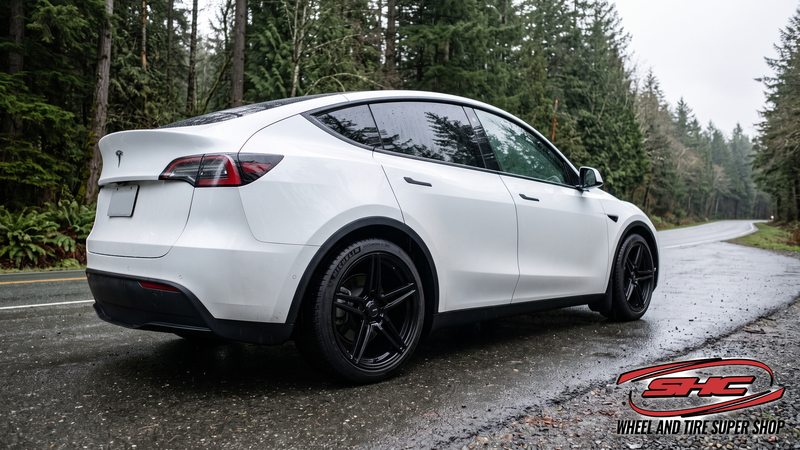
The wheel decision on a Tesla is a range decision
On most cars, wheel size is a look and a ride-quality trade. On a Model 3 or a Model Y it is also a range trade, and the numbers are larger than people expect. Tesla's own EPA certification figures, where the car and the drivetrain are identical and the wheel is the only variable, show a Highland Model 3 Long Range All-Wheel Drive dropping from 342 miles on 18s to 305 on 19s. That is nearly eleven percent for one inch.
That is the headline. Everything below is the detail underneath it.
The hardware, which is the same across both cars
Model 3 and Model Y, every year, run 5x114.3 on a 64.1 mm hub with M14 x 1.5 studs and a 21 mm hex. They use lug nuts on studs, not bolts.
Torque is 175 Nm, which is 129 ft-lb. That figure comes straight from Tesla's service manuals and is identical across the 2017-2023 Model 3, the 2024-onward Model 3, the 2020-2024 Model Y and the 2025-onward Model Y. It is a genuinely high number compared with most cars, and it is one of the reasons these wheels do not tolerate being done up by feel.
One honest note: the 64.1 mm centre bore is unanimous across every independent source but we could not find it stated in a Tesla document. Treat it as reliable rather than certified. It also means the same thing it means on any car, which is that a wheel bored larger needs hub-centric rings. On a two-tonne car with instant torque, running lug-centric is a known source of vibration.
Model 3, 2017 to 2023
| Wheel | Size | Offset | Tire | Fitted to |
|---|---|---|---|---|
| 18 inch Aero | 18 x 8.5J | ET40 | 235/45R18 | SR, SR+, Long Range |
| 19 inch Sport | 19 x 8.5J | ET40 | 235/40R19 | Long Range option |
| 20 inch Sport | 20 x 8.5J | ET35 | 235/35R20 | Performance, 2018 to Sept 2020 |
| 20 inch Uberturbine | 20 x 9.0J | ET34 | 235/35R20 | Performance, Oct 2020 to 2023 |
Every one of these is square. There is no staggered setup on any 2017-2023 Model 3, which means you can rotate the tires and get the mileage out of them.
Note the October 2020 change. The 20-inch Performance wheel became a different wheel at that point, a 9.0 inch rim at ET34 instead of an 8.5 at ET35. Anyone treating "2017-2023 Model 3 Performance 20 inch" as a single fitment will order the wrong thing about half the time. We need the build date, not just the model year.
Model 3, 2024 onward (Highland)
| Wheel | Size | Offset | Tire | Fitted to |
|---|---|---|---|---|
| 18 inch Photon / Prismata | 18 x 8.5J | ET38 | 235/45R18 | RWD, Long Range |
| 19 inch Nova | 19 x 8.5J | ET38 | 235/40R19 | Long Range option |
| 20 inch Warp | F 20 x 9.0J / R 20 x 10.0J | F ET34 / R ET45 | F 235/35R20 / R 275/30R20 | Performance |
Two things changed here that catch people out. The offset moved from ET40 to ET38 on the 18s and 19s, and more than one well-regarded aftermarket fitment guide has carried the old ET40 forward and published it as current. Tesla's own service manual and owner's manual both say ET38. We go with Tesla.
The Highland Performance is genuinely staggered, front to rear, and cannot be rotated. The rears will wear out first and you will buy tires more often. That is not a defect, it is the cost of the setup, and it is worth knowing before you buy the car rather than after the first set.
Tesla also publishes an explicit warning about the 18-inch steel wheel on this car: it is for the Standard trim only, and fitting it to a Premium or Performance Model 3 may damage the suspension. That is Tesla's wording, not ours.
Model Y, 2020 to 2024
| Wheel | Size | Offset | Tire | Fitted to |
|---|---|---|---|---|
| 19 inch Gemini | 19 x 9.5J | ET45 | 255/45R19 | RWD, AWD, Long Range |
| 20 inch Induction | 20 x 9.5J | ET45 | 255/40R20 | Long Range option |
| 21 inch Uberturbine | F 21 x 9.5J / R 21 x 10.5J | F ET40 / R ET48 | F 255/35R21 / R 275/35R21 | Performance only |
Model Y, 2025 onward (Juniper)
| Wheel | Size | Offset | Tire | Fitted to |
|---|---|---|---|---|
| 18 inch Aperture | 18 x 8.5J | ET38 | 235/55R18 | Standard only |
| 19 inch Crossflow | 19 x 9.5J | ET45 | 255/45R19 | Long Range, Launch |
| 20 inch Helix 2.0 | 20 x 9.5J | ET45 | 255/40R20 | Long Range option |
| 21 inch Arachnid 2.0 | F 21 x 9.5J / R 21 x 10.5J | F ET40 / R ET48 | F 255/35R21 / R 275/35R21 | Performance |
The same steel-wheel warning applies on the Juniper: the 18-inch steel is for the Standard trim only.
There is one live disagreement we will flag rather than paper over. The rear offset on the 21-inch wheel is given as ET48 by both Tesla service manuals, by the major fitment specialists, and by an owner who physically measured one. Tesla's current owner's manual says ET52. Our guess is that ET52 belongs to a newer Juniper Performance rear and ET48 covers the earlier car, but we could not confirm it. If you are ordering 21-inch rears, we measure or check the part number first.
What the aero covers are actually worth
The 18-inch Aero cover is a snap-on plastic cap over a finished dark grey alloy. It is not structural. Taking them off is safe and reversible, and people do it constantly because the wheel underneath looks better.
The honest number for what it costs you: about three percent at sustained highway speed. That comes from a controlled test by a German EV rental company that ran three Model 3s over a 94 km circuit at a constant 150 km/h and held one car as a reference across all laps to cancel out wind, and it is corroborated by a magazine test that landed in the same place. In city driving the difference is effectively nothing, because aerodynamic drag barely matters below about 80 km/h.
You will also see a figure of about ten percent attributed to a senior Tesla engineer. It is a claim, not a measurement, and the measured tests do not support it.
Note that the Highland's Photon and Nova covers are described as primarily cosmetic rather than aerodynamic, so the three percent figure should not be carried across to the 2024-onward cars. We could not find a measured number for those.
What bigger wheels cost in range
This is the number people actually want, so here are the real ones. Each row is the same car with the same drivetrain and only the wheels changed.
| Car | Change | Range | Loss |
|---|---|---|---|
| Model 3 Highland LR AWD | 18 to 19 inch | 342 to 305 mi | 10.8 percent |
| Model 3 Highland RWD | 18 to 19 inch | 272 to 248 mi | 8.8 percent |
| Model 3 Performance 2020 | 18 to 20 inch | 322 to 299 mi | 7.1 percent |
| Model Y LR AWD 2023 | 19 to 20 inch | 330 to 318 mi | 3.6 percent |
| Model Y LR, real-world A/B test | 19 to 20 inch | - | 7 percent |
Three to eleven percent, with five to eight percent the realistic middle. The Model 3 is more sensitive than the Model Y because it is a lower, more aerodynamically optimised body, so the wheels are a bigger share of total drag.
One thing to be clear about: these deltas bundle three separate effects together. Aerodynamics, tire rolling resistance, and mass. The bigger wheel almost always comes with a grippier, higher-rolling-resistance tire, and that tire is doing more of the damage than the extra weight of the wheel is. We could not find any credible measured figure for range lost per pound of wheel weight on these cars, and every claim of that shape we found was retailer copy with no method behind it. If someone quotes you a percentage per pound, ask where it came from.
The practical version: your tire choice will move your range more than your wheel weight will.
TPMS, and the trap in the middle of 2020
Tesla uses two incompatible sensor protocols and they are not interchangeable. The wrong one simply never pairs.
- Model 3 built September 2017 to September 2020: 433 MHz radio sensors.
- Model 3 built October 2020 onward: Bluetooth Low Energy.
- Model Y, all years: Bluetooth Low Energy.
Cars built within a few weeks either side of the October 2020 cutover can go either way depending on the production batch, so the model year on the registration is not good enough. We check the door-jamb build date or read the part number off the existing sensor.
The good news on these cars is that Bluetooth sensors register themselves. There is no relearn tool and no dealer visit: fit them, drive above about 25 km/h for fifteen minutes or so, and the car picks them up. That is genuinely unusual and it makes a second set of wheels easier on a Tesla than on most cars.
Load rating is not optional on these
A Model Y Long Range is roughly 4,400 lb before anybody gets in it, and every factory tire fitment on both cars is Extra Load. The 19-inch Model Y runs a 104 XL, which is 1,984 lb per tire. The 19-inch Model 3 runs a 96 XL.
Standard Load and Extra Load are not quality grades, they are the reference pressure the tire's capacity is certified at: 35 psi for SL, 41 psi for XL, 50 psi for the newer HL standard. Fitting a Standard Load tire where the car calls for Extra Load drops the rated capacity below what the vehicle needs. It is not a small margin call and it is not something to save forty dollars on.
One genuine oddity: the legacy Model 3 18-inch fitment appears to have shifted from 98W XL to 94V SL in later production. If you are replacing tires on an 18-inch legacy car, read the placard in the door jamb of that specific car rather than assuming.
We found no evidence Tesla specifies HL on any Model 3 or Model Y. Extra Load is sufficient. HL is harmless if you end up with it, just stiffer.
Acoustic foam and the T-mark tires
Tesla sells tires marked T0, T1, T2 or T3 on the sidewall, tuned by Tesla for noise, ride, rolling resistance and range. Most of them have an acoustic foam liner bonded inside the tire.
Tesla's own support material says the foam reduces road noise by six decibels at 200 Hz, and that tires without it may correlate with up to a ten percent increase in noise, vibration and harshness. Tesla also claims up to a ten percent range gain from its own tires, which is a marketing figure with no published method and sits well above every independently measured tire effect we found. We would not repeat that one as fact.
What actually happens if you fit a non-acoustic tire: the car drives and functions completely normally. No fault codes, nothing electronic depends on the foam. You get audibly more road roar, most noticeable on the coarse chip seal that covers a lot of Island highway, because there is no engine noise to mask it. That is the single most common complaint after a tire change on these cars, and it is worth deciding about in advance rather than discovering it on the way to Nanaimo.
A T-mark tire is not required. Tesla itself ships at least one factory fitment with no foam liner, which rather settles the question.
The 20s and 21s take a beating here
Cracked inner barrels are a documented problem on the 20 and 21 inch Performance wheels, and it is the serious failure rather than the cosmetic one. The combination of a heavy car, a very stiff 30- or 35-series sidewall and a pothole is what does it. The crack usually forms on the barrel face pointing in toward the suspension, where you will not see it on a walk-around.
If you are running 20s or 21s on Island roads, look at the inboard side of the barrel occasionally. A bent wheel can usually be straightened. A cracked one on a car this heavy and this fast should be replaced, not welded.
Curb rash is also very common on these, because the rim lip is exposed with very little tire shoulder standing proud of it to protect it. We repair curb rash and refinish wheels in-house.
All specifications above are North American market only.
Confirm the fitment with us before you order. On these cars we need the build date, not just the model year, because both the Model 3 20-inch wheel and the TPMS protocol changed partway through a model year.
Wheels we can actually put on these cars
Both cars are 5x114.3 on a 64.1 mm bore, which is a common enough combination that the aftermarket choice is wide. Two things narrow it in practice: the wheel has to be wide enough for the factory tire, and it has to carry the load.
That second one is not a formality on these cars. A Model Y Long Range is roughly 4,400 lb before anyone gets in, and every factory tire fitment is Extra Load. Before we order any wheel for a Tesla we check its published load rating against the vehicle, and we would rather lose the sale than fit something that is under-rated. Ask any supplier for that figure in writing.
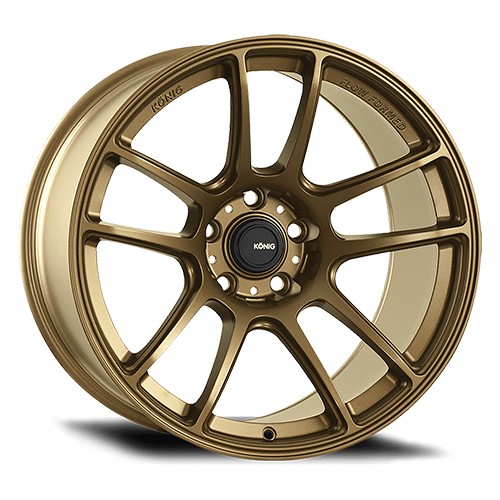
Konig Ultragram. A flow-formed wheel offered in 5x114.3 and in widths up to the 8-inch-plus range these cars need. Flow forming is the relevant part on an EV: it gets the weight down without going to a forged price, and weight at the rim is the worst place to carry it.
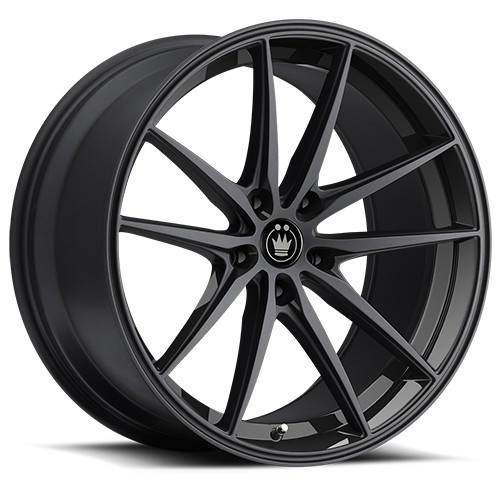
Konig Oversteer. Broad split spokes and a deeper concave face. Offered in 5x114.3 and in the wider sizes, which matters on a Model Y running a 255-section tire.
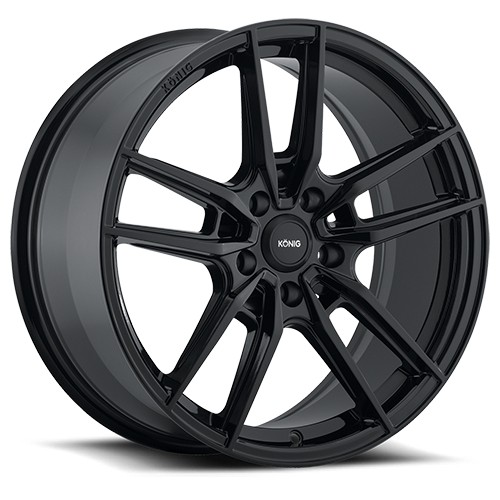
Konig Myth. Five split spokes, a simpler face that sits closer to the look of the factory Induction and Gemini wheels than most aftermarket designs do.
One practical note whichever you choose: keep a set of factory or winter-appropriate wheels for the wet months. Aftermarket wheels on an EV in a coastal winter take the same abuse as anything else, and the 20 and 21 inch fitments are the ones that crack.
These are three of many, and the website lists a fraction of what we can order. If you have found a wheel elsewhere, send us the model, the size and its load rating and we will check it.
About SHC Auto
We have been fitting wheels and tires in Victoria since 1991, out of the same shop at 474 Bay Street. Alongside wheels and tires we do window tint, paint protection film, vinyl wraps, ceramic coating, paint correction and detailing, suspension, caliper painting, chrome delete, and vehicle graphics and signage. We also do the things most shops send out: tint removal, curb rash repair and wheel refinishing, TPMS sensor supply and fitting, and re-torque after install.
The catalogue on our website is a fraction of what we can actually order. We are an authorized dealer for more than three hundred aftermarket brands, and a good number of them never made it onto the site because there is no data feed for them. If you cannot find something, ask us rather than assuming we cannot get it.
SHC Autographx and Tires
474 Bay Street, Victoria, BC
Monday to Friday, 9:00 to 5:30. Closed weekends.
Free shipping anywhere on Vancouver Island.
Thinking about a second set for winter? On a Tesla this is easier than on most cars because the sensors self-register. Tell us the model, the build date and which wheel you have now, and we will quote a package.