The 2024 change breaks everything you knew
For about twenty years, Toyota trucks were simple. Six on 139.7, a 106.1 mm hub, M12 x 1.5 studs. A set of wheels off a Tacoma went on a 4Runner went on a Tundra.
That ended with the 2024 Tacoma and the 2025 4Runner. Both moved to the new platform and both changed two things at once: the hub bore dropped from 106.1 mm to 95.1 mm, and the studs went from M12 x 1.5 to M14 x 1.5. Old wheels will not centre on the new hub. Old lug nuts will not thread onto the new studs. Nothing about the bolt pattern warns you, because the bolt pattern did not change.
If you take one thing from this article, take that. The rest is detail.
The hardware, by generation
| Vehicle | Years | Pattern | Bore | Thread |
|---|---|---|---|---|
| Tacoma 2nd gen, 4WD and V6 | 2005-2015 | 6x139.7 | 106.1 mm | M12 x 1.5 |
| Tacoma 2nd gen, base 2WD 4-cyl | 2005-2015 | 5x114.3 | not verified | M12 x 1.5 |
| Tacoma 3rd gen | 2016-2023 | 6x139.7 | 106.1 mm | M12 x 1.5 |
| Tacoma 4th gen | 2024+ | 6x139.7 | 95.1 mm | M14 x 1.5 |
| 4Runner 5th gen | 2010-2024 | 6x139.7 | 106.1 mm | M12 x 1.5 |
| 4Runner 6th gen | 2025+ | 6x139.7 | 95.1 mm | M14 x 1.5 |
Note the base two-wheel-drive four-cylinder second-gen Tacoma is a five-lug truck. Several published fitment charts miss this and list the whole second generation as one pattern, which is wrong in both directions depending on which chart you read. We have seen one that lists five-lug with a 106.1 bore, which is not a combination that exists.
All of these use lug nuts on studs. None use bolts. Toyota's factory nuts are a flat or mag-washer seat, and most aftermarket wheels want a 60-degree conical seat, so the original nuts usually will not work on aftermarket wheels. That is a normal part of the job, not a problem, but it is a line item people forget to budget.
Tacoma factory wheels and offsets
Second generation, 2005-2015. The 16-inch wheels are around ET30 and the 17s and 18s land between ET25 and ET30. We will be honest that this is the weakest data on the page: we could not find a source that separates second-gen offsets properly by trim and year, and the databases group them by rim size instead. Treat these as approximate and let us measure yours.
Third generation, 2016-2023.
| Trim | Wheel | Offset | Tire |
|---|---|---|---|
| SR / SR5 | 16 x 7 | ET25 | 245/75R16 |
| TRD Off-Road | 16 x 7 | ET25 | 265/70R16 |
| TRD Sport | 17 x 7.5 | ET30 | 265/65R17 |
| Limited | 18 x 7.5 | ET30 | 265/60R18 |
| TRD Pro | 16 x 7 | ET13 | 265/70R16 |
Toyota kept the overall diameter almost constant across the whole third-gen range at roughly 30.5 to 30.6 inches. The wheel grows, the sidewall shrinks, the speedometer stays honest.
The 16-inch offsets are genuinely disputed. Two retailer sites publish an identical table giving ET23 for the SR5 and ET13 for the Off-Road, and because they match to the millimetre across five trims they are almost certainly the same source twice rather than two confirmations. The fitment databases and an owner thread both say ET25. We have gone with ET25 and we are flagging the disagreement rather than hiding it.
Fourth generation, 2024 onward. Documented so far: Limited 18 x 7.5 ET55, TRD Sport 18 x 8 ET45 or 18 x 7.5 ET55 depending on which of the two factory variants your truck got, Trailhunter 18 x 8.5 ET20 on a 265/70R18. Offsets for the SR, SR5, TRD PreRunner, TRD Off-Road and TRD Pro are not published anywhere we consider reliable, and the best figures available for the Limited and Sport came from a tire retailer posting on an owners' forum. Check the door jamb sticker on your actual truck.
4Runner factory wheels and offsets
Fifth generation, 2010-2024. This one is unusually tidy: every factory wheel is ET15 except the TRD Pro, which is ET4.
| Trim | Wheel | Offset | Tire |
|---|---|---|---|
| SR5 / SR5 Premium | 17 x 7 | ET15 | 265/70R17 |
| TRD Off-Road / Trail | 17 x 7.5 | ET15 | 265/70R17 |
| TRD Pro, 2015-2024 | 17 x 7 | ET4 | 265/70R17 |
| Limited / Nightshade | 20 x 7 | ET15 | 245/60R20 |
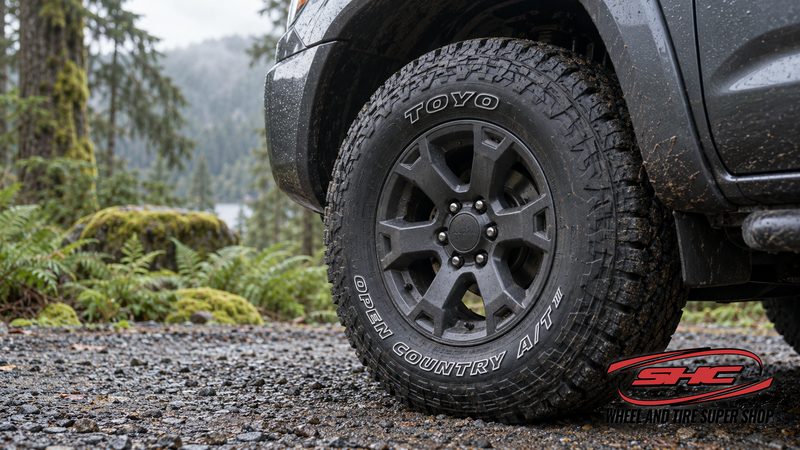
Sixth generation, 2025 onward. SR5 17 x 7 around ET55, TRD Off-Road 18 x 7.5 ET55, Trailhunter and TRD Pro 18 x 8.5 ET20 on 265/70R18 Toyo Open Country A/T III, and the 20-inch Sport, Limited and Platinum somewhere between ET45 and ET55 depending on which source you trust. Toyota's own press release confirms the wheel diameters and that the Trailhunter and TRD Pro run 33-inch Toyos, but Toyota does not publish offsets at all.
What lower offset actually does
Everyone knows low offset pushes the wheel out and fills the arch. Fewer people can say what it costs, so here is the mechanical version, which comes from a suspension engineer with three decades in the industry rather than from a forum.
Scrub radius grows roughly one for one. Move the wheel centreline 25 mm outboard and the scrub radius grows by about 25 mm. In a worked example, a 50 mm spacer took a scrub radius from plus or minus 15 mm to roughly plus or minus 65 mm. That is more than four times larger.
Scrub radius is the lever arm through which forces at the contact patch act on the steering. Braking, a pothole, one tire biting harder than the other on a wet line: all of those become steering torque, multiplied by that arm. Quadruple the arm and you quadruple the torque the steering system and your hands have to resist. That is what people are describing when they say a truck tramlines, kicks back over ruts, pulls under braking or has gone heavy.
Wheel bearing load moves where it should not be. The load line from the contact patch is supposed to pass between the two bearing races. Push the wheel outboard and that line moves outboard too, converting part of a radial load into a bending moment the bearing was never sized for. A wheel bearing normally lasts the life of the truck. This is how that stops being true.
An important honest nuance: the same engineer is more forgiving of low-offset wheels than of spacers, because a well-chosen wheel can move the rim outward for tire clearance while keeping the tire centreline closer to stock than a spacer of the same visual effect would. But a minus-25 wheel on a truck designed for plus-25 has moved the centreline 50 mm outboard and takes the full penalty. The idea that wheels are fine and spacers are bad is only half true. The hub does not know how the wheel got where it is.
For scale: going from a third-gen Tacoma's factory ET30 to a minus-25 wheel is a 55 mm per-side shift, which is more than the 50 mm spacer in that worked example.
What tire fits, and what has to be cut
The thing that catches people is that a lift does not clear tires. A lift raises the body, but the tire still swings into the cab mount and the firewall at full lock and at full compression, which is exactly where it was going to hit anyway. The cab mount, not the lift height, is the real gate on 33s.
Tacoma, third generation.
- Stock. 265/70R17 to 275/70R17, about 31.6 inches. Nothing to do. Many people pull the mud flaps.
- Stock with trimming, 285/70R17 (33 inch). Not a clean fit. In order of severity the rub points are the firewall, which is about three quarters of the problem, then the upper control arms, then the lower rear fender flare, then the front inner fender liner. Needs at minimum ET16 or a 3/4 inch spacer to clear the upper control arm, the front liner pushed back, the rear liner heat-gunned and reshaped, the lower flare cap trimmed and the front bumper trimmed.
- Levelling kit, 2 to 2.5 inch. 285/75R16, about 32.8 inches, reported clean at ET10 with no trimming. Lower offsets need the mud flaps gone and the liner warmed and pushed.
- 3 inch lift, 33s. At ET0, reported with no fender trimming. At minus 10 to minus 25, you are into a cab mount chop, hammering or folding the pinch weld, heat-gunning the liner, and the factory mud guards no longer fit.
- 3 inch lift, 35s. Aggressive cab mount chop or relocation, extensive body cutting, firewall indenting, high-caster alignment around plus 4 degrees, and spindle and cam tab gussets.
Tacoma, second generation. Stock 265/70R17 or 265/75R16. A levelling kit takes 285/70R17 with mud flaps off and minor liner work. A 3 inch lift takes 285/75R16 or 285/70R17 with light front fender trim. The second-gen cab mount is physically smaller than the third-gen's, which is why second-gen trucks reach 33s with meaningfully less cutting. That is a real structural difference, not a preference.
4Runner, fifth generation.
- Stock. 275/70R17, about 32.2 inches, at factory ET15. Nothing to do.
- 285/70R17 on a stock truck. Mud flaps off, front fender liner pushed back, minor rub at full lock.
- 2 inch level. 285/70R17 or 275/75R17, about 33.2 inches. Heat-gun the front liner, mud flaps off, mild trim of the front fender lip.
- 3 inch lift. 285/75R17 or 295/70R17, 33.3 to 33.8 inches. Mud flaps, liner push-back, inner fender trim, and a body mount chop for anything wider than about 11 inches.
- 34 inch. Body mount chop required. Toyota extends the housing around the body mounts well into the wheel well, so this is a weld job, not a trim job. Plus roughly six inches off the fender liners, rocker panel caps trimmed, pinch welds hammered in.
Swapping a fifth-gen 4Runner from the ET15 factory wheel to the ET4 TRD Pro wheel pushes the tire out about half an inch per side. That buys upper control arm clearance and spends fender clearance. That trade is the whole game on this platform.
4Runner, sixth generation. This is the platform's headline improvement and it is worth knowing before anyone quotes you a fifth-gen-style build. Stock takes 33s. A 2 inch level takes 34s with the crash plate removed, which is two bolts a side and buys about four inches of clearance, plus the mud flaps. A 3 inch lift takes 35s with the crash plate and air dam out and the fender liner re-pinned. No body mount chop is needed for anything up to 35 inches.
Why the street trims and the off-road trims differ
They differ more than they used to. On the third-gen Tacoma the gap between the Sport at ET30 and the TRD Pro at ET13 is 17 mm. On the fourth gen it is 35 mm, between the Limited at ET55 and the Trailhunter at ET20. Same story on the 4Runner: 11 mm on the fifth gen, 35 mm on the sixth.
The mechanical reading is straightforward. Lower offset buys clearance between the tire and the upper control arm and the frame, so a taller and wider tire can be fitted and can still steer to full lock, and it widens the track for stability on off-camber ground. The street trims keep the higher offset because it tucks the wheel under the bodywork, keeps spray inside the arch, and keeps scrub radius and bearing loading closer to the geometric ideal, which is worth more on a truck that will spend its life on pavement.
That is a sound reading of the numbers. We should say that Toyota has not published an engineering statement confirming the reasoning, so treat it as well-supported inference rather than fact.
TRD Pro wheels, since everyone asks
| Wheel | Size | Offset | Fits |
|---|---|---|---|
| 4Runner TRD Pro, 2015-2024 | 17 x 7 | ET4 | 4Runner 2010-2024, also sold as an accessory for Tacoma 2016-2023 |
| Tacoma TRD Pro, 2016-2023 | 16 x 7 | ET13 | Tacoma 2016-2023 |
| Tacoma TRD Pro accessory | 17 x 7 | ET4 | Tacoma 2016-2023 |
| 4Runner TRD Pro, 2025+ | 18 x 8.5 | ET20 | 2025+ only, 95.1 bore |
This is the most confused topic in the whole subject, and we think we know why. The ET4 figure belongs to the 17-inch accessory wheel that is shared between the two trucks, and it keeps getting applied to the Tacoma's 16-inch factory wheel, which is ET13. If a listing says "Tacoma TRD Pro 16 inch, offset 4", it has almost certainly made that swap.
Hub rings, and why they are now standard on new trucks
Most aftermarket 6x139.7 wheels are bored to 106.1 mm, because that was Toyota's standard for two decades. On a 2024 Tacoma or a 2025 4Runner with a 95.1 mm hub, those wheels sit loose on the register and need 106.1 to 95.1 hub-centric rings. Several vendors now make rings specifically for it. This is routine, not an edge case, and it is a question we ask on every new-platform truck.
The reverse also bites. General Motors uses 6x139.7 on the Colorado and Canyon with a 78.1 mm bore. A wheel off one of those will bolt to a Toyota hub and never centre on it. The same bolt pattern means only that the studs line up.
TPMS
Factory sensors transfer to aftermarket wheels, but they have to be re-registered afterwards or you get a TPMS malfunction light, sometimes appearing intermittently after half an hour of driving rather than immediately.
On the fourth-gen Tacoma and the sixth-gen 4Runner, re-registration is owner-serviceable through the information display: choose Tire Rotation, press OK, then drive above 40 km/h for ten to thirty minutes. No dealer visit and no scan tool. Programming genuinely new aftermarket sensors is a different job and usually does want a tool.
One that catches people: the system expects five sensors, because the spare has one. We have seen a persistent TPMS malfunction traced to the spare having been removed rather than to anything on the four corners.
Torque
We are not publishing a torque figure for these trucks. We could not reach a Toyota-hosted document for either model, and the third-party numbers, while they agree with each other, are third-party numbers.
What we will say is this: the 2024 change from M12 to M14 studs makes carrying an old torque figure forward actively unsafe. Use the placard in the door jamb and the manual in the glovebox for your specific truck.
All specifications above are North American market only.
Confirm the fitment with us before you order. Give us the year, model and trim and tell us what tire you want to end up on, and we will tell you what has to happen to the truck to get there.
Wheels we can actually put on these trucks
These are three six-lug wheels we stock and can order, all in 6x139.7, all available in sizes that suit a Tacoma or a 4Runner. Which one is right depends on the tire you are running and whether the truck is stock, levelled or lifted, so treat these as a starting point rather than a recommendation.
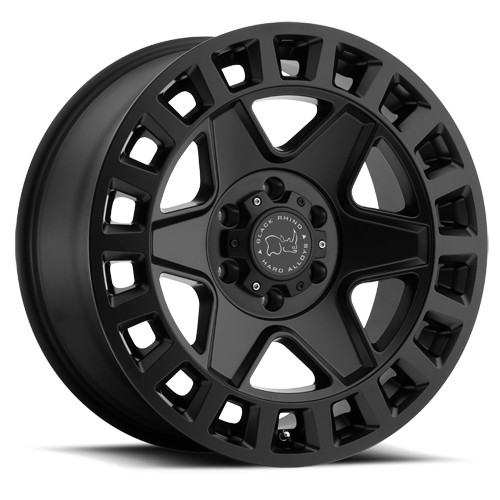
Black Rhino York. Six broad spokes with a cut-through pattern around the outer lip. Available in 17x8, 17x9, 18x8, 18x9 and 20x9, which covers everything from a stock truck to a lifted one. The 17x9 is the size most people on this platform end up at, because it keeps a tall sidewall while filling the arch.
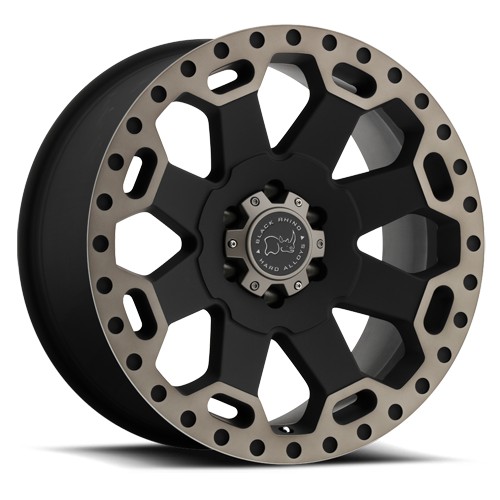
Black Rhino Warlord. A simulated beadlock ring with a dark tint lip over a matte black face. Available in 17x8, 17x9, 18x8, 18x9 and 20x9. Worth saying plainly: the ring is decorative, not a functional beadlock, and it does not let you run lower pressures than any other wheel.
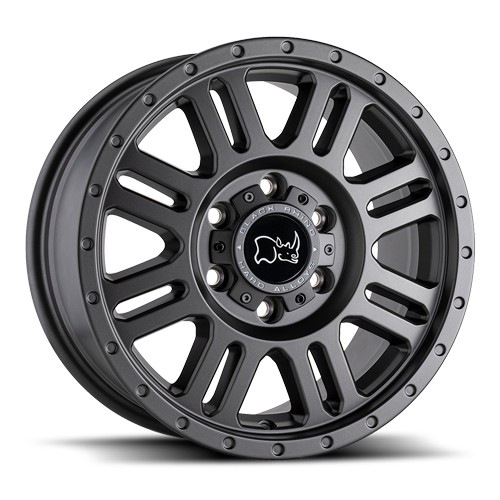
Black Rhino Yellowstone. Available in 16x8, 17x8 and 18x8. The 16-inch option is the useful one here, because a 16-inch wheel is the cheapest way to keep a tall sidewall on a truck that lives on Island back roads, and it is a sensible winter size on a 4Runner.
We can also get the wheel you have already found somewhere else. The website lists a fraction of what we can order, so if you have a model in mind that is not on there, send us the name.
About SHC Auto
We have been fitting wheels and tires in Victoria since 1991, out of the same shop at 474 Bay Street. Alongside wheels and tires we do suspension and lift work, window tint, paint protection film, vinyl wraps, ceramic coating, paint correction and detailing, caliper painting, chrome delete, and vehicle graphics and signage. We also do the things most shops send out: curb rash repair and wheel refinishing, TPMS sensor supply and fitting, tint removal, and re-torque after install.
The catalogue on our website is a fraction of what we can actually order. We are an authorized dealer for more than three hundred aftermarket brands, and a good number of them never made it onto the site because there is no data feed for them. That includes most of the lift and levelling kit market. If you cannot find something, ask us rather than assuming we cannot get it.
SHC Autographx and Tires
474 Bay Street, Victoria, BC
Monday to Friday, 9:00 to 5:30. Closed weekends.
Free shipping anywhere on Vancouver Island.
Planning a build? Bring the truck by 474 Bay Street. It is much faster to look at what you have and tell you what it will take than to work it out over email.