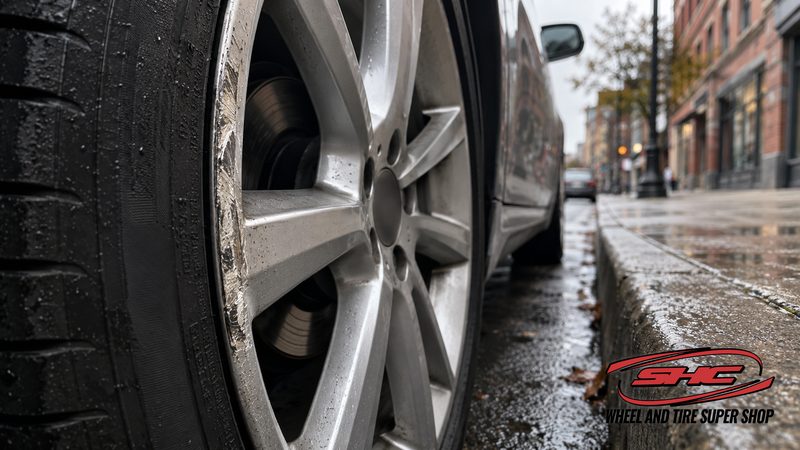
It is almost always the passenger front
Curb rash has a signature. It is nearly always the front passenger wheel, because that is the corner you cannot see from the driver's seat, and it happens at about four kilometres an hour while parking. Nobody has ever damaged a wheel doing something interesting.
The question that matters is not how it happened. It is whether what you are looking at is cosmetic or structural, because those two things look similar from three feet away and have completely different answers.
The four things that happen to a wheel edge
Scuffing. The clear coat and paint are ground off the outer lip, exposing bare aluminium, which then goes dull grey and eventually starts to corrode in a wet climate. The rim itself is untouched. This is by far the most common and it is straightforward to repair.
Gouging. The concrete has actually removed metal, leaving furrows in the lip. Still repairable in most cases, because the material comes out of the decorative lip rather than the structural barrel, but it needs filling and reshaping rather than just refinishing, and there is a depth past which it stops being worth doing.
Bending. The lip or the barrel has deformed, usually from a pothole rather than a curb. You feel this as a vibration that appears at a particular speed and gets worse as the speed climbs, or as a tire that will not hold pressure because the bead is no longer sealing against a straight edge. Bent wheels can usually be straightened.
Cracking. This is the one that matters. A crack in the barrel or across a spoke is a structural failure, and it is not a cosmetic decision any more. On a heavy car with a low-profile tire, a pothole impact loads the rim edge with very little sidewall to absorb it, and the crack often forms on the inboard face of the barrel where you will never see it walking around the car.
If you have hit something hard enough to worry about, look at the back of the wheel, not the front.
Our position on cracked wheels
A cracked wheel can be welded. We do not think that is a good idea on most modern vehicles and we will tell you so.
Cast aluminium wheels are not a uniform material. Welding introduces a heat-affected zone around the repair where the grain structure and the temper are different from the rest of the wheel, and the stress simply moves to the edge of that zone. On a 4,000 lb car running a 35-series sidewall, the loads that cracked it the first time have not gone anywhere.
That is our view and not a regulation. Some shops weld wheels and some customers want it done. What we will not do is tell you a welded wheel is as good as it was.
What repair actually involves
For scuffing and gouging the sequence is the same. The tire comes off. The damaged area is sanded back past the damage to sound material, gouges are filled and reshaped to restore the original profile of the lip, the wheel is primed, refinished and cleared, and then the tire goes back on, gets balanced, and the wheel goes back on the car.
The part people underestimate is the reshaping. The lip of a wheel is a specific profile, not a flat edge, and the difference between a repair you cannot find and a repair you can spot from the sidewalk is almost entirely whether that profile was put back properly before anything was painted.
For bends, the wheel is measured for runout, heated locally, and pressed straight, then re-checked. A wheel that has been straightened should be re-balanced and, if it was leaking, re-sealed at the bead.
The finishes that make this harder
Not all wheels repair the same, and it is worth knowing which kind you have before you decide.
Painted and powder-coated wheels are the easy case. The finish is uniform, so a repaired section can be blended or the whole wheel refinished, and the result is invisible.
Machined or diamond-cut faces are the difficult case. That bright metal look comes from the face being cut on a lathe, leaving fine concentric tool marks under the clear coat. You cannot reproduce those by hand. A proper repair means re-cutting the face on a lathe, and a shop without one will either fill and paint the area, which will not match, or talk you into refinishing the whole wheel in a solid colour. Both are legitimate outcomes, but you should be told which one you are getting.
Chrome is a plating, not a coating. It cannot be locally repaired at all. The realistic options are stripping and re-plating, which is a specialist process and rarely economic on a single wheel, or refinishing the wheel in a different finish entirely.
Polished lips on multi-piece wheels are usually the most repairable of the bright finishes, because the lip is a separate component and can be removed and re-polished.
When repairing is the wrong answer
There is a point at which a repair is the more expensive option. Three situations where we will say so:
The wheel is structurally compromised, as above. Replace it.
All four are heavily rashed and the wheels themselves are common. If you are looking at four full refinishes on a set of wheels that are widely available used, the arithmetic sometimes favours replacing them, especially if you wanted a different look anyway.
The wheel is a factory diamond-cut that is also corroding under the clear. Once moisture has got under the lacquer on a machined face it spreads as a milky bloom across the whole face, and by the time you notice it the damage is not confined to where the curb hit. That is a full refinish, not a repair, and refinishing removes the machined look permanently.
The thing that stops it happening again
The reason curb rash is more common now than it was fifteen years ago is not that people park worse. It is that wheels got bigger and sidewalls got shorter.
A 16-inch wheel with a 65-series tire has a sidewall standing well proud of the rim, and when you touch a curb the rubber touches first. A 20-inch wheel with a 35-series tire has almost nothing standing proud, and on many modern designs the rim lip is the outermost point of the whole assembly. There is nothing between it and the concrete.
This is one of the real, unglamorous costs of going up in wheel size, and it is worth weighing before you do rather than after. If you already have large wheels and low-profile tires, the practical defences are choosing a tire whose shoulder stands slightly proud of the rim where such a tire exists in your size, and parking further out than feels necessary.
We do this in-house
Wheel refinishing and curb rash repair are not on our website, which is an oversight on our part rather than a gap in what we do. We repair and refinish wheels at 474 Bay Street, including tire removal and refitting, balancing and TPMS handling as part of the same job.
What it costs depends on which of the four things above you have, what the finish is, and how many wheels. Bring the car by or send us a photograph of the damage taken square on rather than at an angle, and we will tell you what we are looking at and what it takes to fix.
About SHC Auto
We have been working on wheels and tires in Victoria since 1991, out of the same shop at 474 Bay Street. Alongside wheels and tires we do window tint, paint protection film, vinyl wraps, ceramic coating, paint correction and detailing, suspension, caliper painting, chrome delete, and vehicle graphics and signage. We also do several things most shops send out: curb rash repair and wheel refinishing, TPMS sensor supply and fitting, tint removal, and re-torque after install.
The catalogue on our website is a fraction of what we can actually order. We are an authorized dealer for more than three hundred aftermarket brands, and a good number of them never made it onto the site because there is no data feed for them. If you cannot find something, ask us rather than assuming we cannot get it.
SHC Autographx and Tires
474 Bay Street, Victoria, BC
Monday to Friday, 9:00 to 5:30. Closed weekends.
Free shipping anywhere on Vancouver Island.
Send us a photo. A square-on shot of the damaged lip and a shot of the whole wheel is usually enough for us to tell you whether it is a repair or a replacement, and what it will take.