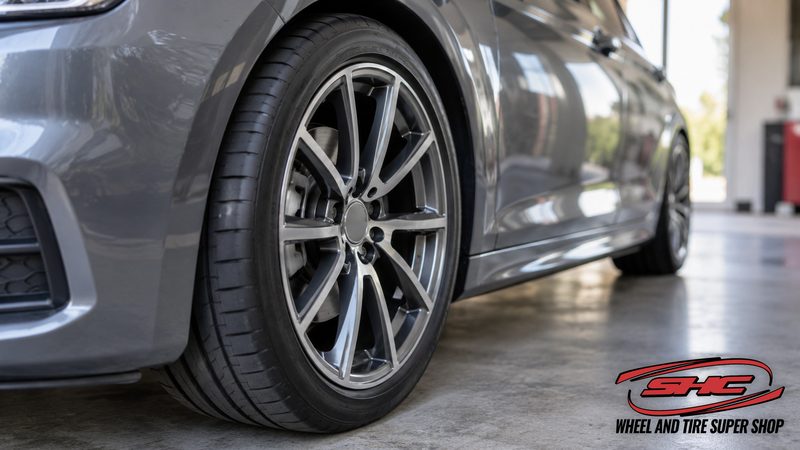
Every wheel conversation at the counter arrives at the same two numbers eventually. Someone has found a set they like online, the bolt pattern matches, the diameter matches — and then there is a stamped marking on the back of the spokes that reads something like ET35, and nobody is sure whether that is the one that matters. It is. Offset and backspacing are what decide whether a wheel tucks neatly under the fender, sticks out past it, or quietly grinds against a strut on the first hard turn.
What offset actually measures
Picture the wheel sliced down its middle, edge to edge — that imaginary line is the centreline. Now find the mounting pad, the flat machined face that bolts against your hub. Offset is simply the distance between those two, and it is stamped on the wheel in millimetres, usually with an ET prefix.
Positive offset means the mounting pad sits outboard of the centreline, toward the street side of the wheel. That pulls the whole wheel inward, deeper into the arch. Nearly every front-wheel-drive car and modern crossover runs positive offset — something in the +35 to +50 range is typical.
Zero offset means the pad lands exactly on the centreline.
Negative offset puts the pad inboard, behind the centreline, which pushes the wheel outward. This is the deep-dish look, and it is common on trucks and older rear-drive cars.
Here is the part worth internalizing: a lower number moves the wheel out, a higher number pulls it in. Going from +45 to +35 does not sound like much, but it moves that wheel 10 mm further into the fender opening — a full centimetre of poke you can see from across a parking lot.
Backspacing measures the same thing differently
Backspacing is the older way of describing the same geometry, still used constantly in the truck world. Instead of measuring from the centreline, it measures from the mounting pad to the inboard edge of the wheel, and it is quoted in inches.
The two are related but not interchangeable, because backspacing depends on how wide the wheel is. Take two wheels with identical 5 inches of backspacing — one 8 inches wide, one 10 inches wide. They sit in completely different places, because the extra width all goes to the outside. That is exactly why a truck owner who orders by backspacing alone sometimes ends up with tires rubbing the fender flares.
If a supplier gives you one and you need the other, we will convert it. Get it wrong by an inch and you are a long way out.
What actually goes wrong
Too little offset — the wheel pushed too far out — and the tire catches the inside of the fender lip when the suspension compresses over a driveway lip or a Blanshard pothole. It also widens the track, which loads the wheel bearings differently than the factory intended and adds steering kickback you can feel through the wheel over rough pavement.
Too much offset, and the tire moves inward toward the strut housing, the control arm, or the inner liner. On a lot of modern cars there is less than a centimetre of room in there. It usually shows up at full steering lock, backing out of a parking spot, as a noise the owner cannot place.
Both of these are geometry, not opinion, and both are avoidable before anyone spends money.
How we check it before you buy
The site’s wheel visualizer is the fastest way to see a set on your actual year, make and model before committing — it is worth ten minutes of clicking before any order. From there, a couple of practical rules we apply on every fitment:
One caveat on the visualizer: it only shows the brands with a live data feed, and that is a fraction of what we can actually order. We are an authorized dealer for a far wider catalogue than the website shows — HRE, APEX and a long list of other performance brands that never appear on any website. If you have a set in mind and cannot find it online, ask us. The odds are good we can get it.
Staying within roughly 5 mm of the factory offset almost always bolts up without drama. Beyond that, we want to check clearances properly. Wider wheels change the arithmetic — adding width without adjusting offset splits that extra width evenly inboard and outboard, so a wider wheel at the same offset can rub in two places at once. And spacers are a legitimate tool for correcting offset when a set is otherwise perfect, but only hub-centric spacers with the correct extended hardware, and never as a shortcut past a wheel that was the wrong spec to begin with.
We check every set at full lock and full compression before the car leaves. A wheel that clears in the shop can still rub loaded with passengers on a dip in the road, and that is our problem to catch, not yours.
About SHC Auto
Wheel fitment is the everyday work here — the website lists over forty aftermarket wheel brands, and through our distributors we can order a great many more than that, including brands that never appear online. SHC Auto is a wheel, tire and appearance shop at 474 Bay Street in Victoria, serving Greater Victoria and Vancouver Island. Alongside wheels we order every major tire brand and handle tint, paint protection film, wraps, ceramic coating, detailing and vehicle graphics under one roof. Tread-depth and sidewall checks are always free, no appointment needed.
SHC Autographx and Tires — 474 Bay Street, Victoria BC — 250-360-2209 — Monday to Friday, 9:00 to 5:30
See Wheels on Your Vehicle in our visualizer, or Call the Shop and we will confirm the offset before you order.