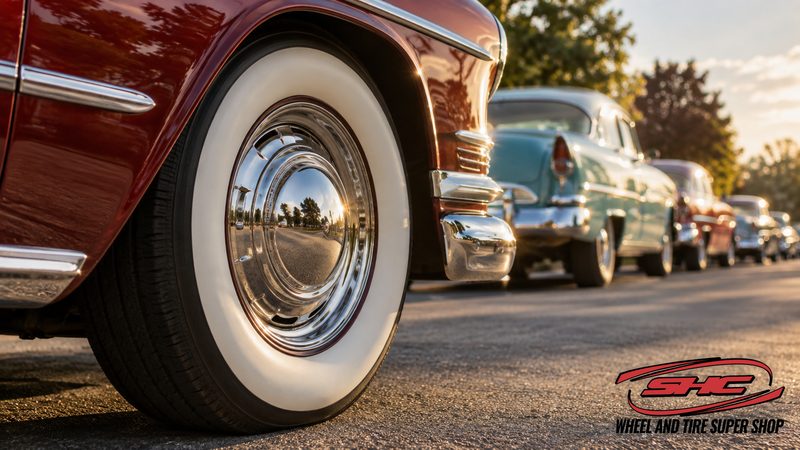
Victoria is quietly one of the best classic car towns in Canada. The climate is gentle, the roads are scenic, and when Deuce Days rolls around, the Inner Harbour fills with more ’32 Fords than most people will see in a lifetime. Between shows, though, those cars sit — and sitting is exactly what vintage tires and wheels handle worst. Here is how we keep classics at 474 Bay Street road-ready, whether yours is a full show car or a Sunday driver.
Classic tires age out long before they wear out
A classic that covers a few hundred kilometres a summer will never wear through its tread — but the rubber is aging anyway. Oxidation hardens the compound, sidewalls crack around the whitewall band, and long storage flat-spots the carcass. Check the DOT date code on the sidewall: as a general guide, tires past six years deserve a close inspection and tires approaching ten deserve replacement regardless of how much tread remains. Old rubber is the single most common safety issue we find on beautiful, otherwise well-kept classics.
The period look, without period manners
Original bias-ply tires have a look and a feel — and on a wet Victoria road, the feel is the problem. Modern reproduction radials give you the tall-sidewall, wide-whitewall appearance with radial wet grip and stability, and for most owners who actually drive their cars, that is the right trade. We can order reproduction and specialty classic lines, wide whitewalls included, alongside every major modern brand — tell us the look you are chasing and we will match it in a size that suits the car.
Muscle-era staples we mount all the time
For 1960s and 70s muscle and street machines, three raised-white-letter names dominate: the BFGoodrich Radial T/A, the classic look that never left; the Cooper Cobra Radial G/T, a softer-riding alternative; and the Milestar StreetSteel for builds on a budget. All three carry the period look with modern construction, and all three are easy for us to source.
Wheels: chrome, steelies and salt air
Island air is kind to sheet metal but hard on chrome — a coastal winter will find every thin spot in a fifty-year-old bumper or hubcap. Wash and wax chrome wheels before storage, never store them wet, and have vintage studs and lug seats inspected when tires come off; hardware that old has usually been over-torqued somewhere in its life. Running wire wheels? Talk to us about tubes — many wires are not tubeless-safe no matter what tire goes on them.
Storage, pressures and show prep
For winter layup: clean tires, bump pressures up a few PSI, park on smooth concrete or tire cradles, and move the car a quarter-turn of the wheel every month or so if you can — it is the cheapest flat-spot prevention there is. Come spring we will inspect, rebalance and get the stance sitting right before the first cruise-in of the season.
Bring the car by 474 Bay Street any time — walk-in tread and sidewall checks are always free, classics especially welcome.
Call the Shop or Start Your Quote Online to talk through your build.