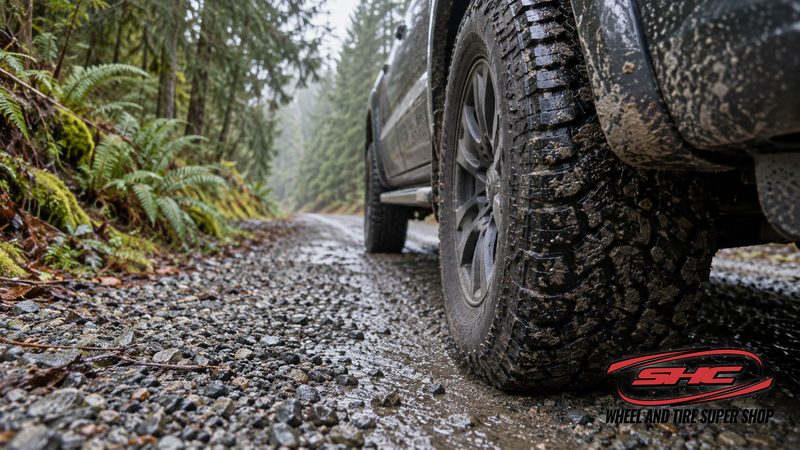
Out past the Metchosin fire hall, up in the Highlands, or anywhere along East Sooke Road, driving stops being a pavement-only activity. The same ten-minute trip can involve a gravel driveway, a washboard forest access road, a leaf-slick rural two-lane and a stretch of proper highway — and one set of tires has to handle all of it, all year. That is exactly the job all-terrain tires were built for, and also exactly where people over-buy or under-buy them.
What rural West Shore driving actually asks of a tire
Gravel bite and chip resistance. Loose surfaces reward an open shoulder pattern, and sharp crushed rock chews up soft highway compounds. AT casings carry tougher rubber and often stone ejectors that keep gravel from drilling into the grooves.
Wet-pavement manners. Here is the part that surprises people: most of your kilometres are still on soaked asphalt. A tire that is all knobs and no siping gives up real braking distance in the rain — which is why a modern all-terrain with dense siping beats an aggressive mud-terrain for almost everyone out here. Mud terrains look the part and are genuinely worse in the wet.
Sidewall strength. Rocks, roots, and the pothole at the end of the driveway you keep meaning to fill. AT tires in LT or heavier load ranges carry stiffer, better-armoured sidewalls — worth it if you haul, tow or run forest roads regularly, though the trade is a firmer ride and a little more rolling resistance.
Winter is already included — if you pick right
Several current all-terrains carry the 3PMSF mountain-snowflake rating, which makes them legal on every designated BC winter route all season — no second set, no changeover. Toyo’s Open Country AT line and Falken’s Wildpeak AT are the two we fit most, both available in snowflake-rated versions; Toyo Tires Canada lists the current range. On a rural property where the plow comes late or never, that rating is not a nice-to-have.
Getting the size and load range right
Match the load index to what the truck actually does. A half-ton that tows a horse trailer or hauls firewood wants the LT tire and the load range the placard calls for — not the lighter P-metric that rides nicer in the parking lot. Going the other way, a Highlands commuter CR-V does not need an E-rated tire; it needs the SUV-sized AT that keeps some ride comfort and fuel economy.
Two habits that make ATs last out here
Watch pressures after gravel runs. Slow leaks from picked-up stones and bead seepage are routine rural problems. Check monthly, and investigate any tire that keeps drifting low.
Rotate on schedule. ATs wear noisier when rotation is skipped — the blocks heel-and-toe and the hum never goes away. Every 8,000 km keeps them quiet and even.
Set up for the driveway and the highway both
Tell us what you drive, what you tow and how much of your week is gravel — we will match an all-terrain, a load range and a pressure setup to the actual life, not the brochure.
Call the Shop — straight advice on AT fitments.
Start Your Quote Online — price snowflake-rated all-terrains in your size.