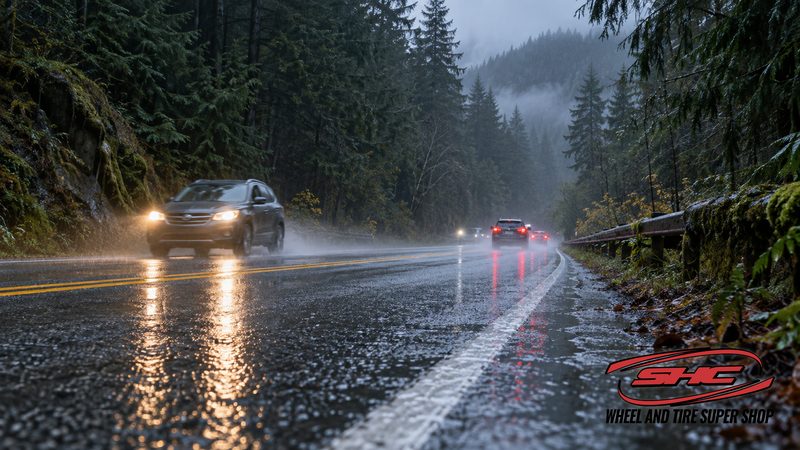
Ask anyone who does it: the Sooke commute is a different animal. Out the door in the dark, forty-five minutes or more of Highway 14 and the West Shore each way, most of it wet from October through April, plenty of it at highway speed on a two-lane road with no shortage of curves. Multiply by two trips a day, five days a week, and your tires are doing more real work than almost any other set in Greater Victoria.
What this drive actually does to tires
Distance, first. A Sooke–Victoria round trip puts serious annual mileage on a daily driver, which means tires age out by tread wear here rather than by time. Second, the braking. The run through Langford and Colwood adds stop-and-go to the highway miles, and repeated hard braking zones wear shoulders and heat the tread. Third, the water. Long stretches of Highway 14 run through forest that keeps pavement shaded and damp for days after the rain stops, and standing water collects in the wheel ruts at exactly the speeds where hydroplaning starts.
The conditions that should pick your tire
Forget the snow question for a moment — the defining condition on this commute is cold and wet: 3 to 8 degrees, soaked pavement, before sunrise. Standard all-season compounds have already stiffened and lost a step by then. What earns its keep is a tread compound that stays pliable in that band, deep circumferential grooves that keep evacuating water as the tire wears, and enough siping to bite on greasy pavement.
And the snow question does come up: when a cold snap does land, the hills between Sooke and town are among the first places it sticks. Watch for the posted winter tire signage on Highway 14 from October 1 — a 3PMSF (mountain snowflake) tire settles the question for the whole season.
What we recommend for this commute
For most Sooke commuters, a premium all-weather tire is the honest answer: 3PMSF-rated for the winter routes, built for exactly the cold-wet band this drive lives in, and one set year-round with no changeover appointments. The Michelin CrossClimate2 and Nokian’s all-weather line are the benchmarks; Toyo’s Celsius II covers the same ground at a friendlier price. If you prefer dedicated winters plus a summer set, that works too — just budget for the two changeovers and storage.
High-mileage habits that pay for themselves
Rotate more often than the average driver. At commuter mileage, every 8,000 km comes around fast — roughly every oil change. Even wear is worth real money on a set this hard-worked.
Check pressures monthly, cold. Underinflation flexes shoulders, burns fuel, and hydroplanes earlier. Cold weather quietly drops pressure just as the rain arrives.
Do not ride the tread down to the legal minimum. Wet braking and hydroplaning resistance fall off well before 1.6 mm. On this commute, treat 4 mm as replacement territory, not 2.
Set up for the dark season
We are a short detour off the commute at 474 Bay Street, and we can quote a set matched to a Highway 14 schedule — tires, rotation cadence and all.
Call the Shop — tell us what you drive and where you park it at night.
Start Your Quote Online — see installed pricing on all-weather sets in your size.