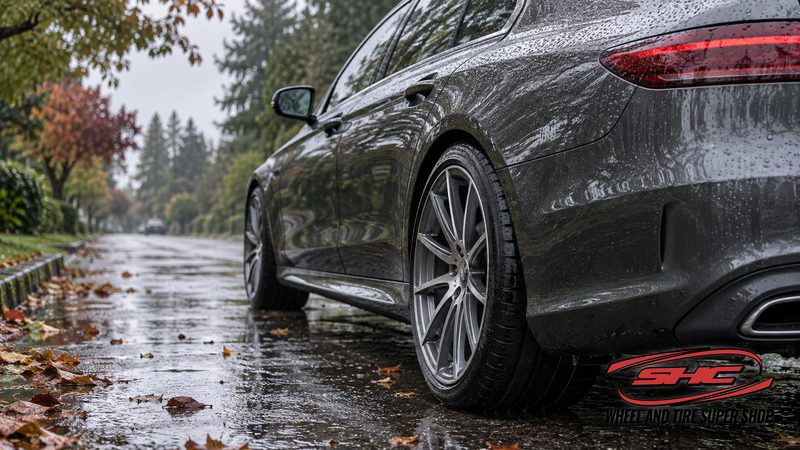
Mercedes ownership comes with tire decisions most drivers never have to think about. Your car likely left the factory on run-flats, the size code carries an MO in it, and if it wears an AMG badge the front and rear tires may not even be the same size. None of this is a problem — but it changes how you should shop, especially with a Victoria winter coming.
What those sidewall letters mean
MO marks a tire built to Mercedes’ original-equipment specification — the version of that model the factory validated for your car. MOE is the run-flat variant of the same idea: an approved tire with reinforced sidewalls that can carry the car a limited distance after losing pressure.
Here is the part the dealer rarely leads with: you are not locked into those markings when you replace tires. Matching the size, load index and speed rating on your door placard is what matters. The markings tell you what the car was validated on; they are a reference point, not a life sentence.
Run-flats: what you get and what you give up
The pitch is real. Lose pressure and a run-flat will typically carry you far enough at reduced speed to get somewhere safe — no roadside change on the Pat Bay shoulder in the dark. That is why there is no spare in the trunk.
The costs are real too: a firmer ride on stiff sidewalls, a higher price per tire, a thinner selection — particularly in winter patterns — and a tire that often cannot be repaired after it has been driven deflated. On Victoria’s frost-heaved side streets, that firm ride is something you feel every single day.
Switching to conventional tires
Plenty of Mercedes owners make the switch at replacement time, and it is entirely legitimate. Your tire pressure monitoring keeps working exactly as before. The ride softens noticeably, the selection opens right up, and the price drops.
The one honest caveat: the car still has no spare. Carry a compressor and sealant kit, or make sure your roadside coverage is current. For most drivers on the South Island — where you are rarely far from help — that trade is easy to justify. Mercedes-Benz Canada lists your model’s approved fitments if you want the factory reference.
Winter on a Mercedes in Victoria
A rear-wheel-drive C-Class or E-Class on all-seasons is a handful the two or three times a year this city actually freezes — and non-compliant on the Malahat and every other designated BC winter route from October 1 unless the tires carry at least the M+S marking, with the mountain snowflake being what actually works when the temperature drops.
The setup we recommend to most Mercedes owners is a dedicated winter package on its own set of wheels, usually one rim size down where the brakes allow it. Smaller diameter means a taller sidewall — better over potholes, quieter, cheaper per tire — and your summer alloys sit out the salt and grit season entirely.
The staggered-fitment wrinkle
AMG and sport-package cars often run wider tires at the rear than the front. Staggered sets cannot be rotated, so they wear faster, and winter choices in those exact widths get thin. The common solution: where an approved square size exists, run it on the winter set. Even wear, full rotation, more tire choices, better snow behaviour on narrower rubber.
What we check before quoting
Placard sizes front and rear, load and speed ratings, brake clearance on a downsized winter wheel, and TPMS compatibility — then we quote you both routes, run-flat and conventional, with honest numbers on each. It takes a few minutes and it usually saves a few hundred dollars.
Sort your Mercedes before the rush
Call the Shop — tell us your model and we will walk the options.
Start Your Quote Online — price a winter package or a run-flat replacement set.