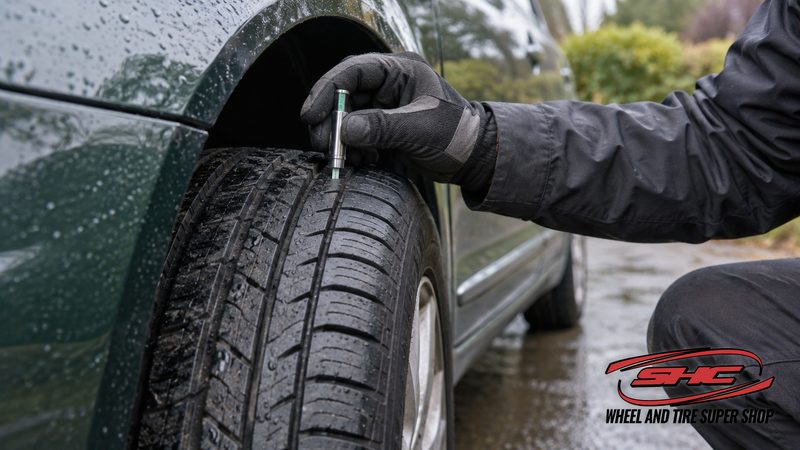
Spend ten minutes in a ferry lineup at Swartz Bay and you will see why Subaru ownership is practically a South Island tradition. Outbacks, Foresters, Crosstreks, the odd WRX — the symmetrical all-wheel drive that makes them so sure-footed on wet pavement is a big part of the appeal. It also comes with a rule that surprises a lot of owners at the worst possible moment: all four tires need to match, and Subaru means it more than almost any other manufacturer.
Why Subaru is stricter than most
Most Subarus run full-time all-wheel drive. Power goes to all four wheels all the time, and the driveline constantly balances the rotation speed of each axle. When your tires match, the system works exactly as designed. When one tire has meaningfully less tread than the others, it has a smaller rolling circumference — it spins slightly faster than the rest, every second you drive.
The centre differential or coupling absorbs that difference continuously. It was designed to handle brief speed differences in corners, not a permanent mismatch. The result is heat and wear in driveline components that cost thousands of dollars — to save a few hundred on a tire. Subaru Canada covers the drivetrain itself; the tire discipline is on the owner.
How close is close enough?
Subaru’s commonly cited guidance is to keep all four tires within about 6 mm (1/4 inch) of rolling circumference — which works out to roughly 2/32nds of an inch of tread depth. That is tighter than most drivers expect. A new tire typically starts around 10/32nds to 12/32nds, so a set that is only half worn can already put a single new replacement outside the window.
The practical translation: if your tires are half worn or more and one is destroyed by a pothole or a sidewall screw, you are usually not buying one tire. You are buying four — or looking at the options below.
Damaged one tire? Your real options
Measure the other three first. If the set is nearly new, a single matching replacement — same brand, same model, same size — may fall inside the tolerance. We will measure and tell you honestly which side of the line you are on.
Tire shaving. A new tire can be shaved on a lathe to match the tread depth of your existing three. It sounds wasteful, and it is a little — but it is far cheaper than three tires you did not need, and it is the accepted industry solution for exactly this situation. Ask us about availability before assuming you need a full set.
Replace all four. If the set was near the end of its life anyway, treat it as maintenance brought forward and start fresh with even tread on every corner.
How to stay out of this situation
Rotate religiously. Every 8,000 to 10,000 km. Even wear across the set is what keeps the single-tire fix available to you for longer — and it protects the driveline the rest of the time.
Run four matching winters. There is no “just the drive wheels” on a Subaru; every wheel is a drive wheel. One set of four, same model, swapped as a set each season.
Repair punctures promptly. A small puncture in the tread face is usually repairable if you catch it before driving it flat destroys the sidewall. A repaired tire keeps its tread depth — a replaced one resets the clock.
The Island part of the equation
Wet grip is where matched tread quietly pays off. A Subaru with even tread and decent rubber is superb in a Victoria winter — the Malahat in a November downpour, greasy roundabouts, the gravel washboard out to a trailhead. A mismatched set undermines all of it: uneven contact patches, longer wet braking distances, and stability control working harder than it should have to.
Not sure where your set stands?
Bring it by. Measuring all four corners takes two minutes and costs nothing, and you will know exactly what a flat would mean for your set.
Call the Shop — free tread depth check on all four corners.
Start Your Quote Online — price a single match, a shaved tire, or a full set for your Subaru.