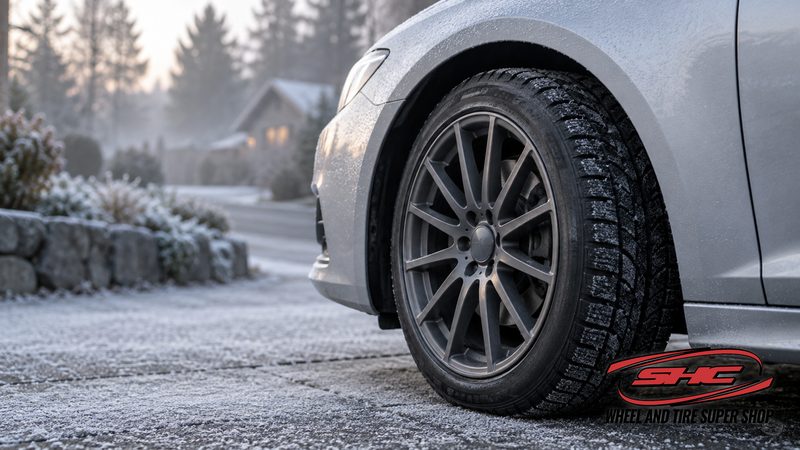
Volkswagen and Audi owners share more than a corporate parent — they share a bolt pattern, a set of fitment quirks, and the same annual question every Victoria fall: what’s the right winter setup for a Golf, Jetta, Tiguan, Q5 or A4? Here’s the guide we wish every VW and Audi driver read before October.
The 5x112 club
Nearly every modern VW and Audi — and their Mercedes neighbours — uses the 5x112 bolt pattern. That’s good news for winter wheel shopping: the aftermarket is deep, and a well-chosen set of winter steels or alloys can serve across several vehicles and model years.
The parts that trip people up are the details around the pattern:
Hub-centric fit. VW/Audi hubs locate the wheel on a centre bore (57.1mm on most), and aftermarket wheels with a larger bore need the correct hub-centric rings. Skip them and you get the classic highway-speed vibration that three rebalances won’t cure.
Bolts, not nuts. These cars use lug bolts, and seat type matters — ball seat versus cone seat depends on the wheel. Running factory bolts in aftermarket wheels (or vice versa) with the wrong seat is a genuine safety problem, not a detail.
TPMS. A second set of wheels wants its own sensors so the car isn’t complaining from October to April. We clone or program them as part of a package.
Why a dedicated winter set makes sense on these cars
VWs and Audis in this market usually arrive on performance-leaning all-seasons — fine in July, past their best on a 4°C November morning, and a genuine liability on the Malahat in January. A winter package solves three problems at once: proper cold-weather rubber on the car when the designated-route rules kick in on October 1, your original alloys protected from a winter of grit and curb-hunting slush, and a fifteen-minute seasonal swap instead of a mount-and-balance appointment twice a year.
For the tires themselves, it’s hard to argue with the OE relationship: Continental supplies much of the VW group from the factory and builds excellent winter and all-weather lines in the common sizes. Michelin’s winter range covers the rest.
Downsizing: the smart winter trick
Many VW/Audi trims ride on 18- or 19-inch wheels with low-profile rubber. For winter, going down a size or two — say from 18s to 17s or 16s where the brakes allow — is standard practice and genuinely better: taller sidewalls shrug off winter potholes, narrower tread bites better in slush and snow, and both the wheels and tires cost less. We check brake clearance against your exact model before quoting, because some S-line and GTI brake packages limit how far down you can go.
Quattro and 4MOTION aren’t tires
The all-wheel-drive systems on these cars are superb at putting power down — and completely uninvolved in stopping. A Quattro on stiff all-seasons out-accelerates everyone away from the light and then brakes like everything else on the same rubber. If the traction budget allows one upgrade this winter, it goes on the tires, not on confidence in the badge.
All-weather: the one-set alternative
If your driving stays mostly in Greater Victoria with only occasional designated-route trips, a set of mountain-snowflake-rated all-weathers mounted on your existing wheels is the simpler play — legal everywhere all year, no storage, no swap. The trade is ultimate snow-and-ice bite and some tread life. For the daily Malahat commuter or the ski family, the two-set winter package still wins.
Timing and stock
Common VW/Audi winter sizes are popular across half the cars in the region, and they’re among the first to run out when the first cold snap hits the Island. Order in September or early October and the whole conversation stays easy — sizes, brands, and a swap appointment on your schedule rather than the weather’s.
Driving a VW or Audi this winter?
Call the Shop — we’ll spec the right winter package for your exact model and trim.
Start Your Quote Online — wheel-and-tire winter packages priced for your vehicle.