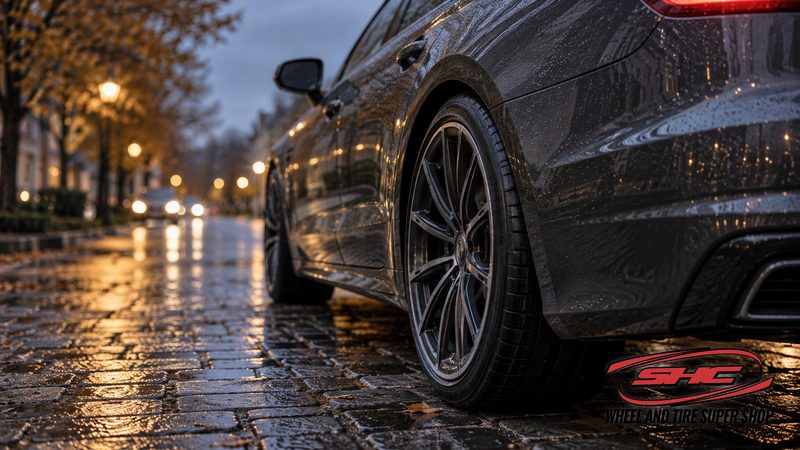
Most BMWs leave the factory on run-flat tires, and most BMW owners in Victoria eventually ask the same question — usually right after a pricing call for replacements: do I have to stay on run-flats?
No, you don’t. But the right answer depends on how you drive, and it changes what else you need to carry. Here’s the whole decision, laid out.
What run-flats actually buy you
A run-flat tire has reinforced sidewalls that can carry the car for a limited distance at reduced speed after a full pressure loss — typically enough to get home or to a shop instead of stopping on the shoulder of the highway in the rain. That’s why BMW pairs them with cars that have no spare: the tire is the spare.
The trade-offs are just as real. Those stiff sidewalls transmit more of the road into the cabin — the classic BMW-on-run-flats ride complaint — replacement costs run higher, a sidewall puncture usually means the tire is done rather than repairable, and selection in some sizes is thinner than the conventional equivalent. Bridgestone, which builds the DriveGuard line and many BMW OE fitments, publishes good technical background on how the construction works.
The case for switching to conventional tires
Around town, a modern conventional tire gives a noticeably better ride, a wider selection in BMW sizes, and a lower replacement bill. On Vancouver Island, punctures are more often tread punctures from screws and gravel than catastrophic blowouts — and a tread puncture in a conventional tire is usually a repairable plug-and-patch, which we handle routinely.
The honest catch: your car has no spare. Switch to conventional tires and you need a plan for a flat — a quality sealant-and-inflator kit in the trunk at minimum, plus roadside assistance you’d actually call. On an Island where the tow to the nearest open shop can be long on a Sunday, that plan is not a formality.
The case for staying on run-flats
If the car does regular highway miles — the Malahat commute, the ferry-and-mainland run — the ability to drive on a dead tire instead of changing plans on a dark shoulder is worth real money. Owners who value that certainty should simply stay OE. The ride penalty on current-generation run-flats is meaningfully smaller than it was ten years ago.
One rule either way: don’t mix. Run-flats and conventional tires on the same car behave differently mid-corner and under braking. Change all four, or change none.
Staggered fitments: the other BMW tax
Many BMWs run wider tires on the rear axle than the front. That staggered setup sharpens handling and looks right in the wheel arches — and it quietly removes tire rotation from your maintenance options, because the fronts and rears can’t swap. Rears on a staggered RWD BMW wear fast. Budget for it, check tread depth on the rear axle more often than feels necessary, and if you’re buying aftermarket wheels, decide deliberately whether to keep the stagger or go square for rotation’s sake — we set up both.
Winter: where BMW owners get caught
The performance all-seasons and summer tires BMWs ship with are the wrong tool from October to March here, and on designated routes like the Malahat, summer-only rubber isn’t just poor — it can fail the legal marking requirement entirely. The clean solution is a dedicated winter package: a second set of wheels in the correct fitment with proper winter or all-weather tires mounted, swapped in October, swapped out in spring. It protects your (expensive) originals, keeps TPMS happy with its own sensors, and turns the seasonal change into a fifteen-minute stop. Michelin builds several of the winter fitments we spec most for BMW sizes.
What we’d tell you at the counter
City-first driver who values comfort: switch to conventional at the next full replacement, put a kit in the trunk, enjoy the ride. Highway-first driver who values certainty: stay on run-flats and accept the premium as insurance. Either way, sort a winter setup before October — BMW sizes are among the first to sell out on the Island every fall.
Driving a BMW in Greater Victoria?
Call the Shop — we’ll price both routes for your exact fitment.
Start Your Quote Online — run-flat, conventional and winter package options for your BMW.