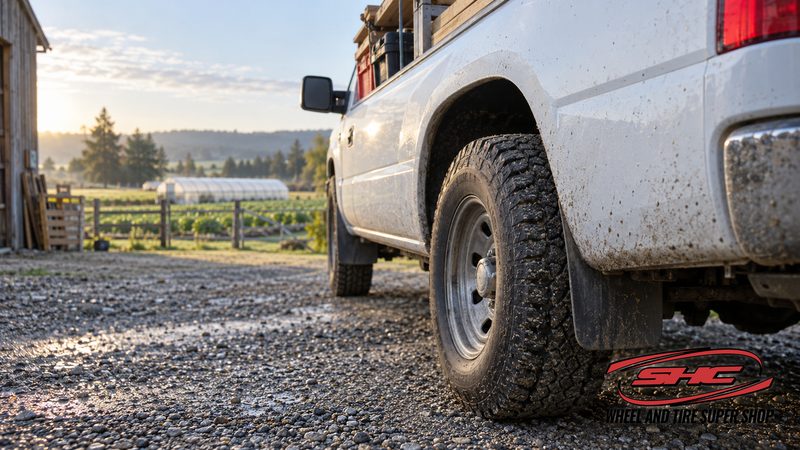
The Saanich Peninsula runs on trucks that work for a living. Farm pickups hauling feed and produce out of Central Saanich, trades vans and half-tons running the Pat Bay to job sites two or three times a day, landscapers towing dump trailers all season. Tires on these trucks are not an accessory decision — they are load-bearing equipment, and the difference between the right spec and the almost-right spec shows up in wear bills and roadside calls.
P-metric or LT: the decision that drives everything
Most half-tons leave the dealership on P-metric or Euro-metric tires — passenger construction, tuned for ride and fuel economy. That is fine for a truck that mostly commutes. The moment a truck spends its life loaded — a slide-in toolbox setup, a yard of gravel, a 5,000-pound trailer — the LT tire in the load range your placard calls for earns its keep: heavier casings, higher load capacity at pressure, and sidewalls that tolerate heat and flex without giving up.
The trade-offs are honest ones: firmer ride, a little more rolling resistance, a modest fuel cost. For a genuinely loaded truck, that is cheap insurance against the alternative, which is an overworked passenger tire running hot on the highway.
Pressure is a load setting, not a constant
An LT tire only delivers its rated capacity at its rated pressure — and that number under load is usually well above what feels comfortable empty. Run the loaded pressure on work days and you get full capacity and even wear; run empty-truck pressures under a load and the shoulders squirm, heat builds, and the centre of the tread outlives the edges by a season. If the truck swings between loaded and empty weeks, it is worth having both numbers written inside the door.
The wear pattern Peninsula trucks show us
Loaded highway kilometres wear tires fast but evenly — when pressures and rotation are right. What we actually see on work trucks is rear tires done long before the fronts (loads live over the rear axle), shoulders scrubbed from roundabouts taken with a trailer on, and job-site punctures: screws, offcuts, and the odd sidewall cut from backing over debris. Rotate every 8,000 km without fail, and get punctures plugged the week they happen — a tread puncture is a cheap repair, a tire run flat to the next job usually is not.
Tread choice for the actual routes
Most Peninsula work trucks do ninety percent pavement, ten percent yard, field or gravel. That calls for a commercial-grade highway or mild all-terrain tread, not an aggressive off-road pattern that howls on the Pat Bay and wears in half the time. If winter routes or early-morning frost runs are part of the season, pick the version with the 3PMSF snowflake and the whole year is covered on one set.
Running more than one truck?
We quote small fleets — matched tires across the trucks, one rotation schedule, and a record of what is on each unit so replacements are a phone call, not a research project.
Call the Shop — tell us the truck, the load and the routes.
Start Your Quote Online — price LT and commercial fitments for your truck.