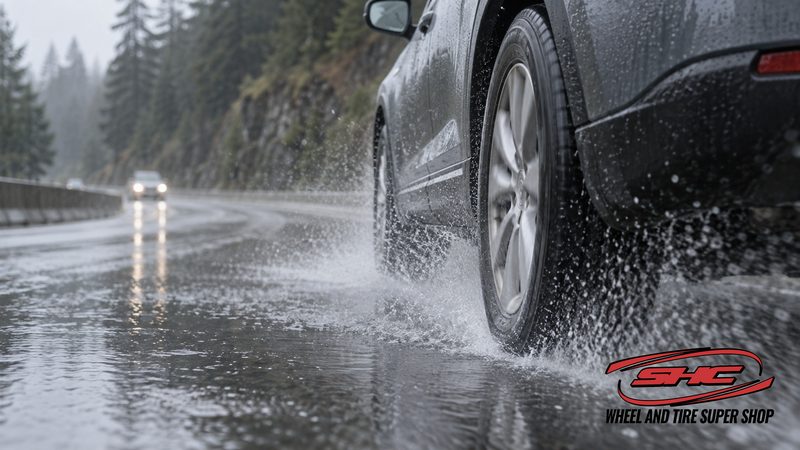
Most “best tires” lists are written for somewhere that gets snow. Victoria mostly doesn’t. What we get is months of rain — roughly 700mm a year in the city, and noticeably more out toward Langford and Sooke — standing water on the Pat Bay in November, and a lot of driving done at 4°C on a soaked road in the dark.
That’s a specific problem, and it rewards a specific kind of tire. Here are five that handle it well — and, more usefully, why.
What we’re actually looking for
Before the list, the three things that matter for wet driving on the Island:
Hydroplaning resistance. Your tire has to pump water out of the contact patch fast enough to keep rubber on pavement. Wide circumferential grooves and open shoulders do this work. Tread depth does it too — which is why a half-worn tire hydroplanes at a much lower speed than a new one, regardless of brand.
Cold-wet braking. Not freezing — just cold. Between 0°C and 8°C, standard all-season compounds have already stiffened and lost grip. This is Victoria’s default winter condition and it’s where most tires quietly underperform.
Siping density. Those fine slits across the tread blocks create biting edges and give water somewhere to go. More siping generally means better wet grip.
1. Michelin CrossClimate2 — the all-round pick
The tire we recommend most often to Victoria drivers, and it’s not close.
It’s an all-weather, so it carries the 3PMSF symbol and is legal on the Malahat and every other designated BC route year-round. But the reason it lands on a rain list is the V-shaped directional tread and the compound, which holds onto grip in exactly that cold-wet band where all-seasons fall off.
Trade-off: it’s a premium price, and tread life is good but not class-leading. Details on the technology are on Michelin Canada’s site.
Best for: the driver who wants one set of tires, does the Malahat a few times a winter, and doesn’t want to think about it again.
2. Continental ExtremeContact DWS06 Plus — the wet performance pick
If you drive something sporty and you’re not willing to give up dry handling, this is the compromise that works.
Continental’s wet grip is a genuine strength, and the DWS06 Plus is one of the better ultra-high-performance all-seasons for a wet climate. It has visible tread indicators for dry, wet, and snow performance moulded into the shoulder, which is a nice touch for knowing when it’s aged out.
Trade-off: M+S only, not 3PMSF — so it’s minimum-legal on designated routes, not properly winter-capable. More background at Continental Tire Canada.
Best for: performance sedans and coupes that stay south of the Malahat in winter.
3. Nokian Tyres WR G4 — the cold-wet specialist
Nokian invented the all-weather category, and it shows. This one is tuned harder toward the cold end than most of its competitors, which suits a climate where the problem is a 3°C downpour rather than a snowdrift.
3PMSF rated, so it’s legal everywhere in BC year-round.
Trade-off: the cold-biased compound means faster wear if you do a lot of warm-weather highway driving. See Nokian Tyres for the full range.
Best for: commuters doing the Malahat or up-Island runs regularly through winter.
4. Toyo Celsius II — the value all-weather
The Celsius line brings genuine 3PMSF all-weather capability at a friendlier price than the premium European and Michelin options. Wet performance is solid, road manners are civilized, and for a lot of daily drivers it’s simply enough tire.
Trade-off: it won’t match the CrossClimate2 at the limit in either wet or snow. You’re paying less and getting a bit less. That’s a fair trade for many drivers. Toyo Tires Canada lists current sizing.
Best for: family vehicles and daily commuters where budget is a real constraint but the Malahat is still on the map.
5. Bridgestone WeatherPeak — the comfort pick
Bridgestone’s all-weather entry leans toward ride quality and quietness while still carrying the 3PMSF symbol. If your current tires are loud and you’ve been living with it, this is a noticeable upgrade on the daily drive without giving up winter legality.
Trade-off: the comfort tuning means it’s not the sharpest handler in the group. More at Bridgestone Canada.
Best for: highway commuters — the Colwood crawl, the run to Sidney, the ferry trips — who value a quiet cabin.
The thing that matters more than which tire you pick
Tread depth beats brand. A worn premium tire will hydroplane before a new budget tire. If you’re below 4mm heading into a Victoria winter, the specific model on this list matters far less than the fact that you replaced them.
Pressure matters almost as much. Underinflated tires flex at the shoulders, reduce the effective contact patch, and hydroplane earlier. Cold weather drops your pressure — roughly 1 PSI for every 5°C — so the set you filled in September is running low by December. Check monthly, cold, first thing in the morning.
And rotate them. Uneven wear across the four corners means your worst tire is worse than it needs to be. Our rotation guide covers the intervals.
Sizes, stock, and what’s actually on the shelf
Everything above depends on availability in your specific size. Some sizes run tight, especially on newer SUVs and EVs with unusual fitments.
Give us your year, make, model, and trim and we’ll tell you what we can get, what it costs installed, and — honestly — whether the premium option is worth it for how you actually drive.
Want a straight recommendation for your vehicle?
Call the Shop — tell us what you drive and where you drive it.
Start Your Quote Online — get installed pricing on any of the above.