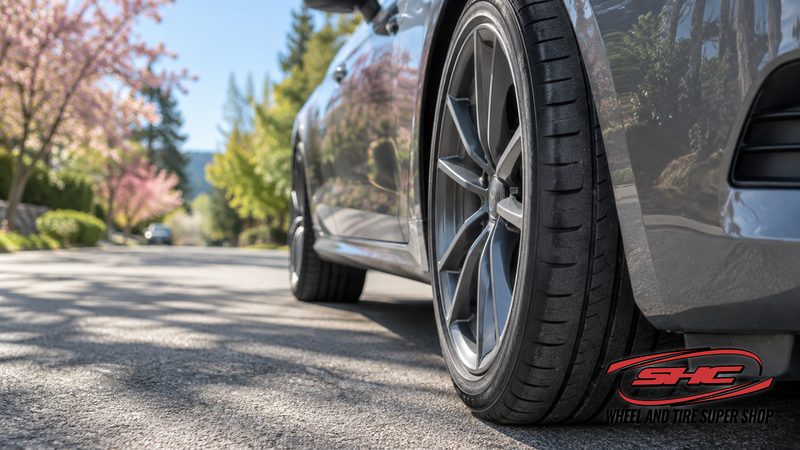
The first genuinely warm weekend in Victoria arrives somewhere in mid-April, everyone books their tire swap at once, and half of them are doing it three weeks too early.
Here’s how to time it properly — and whether summer performance tires are even the right call in a place this wet.
The 7°C rule (and its limits)
The standard industry guidance is straightforward: switch when daytime temperatures are consistently above 7°C.
That number isn’t arbitrary. Summer tire compounds are formulated for heat and stay soft and grippy well into the 30s, but they harden as temperatures fall. Below roughly 7°C, a summer tire loses grip fast — and it loses it in braking, which is the worst place to lose it. Winter and all-weather compounds work the opposite way: pliable in cold, greasy and vague when hot.
The catch in Victoria is that “consistently” is doing a lot of work in that sentence. Our afternoon highs clear 7°C on plenty of days even in midwinter. Our overnight lows don’t reliably clear it until well into May.
If you commute at 6:30am, the temperature that matters to you is the 4°C one, not the pleasant 14°C you get on the drive home.
What we actually tell Victoria customers
Realistic window: late April to mid-May.
Not March, no matter how nice that one week was. Not the first sunny Saturday. Look at the overnight lows for the week ahead, not the afternoon highs.
And on the other end — come back in October, not November. The Malahat winter tire requirement starts October 1, and if you’re on summer tires past that date and heading up-Island, you’re both unsafe and non-compliant. Full details in our BC winter tire law breakdown.
Book early either way. The two changeover weeks are the busiest of our year and the calendar fills.
Should you even run summer tires here?
Honest answer: most Victoria drivers shouldn’t.
Summer performance tires are a genuine upgrade in dry grip, steering response, and braking. On a dry road at 20°C, a good summer tire out-brakes a good all-season by a meaningful margin — car lengths, not inches. They’re also excellent in warm rain, because the tread is designed for water evacuation without any cold-weather compromises.
But the South Island gives you maybe four months where they’re clearly the better choice, and eight months where they range from “fine” to “actively worse than what you had.” Add the cost of a second set, a second set of rims, storage, and two changeovers a year.
Summer tires make sense if:
- You own a genuine performance car and drive it like one
- You do track days or spirited weekend driving
- You already own a dedicated winter or all-weather set
- You have somewhere to store the off-season set
They don’t make sense if:
- Your car is primarily a commuter
- You’ve got one set of wheels and no storage
- You want to fit and forget
For the majority, a good all-weather tire — covered in our all-season vs. all-weather comparison — is the better use of the money.
If you are running summer tires, here’s what to fit
Michelin Pilot Sport 4S / Pilot Sport 5 — the benchmark for a reason. Exceptional dry grip with genuinely good wet performance, which matters more here than in most markets. Not cheap. Michelin Canada.
Continental ExtremeContact Sport 02 — arguably the best wet-weather summer tire in the class, which makes it a natural fit for a coastal climate. Slightly softer on ultimate dry limit than the Michelin, better value. Continental Tire Canada.
Bridgestone Potenza Sport — sharp steering response and strong dry braking. Firmer ride than the other two. Bridgestone Canada.
Falken Azenis FK510 / RT660 — the value play, and the RT660 in particular is a favourite for anyone doing occasional track work. Noisier, shorter-lived, considerably cheaper. Falken Tire.
Verify current sizing and availability with us before you commit — performance sizes move in and out of stock quickly.
Storing the off-season set properly
Whichever set comes off, store it right or you’ll be replacing it early:
- Clean them first. Brake dust and road salt sitting on rubber for six months does real damage.
- Cool, dry, dark. UV and ozone are what age rubber. A garage corner away from a window is fine; a sunny deck is not.
- Away from electric motors. Furnaces, generators, and older motors produce ozone, which cracks sidewalls.
- Stacked flat if off the rims, hung or stacked if mounted. Mounted tires shouldn’t stand on their tread for months.
- Bag them. Cheap tire bags cut moisture and ozone exposure significantly.
If you don’t have the space, ask us about seasonal storage — it’s a common request in a city with this much condo living, and it solves the “the tires are in the garage and the garage is in Sooke” problem.
Don’t forget the wheels
If you’re running two sets of rims, the changeover is also the right moment to inspect the set coming off — corrosion around the bead seat is a common issue in coastal air and it causes slow leaks that get blamed on the tire. We check this as part of every swap.
Ready to book your seasonal changeover?
Call the Shop — the changeover weeks book up fast, so call ahead.
Start Your Quote Online — price a swap, a new summer set, or seasonal storage.