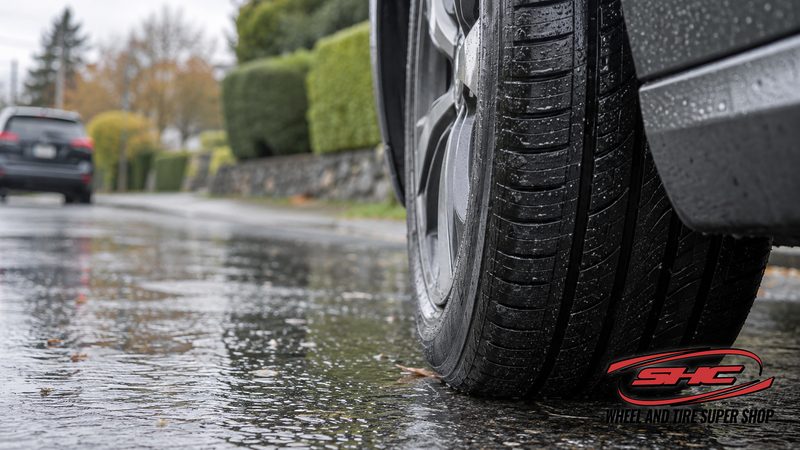
Two names, one letter apart, sold on the same rack. All-season and all-weather tires get used interchangeably by a lot of people — including, occasionally, people who should know better.
They are not the same product, and on Vancouver Island the difference matters more than almost anywhere else in Canada.
The one-sentence version
All-weather tires carry the three-peak mountain snowflake symbol. All-season tires do not. Everything else follows from that.
What “all-season” actually means
All-season is the default tire on nearly every new vehicle sold in North America. It’s built to be competent across a wide temperature band — quiet on the highway, long-wearing, decent in rain, acceptable in a light dusting of snow.
The compromise is at the cold end. All-season rubber compounds are formulated to stay stable in summer heat, which means they progressively harden as temperatures drop. Somewhere around 7°C, a typical all-season starts trading away grip. By the time you’re at freezing, it’s noticeably worse than it was in the parking lot in September.
Most all-seasons carry an M+S marking, which makes them technically legal on BC’s designated winter routes. Legal is not the same as good — see our breakdown of BC’s winter tire law for why that distinction has teeth.
What “all-weather” actually means
All-weather is a genuinely different category, and a relatively recent one. These tires use a more cold-flexible compound and a more aggressive, heavily siped tread pattern, and they’ve passed the standardized snow traction test required to earn the 3PMSF symbol.
That symbol makes them legally winter tires in British Columbia, year-round, on every designated route. No October swap. No April swap. No set of rims taking up half your garage.
The category was pioneered by Nokian Tyres, and most major manufacturers now field an entry — Michelin’s CrossClimate line and Toyo’s Celsius range are two of the more common ones we fit.
Why this matters specifically on the South Island
Victoria’s winter is not a snow problem. It’s a water problem.
We get months of standing water, spray, road film, and temperatures that hover in that 2–8°C band where all-season compounds are already going stiff but nobody’s thinking about winter tires because there’s no snow on the ground.
That band is where all-weather tires earn their money. The softer compound stays pliable, so you keep braking grip on a cold wet morning on Blanshard — not just on the two days a year the Malahat closes.
Then there’s hydroplaning. On a wet road, your tire has to physically pump water out of the contact patch, and the deep siping and open shoulder grooves on an all-weather design move a lot of it. Tread depth matters here more than compound: a half-worn tire of any type hydroplanes at a meaningfully lower speed than a new one.
The honest trade-offs
All-weather is not a free lunch. Three things you give up:
Tread life. The softer compound wears faster. Expect somewhat shorter mileage than a comparable all-season — often noticeably so if you drive hard or do a lot of highway.
Dry summer performance. On a hot August day, an all-weather tire is squirmier in corners and takes slightly longer to stop than a good all-season. Most drivers won’t notice. If you enjoy a spirited run out Sooke Road, you might.
Noise and price. More aggressive tread generally means more road noise, and all-weathers typically carry a premium over a comparable all-season.
And one thing worth being clear about: all-weather is not as good as a dedicated winter tire on ice. It’s a compromise, deliberately. A proper winter tire will out-brake it on packed snow and ice by a wide margin.
So which should you buy?
Choose all-weather if: you live in Greater Victoria, your winter driving includes the Malahat, the ferry run to Nanaimo, or trips up-Island, and you don’t want to store and swap a second set. This covers most of our customers, honestly.
Choose all-season if: your driving is genuinely confined to Victoria city streets, you never touch a designated route between October and March, and you want maximum tread life and a quieter ride. It’s a defensible choice — just make it deliberately.
Choose dedicated winter tires if: you regularly drive to the Interior, ski, commute over the Malahat daily in winter, or simply want the best available cold-weather safety and are willing to swap twice a year.
A note on the “one set for everything” appeal
The single biggest reason people move to all-weather tires isn’t performance — it’s that the seasonal swap never actually happens. The tires sit in the garage. The appointment gets pushed to December. And then there’s an early cold snap and you’re on summer rubber.
A tire that’s already correct in October is worth something, even if it’s a compromise on paper.
Not sure which category your current tires fall into? Bring the vehicle by — we’ll read the sidewall, check your tread depth, and tell you straight whether you need to do anything this year.
Not sure which set is right for your vehicle?
Call the Shop — we’ll walk through your driving habits and budget.
Start Your Quote Online — pick your vehicle and compare options side by side.