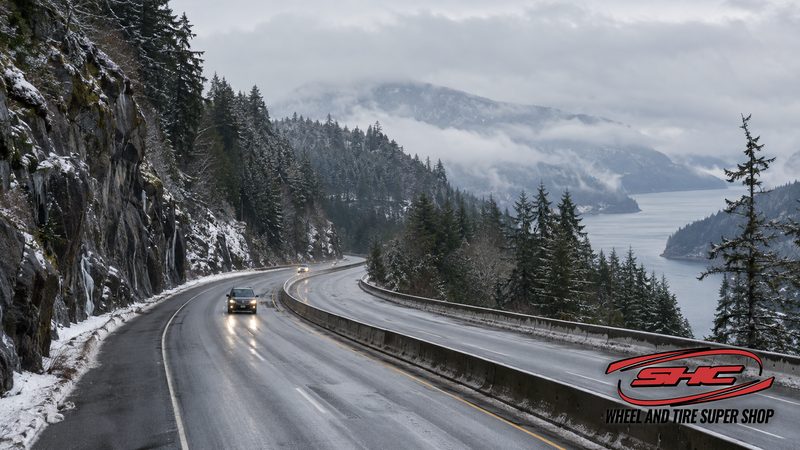
You can live your whole life in Victoria and barely touch a snowflake. Then you plan a weekend in Duncan, or a run up to Nanaimo for the ferry, and suddenly you’re at the bottom of the Malahat in November wondering whether the tires on your car are actually legal.
They might not be. Here’s the straight version, without the fine print.
The short answer
Greater Victoria’s city streets are not designated winter tire routes. Because of the mild South Coast climate, the province does not require winter tires on most roads in and around Victoria, Saanich, Langford, or Esquimalt.
The Malahat is a different story. The stretch of Highway 1 between Greater Victoria and the Cowichan Valley is a designated route. So are Highway 14 toward Port Renfrew, Highway 4 across to Port Alberni and Tofino, and Highway 28 out to Gold River.
If your winter includes any of those roads — and for most Victoria drivers, it does — the law applies to you.
The dates
Winter tire requirements start October 1 on every designated route in BC.
The end date depends on the road. Most designated highways in the province run through April 30, because they cross mountain passes or sit in high-snowfall country. The Malahat is one of the exceptions: because it isn’t a true mountain pass, its requirement ends March 31.
One important caveat — the province can extend these dates at any time based on conditions, and the regulatory signs posted at the start of each corridor take priority over the calendar. If the sign says winter tires, the sign wins.
You can check the current designated routes on the Province of BC’s winter tire and chain-up routes page, which includes a South Coast map covering Vancouver Island.
What actually counts as a “winter tire” in BC
This is where a lot of drivers get caught out, because BC accepts two different sidewall markings — and they are not equally good.
M+S (Mud and Snow)
The letters “M+S,” “M/S,” or “M&S” stamped on the sidewall. This is the minimum legal standard, and it’s the marking found on most conventional all-season tires. It’s a tread-pattern designation, not a performance test.
3PMSF (Three-Peak Mountain Snowflake)
A small pictogram of a mountain with a snowflake inside it. This one is earned — the tire has to pass a standardized snow traction test to wear it. Dedicated winter tires and all-weather tires carry it.
Either marking is legal. But if a police officer or ministry official pulls you over on the Malahat in a January snow event, legal and adequate are two different things. M+S all-seasons will get you through the checkpoint and then let you down on the actual hill. The rubber compound in an all-season stiffens as temperatures drop toward freezing, and a stiff tire simply cannot grip. Manufacturers publish good primers on this — Michelin Canada explains the compound and siping differences in plain language, and the Tire and Rubber Association of Canada maintains a straightforward overview of the provincial rules.
The 3.5mm tread rule
Whichever marking your tires carry, they need at least 3.5mm (5/32”) of remaining tread depth to be legal on a designated route.
This trips people up constantly, because 3.5mm is well above the 1.6mm legal minimum for a tire to stay on the road at all. A tire can be perfectly legal for summer driving in Victoria and still be illegal on the Malahat in December.
The quick check: a Canadian quarter, caribou nose down, into the tread groove. If the tread covers the nose, you’ve got comfortable margin. If the whole nose is showing, you’re at or below the limit.
It’s a rough test. A proper depth gauge takes thirty seconds and gives you an actual number — and we’ll do it for free while you wait.
All-wheel drive does not exempt you
Worth saying plainly, because we hear it every fall: the requirement applies identically to 2WD, AWD, and 4WD vehicles.
All-wheel drive helps you accelerate. It does nothing for braking or cornering — those are entirely down to the four contact patches, each about the size of your hand. A 4x4 on worn all-seasons stops no better than a Civic on worn all-seasons. It just gets to the corner faster.
What it costs to get this wrong
Driving a designated route without compliant tires carries a $121 fine under the Motor Vehicle Act, and enforcement officials can turn you around at the bottom of the hill regardless of where you were headed.
The bigger exposure is on the insurance side. If your tires are found to have contributed to a collision, that can affect how your claim is handled. Set against a set of tires, the math isn’t close.
What we’d actually recommend for Victoria drivers
We fit a lot of tires for people whose driving is 95% city and 5% “over the Malahat to see family.” For that profile, the honest answer is usually all-weather tires — 3PMSF-rated, so legal everywhere in BC year-round, with no seasonal swap and no second set of wheels to store in a condo locker.
If you’re regularly heading up-Island, over to Tofino, or off the Island to the Interior, dedicated winter tires are the right call. Nothing else comes close on ice.
And if you’re a strictly-in-town driver who never touches a designated route, quality all-seasons are a legitimate choice — just know exactly what you’re giving up on the two or three mornings a year when Victoria genuinely freezes.
We’d rather talk you into the right set than the expensive set. Bring the vehicle in and we’ll measure what you’ve got, tell you honestly how much life is left in it, and price out the options.
Ready to sort out your winter tires?
Call the Shop — talk to someone who fits these every day.
Start Your Quote Online — enter your vehicle and get pricing sent to you.
Winter tire regulations are set by the Province of British Columbia and can change. This article reflects the requirements as of the 2026 season — always check posted highway signage and the provincial route map before you travel.