Three kinds of tread, and only one of them does not care
Most people discover this when a shop tells them their tires cannot be rotated the way they expected. It is worth understanding before that conversation, because it changes what a set of tires costs you over its life.
There are three tread layouts:
Symmetric. The tread pattern is the same across the whole face and looks the same in either direction. It can go on any wheel, either side, facing either way, and rotate any way you like. Most touring and all-season tires are symmetric. If your tires are symmetric, none of the rest of this article constrains you.
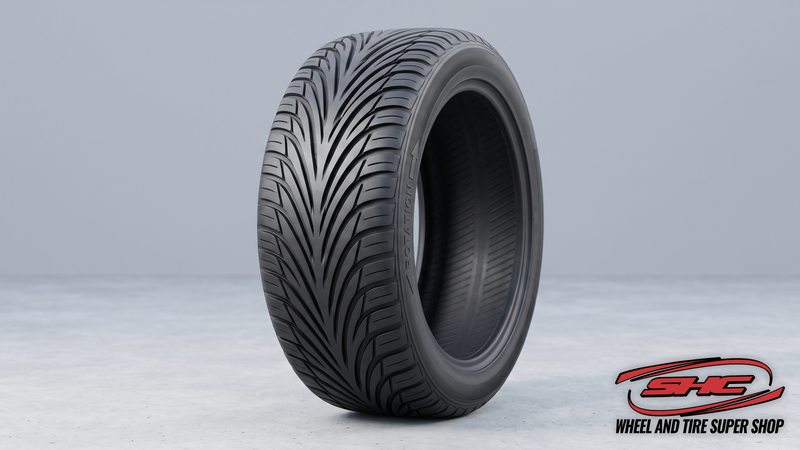
Directional. The tread is designed to rotate in one direction only, usually with a V or arrow shape pointing forward at the centre. There will be an arrow on the sidewall with the word ROTATION.
Asymmetric. The inner half of the tread and the outer half are different patterns doing different jobs. The sidewall is marked OUTSIDE and INSIDE, or OUTWARD FACING SIDEWALL.
And a fourth case that catches people: a tire can be both directional and asymmetric, at which point it is committed to one specific corner of the car.
Why directional exists
The V shape is about water. As the tire rolls, the angled grooves channel water from the centre of the contact patch outward to the shoulders and away. It works like the tread on a snow boot or the vanes on a pump impeller - it only works one way round.
Run a directional tire backwards and you are pumping water into the contact patch instead of out of it. Resistance to hydroplaning drops significantly. The tire will look fine, drive fine in the dry, and behave noticeably worse in standing water - which is the one condition it was designed for.
Directional patterns are common on performance summer tires, on winter tires, and on all-weather tires, because all three are being asked to clear water or slush.
Why asymmetric exists
An asymmetric tire is solving a different problem: the two halves of a tire's contact patch do different work.
When you corner, the car leans and the load transfers onto the outer shoulder of the outside tire. That shoulder wants large, stiff, continuous blocks to resist deforming under load - which is what gives you dry grip and steering precision.
The inner half spends its time doing wet and straight-line work, where you want more grooves and more siping to clear water.
Those two requirements are incompatible, so an asymmetric tire simply builds each half for its own job. It is the reason a good performance tire can be sharp in the dry and still safe in the rain rather than having to pick one.
The practical consequence is simple: an asymmetric tire mounted backwards puts the wet-weather half on the outside and the dry-grip half on the inside. The car understeers earlier, the steering feels vaguer, and wear goes odd. It is not dangerous in the way a reversed directional tire is, but it wastes most of what you paid for.
What you can and cannot rotate
| Tread type | What is allowed |
|---|---|
| Symmetric, square setup | Anything. Front to back, side to side, cross patterns. |
| Directional, square setup | Front to back on the same side only. Never side to side. |
| Asymmetric, square setup | Any position, as long as the OUTSIDE marking stays outside. Side to side is fine - the wheel stays on the same side, the tire just moves. |
| Directional and asymmetric | Front to back on the same side only. |
| Any type, staggered setup | Nothing, unless the fronts match each other and the rears match each other and you are only swapping left for right - which a directional tire forbids. |
The last row is the one that costs money.
The staggered problem, and it is a real one
A staggered setup - wider wheels at the back than the front - means the front and rear tires are different sizes. They cannot swap.
If those tires are also directional, they cannot swap side to side either, because that would reverse them.
Put those together and a staggered set of directional tires cannot be rotated at all. Every tire lives and dies in the corner it was fitted to.
That matters because rotation is what evens out wear. On a rear-drive car the rears wear faster under power; on any car the fronts wear faster on the shoulders from steering. Without rotation, you replace tires in pairs more often, and you are more likely to end up with one corner gone while the other three have life in them.
We are not telling anyone not to run a staggered setup - there are good reasons for it and we fit them regularly. We are saying that the tire cost over the set's life is genuinely higher, and that belongs in the decision rather than arriving as a surprise eighteen months later. Our square-or-staggered article goes into the rest of the trade.
How to read your own tires in thirty seconds
Walk around the car and look at the sidewalls.
- An arrow and the word ROTATION: directional. The arrow must point forward when looking at that side of the car.
- OUTSIDE or OUTWARD FACING SIDEWALL: asymmetric. That text must be visible from outside the car. If you can only see INSIDE on a tire, it is on backwards.
- Neither marking, and the pattern looks the same left to right: symmetric.
- Both markings: directional and asymmetric. Corner-specific.
The asymmetric check is the easy one to do yourself, and it is worth doing after any tire work anywhere. If the OUTSIDE text is facing the car, it was mounted wrong.
The directional check catches a particular error: a tire that was correct, then moved to the other side of the car during a rotation. Both arrows on one side of the car should point the same way you drive.
The full-size spare problem
Here is one that catches people, and it is worth knowing before you are at the side of the road.
If your car carries a full-size spare and your tires are directional, that spare is correct for one side of the car and reversed for the other. There is no way to store it that is right for both.
This is not a reason to panic at the roadside. A reversed directional tire is fine for getting you home at moderate speed in dry conditions - the loss is hydroplaning resistance, not structural safety. But it is a reason to get the proper tire back on rather than leaving the spare there for a month, and it is a reason to drive to the wet-weather limitation in the meantime.
What we do about it
When we rotate tires we read the sidewalls first and rotate to the pattern the tire allows. If a car comes in with an asymmetric tire mounted backwards, we will tell you - it is a ten-minute fix on the machine and it gets you back the tire you paid for.
And if you are choosing tires now, it is worth asking us which layout a given model uses before you commit, particularly on a staggered car. Two tires that look equivalent on paper can have quite different lifetime costs purely because one can be rotated and the other cannot.
The short version
- Symmetric tires rotate any way you like. Most touring tires are symmetric.
- Directional tires have a V pattern that pumps water outward. Reversed, they pump it in. Front to back on the same side only.
- Asymmetric tires build the outer half for dry grip and the inner half for wet. Mounted backwards, you lose most of what you paid for.
- A staggered set of directional tires cannot be rotated at all, which raises the real cost of the set.
- Check your own sidewalls: an arrow means directional, OUTSIDE means asymmetric.
- A full-size spare on a directional set is correct for one side only.
About SHC Auto
We have been fitting wheels and tires in Victoria since 1991, out of the same shop at 474 Bay Street. Alongside wheels and tires we do suspension and lift work, window tint, paint protection film, vinyl wraps, ceramic coating, paint correction and detailing, caliper painting, chrome delete, and vehicle graphics and signage. We also do the things most shops send out: curb rash repair and wheel refinishing, TPMS sensor supply and fitting, tint removal, and re-torque after install.
The catalogue on our website is a fraction of what we can actually order. We are an authorized dealer for more than three hundred aftermarket brands, and a good number of them never made it onto the site because there is no data feed for them. That includes most of the lift and levelling kit market. If you cannot find something, ask us rather than assuming we cannot get it.
SHC Autographx and Tires
474 Bay Street, Victoria, BC
Monday to Friday, 9:00 to 5:30. Closed weekends.
Free shipping anywhere on Vancouver Island.
Not sure what you need? Bring the vehicle by 474 Bay Street. It is much faster to look at what you have and tell you what will work than to sort it out over email.