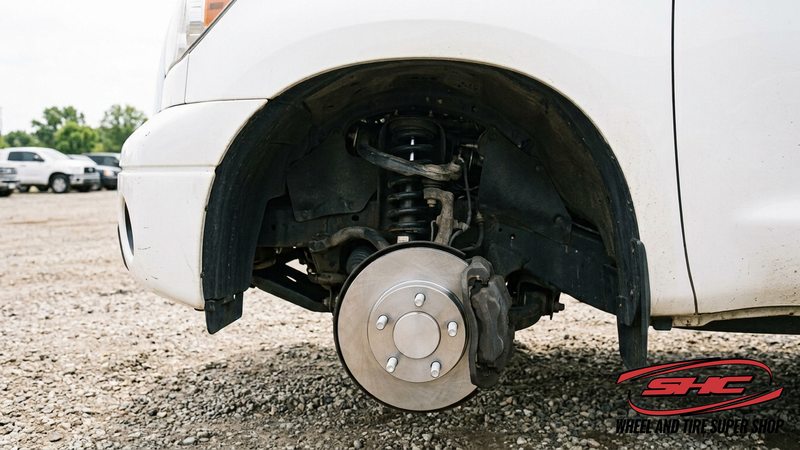
For fifteen years, no two Toyota trucks shared a hub. That just ended.
We were going to write this article as a warning: the Tundra is not a big Tacoma, do not assume the wheels cross over. That was true for a long time. Then we checked the current trucks and found something better.
The 2022 Tundra, the 2023 Sequoia and the 2024 Tacoma all converged on the same hub: 6x139.7, a 95.1 mm bore, M14 x 1.5 studs. After fifteen years of the Tundra going its own way, Toyota's truck line is one pattern again.
And the transition created one specific trap in one specific model year, which we will get to.
The Tundra, by generation
| Generation | Years | Pattern | Bore | Thread |
|---|---|---|---|---|
| 1st gen (XK30/XK40) | 2000-2006 | 6x139.7 | 106.1 mm | M12 x 1.5 |
| 2nd gen (XK50) | 2007-2021 | 5x150 | 110.1 mm | M14 x 1.5 |
| 3rd gen (XK70) | 2022+ | 6x139.7 | 95.1 mm | M14 x 1.5 |
The middle row is the odd one and it lasted fifteen years, which is why "the Tundra is 5-lug" became common knowledge. 5x150 is a Toyota full-size-only pattern. Almost nothing else on the road uses it, which is why the aftermarket catalogue for a 2015 Tundra is so much thinner than for a Silverado of the same year.
Note the first generation: 6x139.7 with a 106.1 mm bore, which is the old Toyota truck standard the Tacoma and 4Runner carried for two decades. So the first-gen Tundra genuinely does share wheels with Tacomas and 4Runners of its era. The second-gen does not share with anything.
The Sequoia, which is the Tundra's hubs in an SUV
| Generation | Years | Pattern | Bore | Thread |
|---|---|---|---|---|
| 1st gen (XK30) | 2001-2007 | 6x139.7 | 106.1 mm | M12 x 1.5 |
| 2nd gen (XK60) | 2008-2022 | 5x150 | 110.1 mm | M14 x 1.5 |
| 3rd gen (XK80) | 2023+ | 6x139.7 | 95.1 mm | M14 x 1.5 |
The Sequoia tracks the Tundra exactly in every generation. That is not a simplification - the factory wheel part numbers overlap. The same part number that appears on a 2018 Tundra list appears on a 2018 Sequoia list, and the 20 inch wheel on the current trucks is sold by resellers as fitting "Tundra Sequoia 2022 2023 2024." They are the same wheels.
Here is the trap: model year 2022
Look at the two tables together and you will see it. The Sequoia carried the old pattern one model year longer than the Tundra.
| Vehicle and year | Pattern |
|---|---|
| 2021 Tundra | 5x150 |
| 2022 Tundra | 6x139.7 |
| 2022 Sequoia | 5x150 |
| 2023 Sequoia | 6x139.7 |
A 2022 Tundra and a 2022 Sequoia, sitting beside each other, take different wheels. Same brand, same year, same showroom, same size of vehicle, different bolt pattern.
Any article, listing or counter conversation that covers both trucks in one table gets this wrong unless it is called out deliberately. If your vehicle is a 2022, say which one it is.
The convergence, and what it actually lets you do
The 2022+ Tundra, 2023+ Sequoia and 2024+ Tacoma share 6x139.7, roughly 95.1 mm bore, M14 x 1.5. That means a wheel from one will physically fit the others - pattern, bore and thread all line up, and owners have done the swap and reported it working.
Two caveats that matter:
- Load rating is not shared. A Tacoma wheel is rated for a Tacoma's loads. Bolting it to a Tundra is a fitment success and a load-rating question, and on a truck that tows those are not the same thing. We check the rating before we fit.
- Offset is not shared. Pattern compatibility says the studs line up. Where the tire ends up in the arch is a separate calculation.
Worth flagging, because we have seen it misreported: you will find claims that the 2024 Tacoma stayed at a 106.1 mm bore while the Tundra went to 95. That is wrong. 106.1 mm is the 2016-2023 Tacoma. The 2024 and newer Tacoma dropped to roughly 95.1 as well. Believing otherwise sends a fourth-generation Tacoma owner shopping for hub rings they do not need and tells them Tundra wheels will not fit when they will.
The 110.1 versus 110.5 question on the 5x150 trucks
Published figures for the second-gen hub bore come in three flavours: 110.1, 110.5, and a flat "110." One wheel retailer publishes 110 on its Tundra page and 110.5 on its Sequoia page, for what is the same hub. That contradiction tells you something useful: nobody in that chain is measuring, they are all copying each other.
The trade sells 110.1 mm hub-centric rings and 110.1 mm bore spacers for this platform and they fit. So treat 110.1 as the working number, understand that published figures range from 110.0 to 110.5, and size any hub ring to the actual wheel you are fitting rather than to a number off a website.
Factory wheels and offsets
Third generation Tundra, 2022 onward - the best-documented of the three generations:
| Wheel | Offset | Tire | Trim |
|---|---|---|---|
| 18x7 steel | not published | 245/75R18 | SR |
| 18x7.5 alloy | ET60 | 265/70R18 | SR5, SX package |
| 20x8 alloy | ET60 | 265/60R20 | Limited, Platinum, 1794 |
| 18x8.5 BBS forged | ET47.5 | 285/65R18 | TRD Pro |
| 22x8 alloy | ET60 | 265/50R22 | Capstone |
The ET60 figures are solid - two independent sources each, and the 20x8 is corroborated by a factory take-off wheel listed with its part number, its ET60 offset and its 95.1 bore together. The TRD Pro ET47.5 and the Capstone 22 inch figure come from one source each, so treat those as provisional.
Second generation Tundra, 2007-2021:
| Wheel | Offset | Tire | Trim |
|---|---|---|---|
| 17x8 | ET50 | 255/70R17 | SR5 and base, 2007-2013 |
| 18x8 | ET60 | 255/70R18 | SR, SR5, Limited, TRD Pro |
| 20x8 | ET60 | 275/55R20 | TRD Sport, Limited, Platinum, 1794 |
First generation Tundra, 2000-2006: 16x7 steel and alloy at ET15 on 245/70R16 or 265/70R16. The 17x7.5 is genuinely disputed - one source says ET15, another says +18 - and we have not resolved it.
Third generation Sequoia, 2023 onward: identical menu to the Tundra - 18x7.5 ET60 on 265/70R18 for the SR5, 20x8 ET60 on 265/60R20 for Limited and up, 18x8.5 ET47.5 for the TRD Pro, 22x8 ET60 for the Capstone.
Second generation Sequoia, 2008-2022: 18x8 ET60 on 275/65R18 and 20x8 ET60 on 275/55R20. Single-source, but consistent with the Tundra data and with the shared part numbers.
The useful generalisation: ET60 is the modern Toyota full-size number, across both trucks and both of the last two generations. The off-road trims come down to roughly ET47.5. That gap of about 12 mm is the entire difference between how a Platinum and a TRD Pro sit.
Tire sizes by lift height
Third-gen Tundra, 2022+. Two independent guides, and they do not entirely agree, so here is both:
| Setup | What is reported |
|---|---|
| Stock | 33 inch maximum. Examples run include 17x9 +1 on 285/70R17, 20x10 -19 on 305/55R20, and 22x12 -44 on 325/50R22 |
| 1.75 to 2 inch level | 33 to 35 inch. 305/60R20 on a 20x9 +18 is reported clean; 35s want positive-offset wheels and some trimming |
| 3 inch lift | 35x12.5 on an 18x8.5 +18. Maximum confirmed is 37x12.5R18 on the same wheel with air dam and fender liner trimming |
| 6 inch lift | 37x12.50R20 or 35x12.50R20 on a 20x9 +20 |
The general envelope - 33 inch stock, 35 levelled, 37 on a six inch lift - is agreed by both sources. The individual wheel and offset combinations are each single-source.
Third-gen Sequoia, 2023+: 33 inch stock. With a 1.75 inch front level, 295/60R20 on a 20x9 at +0 to +20 is the recommended setup and 35x12.5R20 is the reported maximum. With a 3.5 inch lift, 35x12.50R20 on a 20x9 at +0 to -12, with 37x12.5R20 as the maximum. Single-source throughout.
Second-gen Tundra, 2007-2021: 20x9 +20 on 275/60R20 stock, 33 inch maximum. Levelled, 20x9 +18 on a 33x10.5R20. Three inch lift, 20x9 +25 on 285/55R20. Four to six inch, 20x10 -12 on a 35x12.5R20. Single-source.
Notice where those aftermarket offsets sit against a factory ET60. A -12 wheel on a truck built for +60 is 72 mm further out per side. That is a very large change in scrub radius and in how the wheel bearings are loaded, and it is worth deciding on deliberately rather than inheriting from a photo online.
Lug nuts, which are a real issue on the current trucks
Toyota's factory nuts on the third-generation trucks are not the seat most aftermarket wheels expect. Fitting aftermarket wheels generally requires 60-degree conical seat nuts instead of the originals.
This is not a detail. A flat or mag-seat nut in a conical-seat wheel contacts on an edge rather than clamping on a cone, and the wheel will work loose no matter how carefully it was torqued. Budget a set of nuts with any aftermarket wheel purchase on these trucks.
Torque
We could not source a Toyota lug torque figure to a Toyota-hosted document. Their service information is behind a paid portal, and we checked their public press pages directly - the 2022 Tundra page carries marketing copy and no specifications of this kind.
The figures in circulation for these trucks come from retailers. They are internally consistent with each other, which suggests a common factory origin, but we could not reach that origin and we are not going to print a torque number for a full-size truck on that basis.
Door jamb placard, owner's manual, and re-torque at 100 kilometres. That is free on anything we fit, and on a truck that tows it is the most valuable ten minutes in the whole job.
Wheels we can get
The 6x139.7 trucks - first-gen, and everything from 2022 on - have the widest catalogue in the truck world available to them. The 5x150 trucks are narrower but well served by the brands that bother:
- Black Rhino - our deepest catalogue for both patterns, and crucially available in a range of offsets rather than only the aggressive end. On a truck with a factory ET60 that matters more than usual.
- Fast HD - load-rated wheels in sizes that suit a working or towing truck, which is most Tundras here.
- Level 8 - clean designs, good value, strong in 17 and 18 inch.
- Dirty Life - the lifted look, mostly low offsets. Read the offset section above first.
- RTX - practical and well priced, good for a winter set.
For the 2022+ trucks, check that the wheel is bored for 95.1 mm or that the supplier includes rings. Most aftermarket 6x139.7 wheels are cut for the old 106.1 Toyota standard or GM's 78.1, and neither will centre on the new hub on its own. This is routine now rather than an edge case, and several manufacturers make rings specifically for it.
The short version
- Tundra: 6x139.7 to 2006, 5x150 from 2007 to 2021, back to 6x139.7 from 2022.
- Sequoia matches the Tundra exactly - but changes one year later. The 2022 Sequoia is still 5x150.
- 2022+ Tundra, 2023+ Sequoia and 2024+ Tacoma now share 6x139.7 / 95.1 / M14 x 1.5.
- 106.1 mm is the 2016-2023 Tacoma, not the 2024+. Do not buy rings you do not need.
- ET60 is the factory number on both modern trucks. Off-road trims are around ET47.5.
- Aftermarket wheels on these need conical seat nuts, and on 2022+ trucks need a 95.1 bore or rings.
All specifications above are North American market only.
Confirm the fitment with us before you order. Give us the year, model and trim and tell us what tire you want to end up on, and we will tell you what has to happen to the truck to get there.
About SHC Auto
We have been fitting wheels and tires in Victoria since 1991, out of the same shop at 474 Bay Street. Alongside wheels and tires we do suspension and lift work, window tint, paint protection film, vinyl wraps, ceramic coating, paint correction and detailing, caliper painting, chrome delete, and vehicle graphics and signage. We also do the things most shops send out: curb rash repair and wheel refinishing, TPMS sensor supply and fitting, tint removal, and re-torque after install.
The catalogue on our website is a fraction of what we can actually order. We are an authorized dealer for more than three hundred aftermarket brands, and a good number of them never made it onto the site because there is no data feed for them. That includes most of the lift and levelling kit market. If you cannot find something, ask us rather than assuming we cannot get it.
SHC Autographx and Tires
474 Bay Street, Victoria, BC
Monday to Friday, 9:00 to 5:30. Closed weekends.
Free shipping anywhere on Vancouver Island.
Planning a build? Bring the truck by 474 Bay Street. It is much faster to look at what you have and tell you what it will take than to work it out over email.