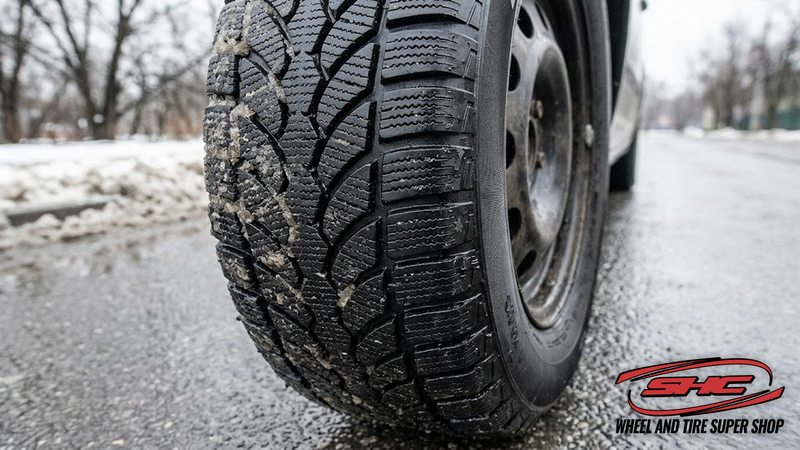
Most Island winter driving is cold rain, not snow
That sentence should shape how you read the rest of this article, because the winter tire market is built around a problem most of us do not have.
Winter tires are developed and marketed on ice and packed snow. In Greater Victoria, the condition you will actually spend your winter in is five degrees and raining, with the occasional genuinely bad week. A tire optimised hard for ice grip is not automatically the tire that serves you best on the Pat Bay in February.
So here are four of the winter tires that get bought here, what each is genuinely tuned for, and where each one spends the trade.
As with everything we write about product choice: we are not picking one. These are different answers to different questions.
The three things being traded
Every winter tire is balancing the same three properties, and you cannot maximise all of them:
- Ice and packed snow grip. Comes from a soft compound with a very high density of sipes - the fine slits across the tread blocks that open into biting edges.
- Wet and dry pavement manners. Comes from tread block stability, which is the opposite of what heavy siping gives you. A block cut with a hundred sipes squirms.
- Wear life. Comes from compound hardness, which is the opposite of what ice grip needs.
Read any winter tire's marketing and you can work out which of the three it prioritised. That is more useful than any score out of ten.
Bridgestone Blizzak
Tuned for: ice. The Blizzak name was built on a compound approach designed to keep a microscopically rough, water-shedding surface in contact with ice, and that has been the line's identity for three decades.
Where it spends: traditionally, wear life. Blizzaks have historically been a tire you replace rather than one you keep. Newer generations have improved on this considerably, but the tire is still tuned from the ice end.
Worth knowing: the Blizzak line is broad, spanning dedicated ice tires, performance winter tires for cars that need to handle, and light truck versions. "Blizzak" on its own is not a specification - the sub-model matters more than the name.
Michelin X-Ice
Tuned for: the balance, and specifically for longevity within it. Michelin's winter line has consistently been positioned as the one you get several seasons out of, with ice and snow performance that is strong without being class-leading.
Where it spends: outright ice grip relative to the tires that chase it hardest. It is not a weak ice tire by any measure - it is a tire that declined to give up everything else for it.
Worth knowing: for a commuter doing high mileage on wet pavement with a handful of snow days, the longevity argument is a real one. A tire that lasts five seasons instead of three changes the annual cost meaningfully.
Nokian Hakkapeliitta
Tuned for: the worst winter you can imagine, because that is the market it was built for. Nokian is Finnish and the Hakkapeliitta has been developed for Nordic conditions since the 1930s. It is available in both studded and non-studded forms, and the studded version is a genuinely different tool from everything else on this page.
Where it spends: dry pavement manners and wear, in the usual proportion for a tire this focused. A studded set also brings noise and, in BC, a legal date range.
Worth knowing about studs: BC allows studded tires between October 1 and April 30, and they must be fitted on all four wheels. Outside those dates they are not permitted. Studs are excellent on glare ice and actively worse than a good non-studded winter tire on wet pavement, which is most of a Victoria winter. If you are buying studs for the Island, be clear with yourself about which days you are buying them for.
Continental VikingContact
Tuned for: cold wet pavement as much as snow. Continental's winter line tends to prioritise braking in the four-to-minus-five range, which is where most of our winter actually sits, and it reads as a European tire designed for European winters - which are much more like ours than Scandinavian ones are.
Where it spends: deep snow capability relative to the Nokian.
Worth knowing: of these four, this is the one whose design brief most closely matches a South Island winter. That is an observation about what the tire is built for, not a recommendation - your winter may involve more mountain driving than ours does.
The question nobody asks and should
How cold does it actually get where you drive?
The technical reason winter tires exist is not tread pattern, it is compound. An all-season or summer compound stiffens as temperature drops, and somewhere around seven degrees it starts losing grip on any surface, wet or dry. A winter compound stays pliable.
That means a winter tire is doing useful work on a cold, wet, snow-free road - which is most of December, January and February here. People who say "we do not get enough snow for winter tires" have the mechanism slightly wrong. The snow is not the only argument.
It also cuts the other way. Winter tires on a warm road are worse than all-seasons: softer, squirmier, and wearing fast. Which is why the date you take them off matters as much as the date you put them on.
A practical point about all four tires
Every tire on this page performs meaningfully better on a second set of wheels than it does being mounted and dismounted twice a year. Repeated mounting is hard on the bead, hard on TPMS sensors, and costs more over a set's life than the wheels do.
We have a piece on the economics of that, and another on TPMS and a second set, which is the part people forget until the light comes on.
One more, since it comes up: all four tires want to match. Four of the same tire, worn to a similar depth. On an all-wheel-drive car this is not a preference, it is a drivetrain requirement - mismatched rolling diameters put a continuous load through the centre differential or coupling. On a Subaru in particular this is how expensive things break.
What we can get
All four brands here are orderable through us, along with the ones we have not named. The website shows a fraction of what we can bring in.
Winter tire model lines are updated on their own schedule and a tire that reviewed well three years ago may have been replaced by a different-generation product. Tell us your size and what your winter looks like, and we will tell you what is actually available.
The short version
- Every winter tire trades ice grip against pavement manners against wear life. You cannot have all three.
- Blizzak is tuned from the ice end. X-Ice is tuned for balance and longevity. Hakkapeliitta is built for a Nordic winter. VikingContact is tuned for cold wet pavement.
- Most of a Victoria winter is cold rain. Weigh that accordingly.
- The real mechanism is compound, not tread. Winter tires help below about seven degrees whether or not there is snow.
- Studs are legal October 1 to April 30, must be on all four wheels, and are worse than a good non-studded winter tire on wet pavement.
- All four tires should match, and on an AWD car that is a mechanical requirement rather than advice.
About SHC Auto
We have been fitting wheels and tires in Victoria since 1991, out of the same shop at 474 Bay Street. Alongside wheels and tires we do suspension and lift work, window tint, paint protection film, vinyl wraps, ceramic coating, paint correction and detailing, caliper painting, chrome delete, and vehicle graphics and signage. We also do the things most shops send out: curb rash repair and wheel refinishing, TPMS sensor supply and fitting, tint removal, and re-torque after install.
The catalogue on our website is a fraction of what we can actually order. We are an authorized dealer for more than three hundred aftermarket brands, and a good number of them never made it onto the site because there is no data feed for them. That includes most of the lift and levelling kit market. If you cannot find something, ask us rather than assuming we cannot get it.
SHC Autographx and Tires
474 Bay Street, Victoria, BC
Monday to Friday, 9:00 to 5:30. Closed weekends.
Free shipping anywhere on Vancouver Island.
Not sure what you need? Bring the vehicle by 474 Bay Street. It is much faster to look at what you have and tell you what will work than to sort it out over email.