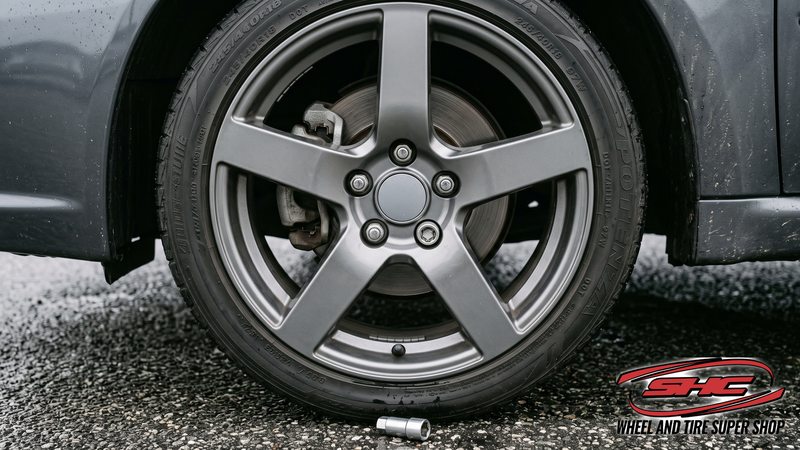
The key is in the glovebox until the day it is not
Locking lug nuts are one of those items that works perfectly for years and then becomes a problem at the worst possible moment, which is on the shoulder of the highway in the rain with a flat tire and no key.
They are still worth having. Wheel theft is real, the deterrent works, and the alternative is leaving a set of expensive wheels held on by nothing but standard nuts. But there are a few things worth knowing about how they fail and what fitting them properly actually requires.
How the key goes missing
Usually it does not. Usually it is in the glovebox, or in the spare tire well, or in the boot organiser, and the reason nobody can find it is that the car changed hands and the previous owner kept it, or it was left on a bench at a shop, or it went out with the junk in the door pocket.
The second failure is more insidious: the key is right there and it no longer works. The pattern on a locking nut is fine-toothed, and every time it is fitted with an impact gun instead of being seated by hand, the teeth on the key round off a fraction. Do that four times a year for six years and one day the key spins in the nut.
That is the single biggest thing to know. A locking lug key should never see an impact gun. Seat it by hand, turn it with a bar or a torque wrench. Any shop that rattles it on and off with a gun is destroying it slowly, and you will not find out until it stops working.
What removal looks like when it has gone wrong
If the key is gone or rounded, there are three routes and they are not equal.
A master key set. Most locking nut manufacturers use a limited range of patterns, and a shop with a manufacturer's master set can often match the pattern directly. This is the cleanest outcome: the nut comes off undamaged and only the key needs replacing. It depends on identifying the brand, which is sometimes stamped on the nut and sometimes not.
An extractor socket. A hardened socket with a reverse-spiral internal thread, driven onto the nut so it bites into the outer surface, then turned anticlockwise. It works most of the time. It destroys the nut, which was going to be replaced anyway, and it puts a lot of torque through the stud, which is why this is a job for someone who has done it before.
Cutting or drilling. The last resort, when the nut is spinning in a recessed pocket or has already been chewed. Slow, and the risk moves to the wheel, because the tool is working inside a lug pocket you do not want to mark.
All three are made much harder by a nut that has been over-torqued, and over-torqued is the normal state of a locking nut that has been fitted with a gun.
The spline drive problem
A lot of aftermarket wheels have deep, narrow lug pockets, which is part of the look. Standard hex nuts and their sockets do not fit down them, so those wheels use spline drive nuts, which are narrower and take a splined key.
Spline drive nuts are fine, and they come with two things worth knowing. They need their own key, which is a consumable in the same way a locking key is, and the key is often the only tool that fits: if it is lost, a standard socket will not get you out of trouble at the roadside. And they are usually made to a smaller outside diameter, which means less material, which means they are less tolerant of being over-torqued.
If your wheels use them, keep the key with the car and make sure whoever services it knows to seat it by hand.
Getting the nut right for the wheel
This is where most of the actual trouble comes from, and it applies to every nut on the car, not just the locking one.
The seat has to match. A wheel's lug seat is one of three shapes: 60-degree conical, spherical or ball, or flat with a captive washer. Most aftermarket wheels are conical. Many factory wheels, Toyota's included, are flat or ball seat. A nut with the wrong seat will thread on, will feel tight, and will not be clamping the wheel properly, because the contact between nut and wheel is a line or a point instead of a face.
This is one of the more dangerous mistakes in the whole subject precisely because it feels fine. It is also extremely common when factory nuts get reused on new aftermarket wheels.
The thread has to match. Obvious, but there are more variants than people expect, and a mismatched thread that is close enough to start will destroy a stud.
The length has to be enough. Deep-pocket wheels often need extended or tuner-length nuts to get proper thread engagement. The working standard is at least as much thread engaged as the stud's diameter: roughly 12 mm on an M12 stud, 14 mm on an M14.
The hex or spline has to fit the pocket. A nut that is the right thread and right seat but too large across the flats will not go down the pocket, and one that is right but leaves no clearance means the socket will mark the wheel every single time.
Practical advice we actually give
Buy the set, not the single. Sets that use one locking nut per wheel plus regular nuts are standard, but the locking nuts and the regular nuts must all be the same seat type and the same thread. Mixing a conical locking nut into a set of ball seat factory nuts is a real thing that happens.
Photograph the key and write down the code. Most locking nut keys carry a code stamped on them. Photograph it and keep that photo somewhere that is not the car. Replacing a key from its code is trivial. Identifying a pattern from a nut still on the vehicle is not.
Keep the key with the car, not in the house. The glovebox is fine. The point is that it should be there when the car is somewhere else.
Tell your shop it is there. A locking nut that is not expected is how keys get rounded, because a gun goes on it before anyone has looked.
If you buy a used car, find the key before you need it. Check the glovebox, the spare well, the boot trim and the centre console. If it is not in any of them, deal with it on a dry afternoon rather than at the side of the road.
Consider whether you need them at all. On factory steel wheels they are largely pointless. On a set of aftermarket alloys that cost real money, they earn their place. That is your call and we are not going to push it either way.
If you are stuck
We remove locking nuts without keys, we identify and supply replacement keys where the pattern can be matched, and we supply nuts in the correct seat, thread and length for whatever wheels you are running, including tuner and spline drive sets for deep-pocket wheels.
If you are dealing with a nut that will not come off, do not keep attacking it. Every attempt makes the next one harder, and the difference between a rounded nut and a chewed one is the difference between a ten-minute job and a careful hour with the wheel off. Bring it in.
About SHC Auto
We have been fitting wheels and tires in Victoria since 1991, out of the same shop at 474 Bay Street. Alongside wheels and tires we do window tint, paint protection film, vinyl wraps, ceramic coating, paint correction and detailing, suspension, caliper painting, chrome delete, and vehicle graphics and signage. We also do several things most shops send out: curb rash repair and wheel refinishing, TPMS sensor supply and fitting, tint removal, and re-torque after install.
The catalogue on our website is a fraction of what we can actually order. We are an authorized dealer for more than three hundred aftermarket brands, and a good number of them never made it onto the site because there is no data feed for them. If you cannot find something, ask us rather than assuming we cannot get it.
SHC Autographx and Tires
474 Bay Street, Victoria, BC
Monday to Friday, 9:00 to 5:30. Closed weekends.
Free shipping anywhere on Vancouver Island.
Lost the key? Bring the car by 474 Bay Street. Bring the wheel nut key if you have any version of it, and a photo of the nut if you do not.