They are not competing products, and the confusion costs people money
Paint protection film and ceramic coating get quoted side by side, at wildly different prices, as though you are meant to pick one. That framing is what leads to the phone call we take a few times a year: someone has spent good money on a ceramic coating, driven the Malahat, and arrived home with a fresh row of chips across the nose of the car.
Nothing went wrong with the coating. It was never able to do that job. Here is what each one actually is.
What paint protection film is
PPF is a physical layer. It is a urethane film, roughly 150 microns thick, bonded to the outside of the panel. When a stone comes off the truck ahead of you on the Pat Bay, it hits the film instead of the paint, and the film absorbs and spreads the impact.
Modern film is thermoplastic polyurethane with a self-healing top coat, which means light swirls and fine scratches in the surface of the film reflow and disappear with heat. Sun on the panel does it. A hot bucket of water does it faster.
PPF is the only one of the two that stops rock chips, because stopping a rock requires thickness and give, and that is a mechanical property.
What ceramic coating is
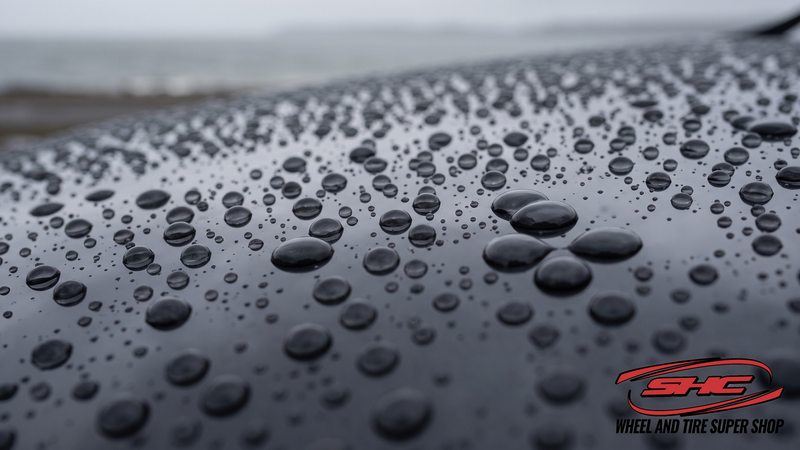
A ceramic coating is a chemical layer measured in microns, not a cushion. It bonds to the clear coat and changes the surface: water beads and runs off instead of sitting, road film and brake dust find less to hold onto, bird mess and tree sap are far less likely to etch before you get to them, and the paint is shielded from the UV that dulls and oxidises it.
What it does not do is stop a stone. A coating a few microns thick has no capacity to absorb an impact. Any coating sold on the promise of chip resistance is being oversold, and it is worth knowing that before rather than after.
The way to choose is to name the damage you are actually worried about
Not the product. The damage.
Chips and road rash on the front of the car. That is impact, and film is the only thing in this article that addresses it. Coating will not help. If you commute over the Malahat, run the Island Highway regularly, or drive anything with a low, upright nose, this is probably your actual problem.
The car looks dull, water sits on it, it is filthy again two days after a wash, bird mess keeps leaving marks. That is a surface chemistry problem and it is exactly what a coating is for. Film would be an expensive and irrelevant answer.
Swirl marks and wash scratches. Both help and neither is a cure. A coating is harder than clear coat and resists light marring. PPF self-heals it outright on the panels it covers. The larger factor is how the car gets washed.
Both, which is most people. They are designed to be layered, and that is the standard build on a car someone intends to keep.
If you are doing both, the order is not optional
Paint correction comes first. Whatever is in the paint when you cover it stays in the paint, permanently, under a film that is meant to last a decade. Any swirls, water spots or oxidation get addressed before anything goes on top. Our five and ten year ceramic packages include a single-pass correction on new cars for exactly this reason.
PPF goes on second, over the panels you want physically protected. On most cars that is the front bumper, hood, fenders and mirrors, which is the front clip package we start at $1,795. Rocker panels, the leading edge of the roof and door cups are common additions.
Ceramic coating goes on last, over the entire vehicle including the film. This is the part people get wrong by reversing it. Coating first and film second wastes the coating, because the film covers it, and film adheres to a coated surface differently than to bare clear coat. Film first, coating over the top, and the coating goes onto both film and paint so the whole car behaves the same way when you wash it.
A coating over PPF also helps the film. It adds a UV-resistant sacrificial layer above it and keeps contamination out of the film's edges, which is where PPF failures usually start.
What each one costs here
PPF starts at $1,795 for the front clip, covering the bumper, hood, fenders and mirrors, in clear or matte.
Ceramic coating is $1,295 for the five year Autotriz 3D Matrix Ultra base coat, or $1,695 for the ten year package with the 3D Matrix Pro and Top Coat V2.0. Both cover all painted panels, trim, wheels and glass, and both include a single-pass correction on a new car.
Two smaller pieces are worth knowing about because they are cheap and people rarely ask. A windshield coating is $75 and sheds water from around 60 km/h, which on the highway in a Victoria November means the wipers do noticeably less work. Coating all four wheels is $300 and makes brake dust rinse off instead of baking on.
The honest summary
Ceramic coating changes how your car behaves. PPF changes what happens when something hits it. A coating on an unprotected front end will keep a chipped car glossy. Film on the front with no coating anywhere leaves the other three quarters of the car doing what untreated paint does in a wet coastal climate.
Which of those matters more depends on the car, how far you drive and on what roads, and how long you plan to keep it. Tell us those three things and we can lay out what each option would and would not fix on your specific vehicle.
About SHC Auto
Correcting paint, fitting film and applying coatings are three separate skills that have to happen in the right order on the same car, and doing all three under one roof is why we can sequence them properly rather than working around whatever the last shop did. We have been on Bay Street since 1991. We also do window tint, vinyl wraps, detailing, wheels and tires, suspension, caliper painting, chrome delete, and vehicle graphics and signage.
The product list on our website is much shorter than the list we can order from. We are an authorized dealer for well over three hundred aftermarket brands, and a lot of that never made it onto the site because there is no data feed for them. Ask rather than assume.
We are independent rather than a chain, and the useful version of that here is that we have no incentive to sell you the more expensive of these two. If your car needs a $300 wheel coating and nothing else, that is what we will tell you.
SHC Autographx and Tires
474 Bay Street, Victoria, BC
Monday to Friday, 9:00 to 5:30. Closed weekends.
Free shipping anywhere on Vancouver Island.
Bring the car by 474 Bay Street. Ten minutes looking at your actual paint under the light tells us more than any amount of describing it over the phone, and we can show you where the chips already are.
Or send us the details. Year, model, how far you drive and on which roads, and how long you intend to keep it. We will come back with what each option would cost and what it would actually change.