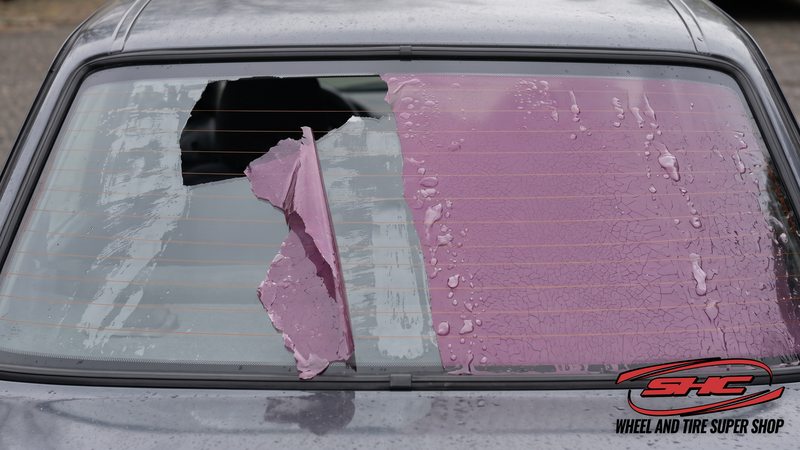
Why old film turns purple
Purple tint is not a colour anybody chose. It is a dyed film at the end of its life.
Cheap and mid-grade film gets its darkness from dye suspended in the adhesive layer. That dye is a blend, and the components do not fade at the same rate. Ultraviolet light breaks down the blue and grey elements first, and what survives longest is the reddish end of the mix. So a film that left the shop charcoal grey drifts through brown and lands on that unmistakable purple, usually somewhere between year five and year ten depending on how much sun the car sits in.
The purple itself is cosmetic. What it tells you is not. A film whose dye has been destroyed by UV is a film that has been letting UV through for some time, which means whatever the tint was supposed to be protecting has been getting a dose of it. On a car with a leather or dark cloth interior, purple side glass and a cracked, faded rear deck usually turn up together.
Bubbling is the other end-of-life symptom, and it is the adhesive rather than the dye. The bond between film and glass fails in patches, air gets in, and the film starts to delaminate. Once that has begun it does not stop and it cannot be pressed back down.
Removal costs more than installation, and here is the honest reason
Customers are regularly surprised that taking film off is not cheaper than putting it on. It comes down to what the installer is actually working with.
An installation starts from a known position. Clean glass, a fresh sheet of film with predictable behaviour, and a process that is the same on every car. It is skilled work but it is repeatable.
A removal starts from an unknown one. Nobody knows what film is on the car, who fitted it, what adhesive they used or how long ago. Twelve-year-old adhesive that has gone hard and brittle behaves completely differently from five-year-old adhesive that is still soft. Film that has begun to delaminate tears into confetti instead of pulling off in a sheet, so what should be one clean pull becomes an hour of lifting fragments.
Then there is the second job hiding inside the first. Getting the film off is only half of it. The adhesive stays behind, and every square inch of it has to come off too, because new film will not bond over old glue and any speck you miss becomes a permanent bubble under the new sheet. The glass has to end up genuinely install-ready, which is a higher standard than merely clean.
None of that can be rushed. It is patient, low-heat, wet work, and the time it takes is the cost.
The rear window is where this gets expensive
If you take one thing from this article, make it this one.
Your rear defroster is a grid of conductive lines printed onto the inside face of the glass. The tint sits directly on top of it. When you strip film off a rear window, whatever you use to attack the film is also attacking the defroster.
The three ways it goes wrong are well known to anyone who does this for a living. A razor blade or scraper catches a line and cuts it, and every failure is invisible until winter, when a stripe of the window stops clearing. A heat gun held too close or too long in one place warps the grid or breaks it. And ammonia, which is the classic driveway method because it dissolves adhesive beautifully, works its way into the grid connections and the edge seal.
A broken defroster grid is not a repair in any meaningful sense. There are conductive paint pens that will bridge one clean break with a visible scar. Multiple breaks, or a torn tab where the wire connects, means a new rear glass, and that is several hundred dollars plus the labour of fitting it. It is a straightforward way to turn a modest job into an expensive one.
Front and rear side windows carry none of this risk, which is why the driveway method sometimes appears to work fine. People strip the sides successfully, get confident, start on the back window and cut the grid.
How we do it
Removal is slow, patient work, and the time it takes is most of the cost. Softening the adhesive evenly across a panel so the film releases in one piece takes longer than attacking it in one spot, and a rear window has to be treated with the defroster grid in mind throughout. Then comes the adhesive pass, which is usually the longer half of the job, because new film will not bond over old glue.
If a defroster line was already broken before the car arrived, that is worth knowing before new film goes over it. Have a look at yours on a cold morning and see whether the whole window clears.
When removal is the right call anyway
Selling the car, and the purple film is doing real damage to how it presents. Buying a used car that came with someone else's tint and you have no idea what it is. Film that has started to bubble, which will only get worse. Front side film that you have decided you no longer want to carry the ticket risk on. Or simply a film that was fitted badly in the first place, with gaps at the top edge and creases at the corners.
Bring it by 474 Bay Street and we will look at what is actually on the glass. Age, film type and how far the adhesive has gone all change the number, and it is not something anybody can quote accurately over the phone.
About SHC Auto
Stripping other people's film off glass without wrecking a defroster grid is one of those jobs where thirty-plus years of doing it is the entire qualification, and we have been doing it in Victoria since 1991 across more than 20,000 vehicles. We also fit new tint, paint protection film, vinyl wraps, ceramic coating, paint correction and detailing, wheels and tires, suspension, caliper painting, chrome delete, and vehicle graphics and signage.
Our website shows a fraction of what we can actually source. We are an authorized dealer for more than three hundred aftermarket brands, and a good deal of it is absent from the site purely because there is no data feed for them. If you cannot find something, ask us rather than assuming.
We are independent, not a chain, and the practical version of that is this: if you bring us a car with film that has another five good years in it, we will tell you to keep it. Removal is a service we sell, not a service we push.
SHC Autographx and Tires
474 Bay Street, Victoria, BC
Monday to Friday, 9:00 to 5:30. Closed weekends.
Free shipping anywhere on Vancouver Island.
Not sure whether yours needs to come off? Bring the car by 474 Bay Street. We will tell you what film is on it, how far gone it is, and whether it is worth doing anything about yet.
Planning a re-tint? Tell us it is a re-tint rather than a fresh install when you ask for a price, because a car with old film on it is a different job from a car with bare glass.