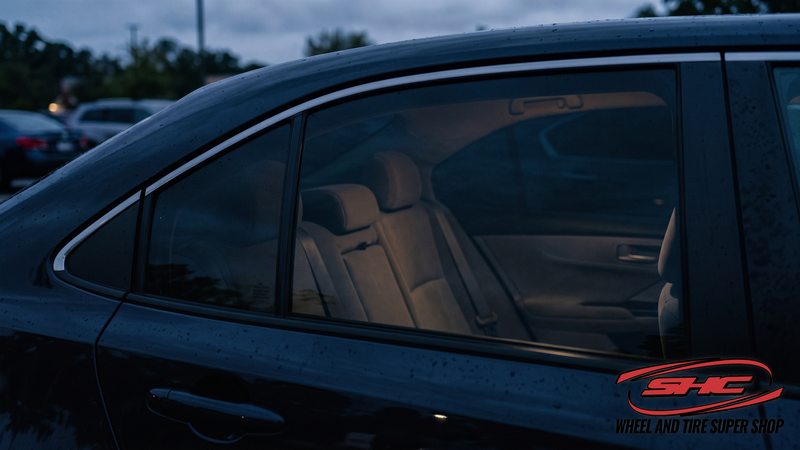
The number is backwards from how most people read it
Window film is described by VLT, visible light transmission. It is the percentage of visible light that gets through the film and the glass together. Five percent means five percent of the light gets in. Seventy percent means seventy percent gets in.
So the number runs opposite to the way people instinctively use it. A customer who asks for "high tint" and says 70 is asking for the lightest film we stock. A customer who says "just a bit, maybe 5" is asking for limousine black. We ask twice, every time, and it is not because we think anyone is slow. The scale is genuinely counterintuitive.
One more thing before the walkthrough. In British Columbia none of this applies to your driver and passenger windows, where aftermarket film is not permitted at any darkness. Everything below concerns the rear side glass and the rear window, where the law leaves the choice entirely to you.
70 and 50 percent: you will not see it, and that is the point
At 70 percent almost nobody can tell there is film on the car. From outside it reads as plain glass. From inside there is no change to how the world looks at night.
Nobody buys this for looks. They buy it because a good ceramic film at 70 percent still rejects infrared heat and effectively all UV while leaving the view alone. If your problem is a hot cabin, a dashboard that is cooking, or sun on your arm, this is the shade that solves it without changing the car.
Fifty percent is the same idea with a faint hint of sunglasses. In Victoria's flat grey light through most of the winter you would struggle to point at it.
35 percent: the shade people mean when they say "not too dark"
This is where film starts to be visible. From outside the glass reads as tinted rather than clear, but you can still see a person in the back seat. From inside on a bright day it takes the edge off without dimming anything.
At night, looking out through a 35 percent window is close to looking through untinted glass. Backing out of an unlit driveway in Fairfield in January, you will not notice it is there.
20 percent: what most factory SUVs already are
Twenty is the most common shade requested. Factory privacy glass on the rear of an SUV, wagon or crew cab is usually somewhere in the 15 to 26 percent range, so a 20 percent film on a sedan lands very close to the look people already recognise from every other vehicle in the parking lot.
From outside, shapes are visible in the back seat but faces are not, in daylight. At night, with an interior light on, that changes and people are always surprised by it. Film does not work at night the way it does in the day, because the light is coming from inside instead of outside.
If you have factory privacy glass and you are adding film over it to go darker, remember the two multiply. A 20 percent film over 20 percent factory glass does not give you 20 percent. It gives you something in the neighbourhood of four, which is darker than most people intend.
15 and 5 percent: a look, and a set of consequences
Five percent is limousine black. In daylight you cannot see into the car. At night, from the driver's seat, you cannot meaningfully see out through that window either.
That last point is the one to have clearly in mind, because it is the practical consequence and it is not a matter of opinion. At 5 percent, rearward and over-the-shoulder visibility in the dark is significantly reduced. Shoulder checks become a mirror-and-camera exercise. Reversing into an unlit spot behind a Bay Street building means relying on the backup camera. No film is dark from the outside and clear from the inside, in either direction, so darkness bought for privacy is darkness you also look out through.
Fifteen percent sits between 20 and 5. It reads as blacked out from outside, with less reduction in night visibility than 5 percent.
Darkness is not heat rejection, and this is the part that costs people money
Darkness and heat rejection get treated as the same purchase, and they are not.
How much heat a film stops has almost nothing to do with how dark it looks. It is a function of what the film is made of. A cheap dyed film at 5 percent can reject less heat than a good ceramic at 50 percent, because the ceramic is engineered to reflect infrared while the dyed film mostly just absorbs visible light and then radiates that heat straight back into the cabin.
So they are two separate questions. Privacy and appearance are answered by the VLT number. Heat and UV are answered by what the film is made of and its stated infrared and ultraviolet rejection figures. A shop should be able to give you both sets of numbers for any film they are quoting.
Look at it on your own glass
Every shade looks different on different glass, and it looks different again depending on whether the car is dark or light coloured and whether the sky is doing anything. A swatch under shop lights tells you very little.
Bring the vehicle to 474 Bay Street and we will hold samples against your own windows outside. Ten minutes of that is worth more than an hour of looking at percentage charts, and it is free.
Full-vehicle tint starts at $249 for compacts, $295 for most cars and trucks, and $349 for vans, SUVs and wagons. Every install carries a lifetime warranty on the film and on the workmanship for as long as you own the vehicle, and we hand-trim every piece on the glass rather than running machine-cut templates.
About SHC Auto
We have been choosing shades with customers on the sidewalk outside 474 Bay Street since 1991, and we have tinted more than 20,000 vehicles in that time, which is roughly enough to have an opinion about what every common shade looks like on every common colour of car. Beyond tint we do paint protection film, vinyl wraps, ceramic coating, paint correction and detailing, wheels and tires, suspension, caliper painting, chrome delete, and vehicle graphics and signage.
Our online catalogue understates us badly. We are an authorized dealer for north of three hundred aftermarket brands, and a lot of those products are missing from the website only because there is no data feed for them. Ask before you assume we cannot get something.
We are an independent shop rather than a chain. Which shade goes on your car is your call and we are not going to push you toward one, but you will get a straight answer about what each one does, including what it does to your view out at night, before any film is cut.
SHC Autographx and Tires
474 Bay Street, Victoria, BC
Monday to Friday, 9:00 to 5:30. Closed weekends.
Free shipping anywhere on Vancouver Island.
Come and look at samples on your own car. No appointment needed for that. Pull up out front and we will bring the shades out to you.
Ready to book? Tell us the year and model and whether you want the rear package or the full vehicle and we will give you a firm price and a time.