The number everyone searches for does not exist
Type "legal tint percentage BC" into your phone and you are looking for a number. Thirty-five percent. Seventy percent. Something you can hand to an installer so the job is safe.
British Columbia does not give you that number for the front of your car. There is no percentage you can meet on your driver and passenger windows, because the rule is not a darkness limit. It is a flat prohibition on applied film. Any film, any shade, including the light stuff that barely looks tinted in the sun.
That single fact is what most people get wrong, and it is why drivers arrive at the shop with a printout of an American tint chart in their hand.
What the regulation actually says
The governing text is the Motor Vehicle Act Regulations, Division 7, section 7.05(8). Stripped of the legal phrasing, it says no person may drive a vehicle with any material affixed to or placed on the windshield or a window that reduces the light transmitted through it, with a short list of exceptions:
- The windshield, but only within 75 mm (about three inches) of the top.
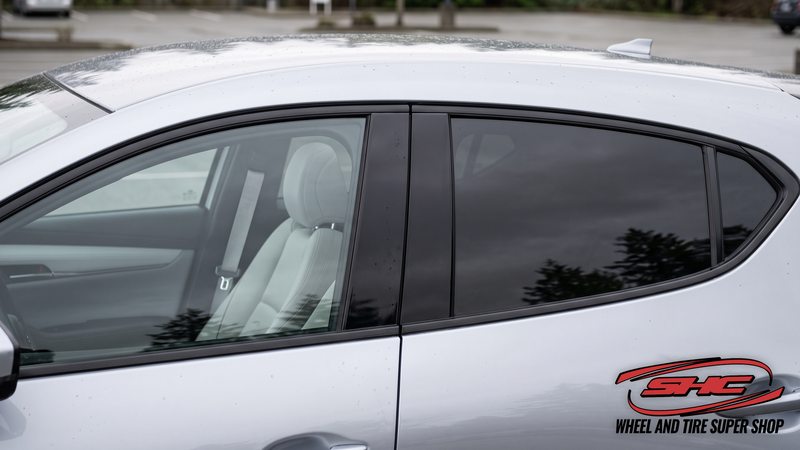
- The rear side windows, at any darkness.
- The rear window, at any darkness, provided the vehicle has both a left and a right exterior mirror.
Read what is missing from that list. The driver and passenger side windows are not on it. Neither is the rest of the windshield. There is no shade of aftermarket film that is legal on either one.
Two more points sit alongside the main rule. Reflective or mirrored film is not permitted, front or back. And film that does not reduce visible light at all, which is what a clear ceramic or clear UV film is, falls outside a rule written about reducing light transmission. That distinction matters more than it sounds, and we will come back to it.
There is no medical exemption in BC
Some jurisdictions run an exemption program: a letter from a physician, a permit in the glovebox, darker film on the front. Alberta has a process. Many American states do.
British Columbia does not. There is no certificate, no sticker, no application, and no doctor's note that makes front side film legal here. If you have a genuine light sensitivity, the honest answer is that the legal tools available to you are clear UV film, the windshield strip, and dark glass everywhere behind the B pillar. We would rather tell you that at the counter than sell you something on a promise that does not exist.
What it costs if you get pulled over
The ticket itself is modest. A violation ticket for an improperly equipped vehicle runs $109.
The expensive outcome is the other one. An officer can issue a Notice and Order, commonly called a Box 2, which requires you to remove the film and present the vehicle for a designated inspection. The inspection itself typically runs $150 to $250. If you do not complete it inside 30 days, the fine climbs to $598, and the vehicle's registration can be affected until it is cleared.
There is a quieter one worth knowing if there is a new driver in the house. An ICBC road test examiner can decline to start a test in a vehicle with illegal front tint. That is a lost appointment fee and weeks of waiting for the next slot, over film on two windows.
Enforcement around Greater Victoria is inconsistent. Plenty of cars run front tint for years without a second look. Inconsistent enforcement is not the same thing as legal, and it is worth being clear-eyed about which one you are relying on.
Where you can go as dark as you like
The good news is that the law leaves most of the glass alone.
Everything behind the driver and front passenger is unrestricted. On an SUV, a wagon or a crew cab that is the large majority of the glass in the vehicle, and it is the glass that matters for rear seat passengers, for cargo you would rather not advertise, and for the heat that builds up in a car parked on Blanshard in July. A 20 percent or 5 percent rear package is entirely legal and it changes how the vehicle lives.
The windshield strip is underrated here. Seventy-five millimetres is not much, but the low sun coming up the Pat Bay in the morning and dropping in your eyes on the way home in January is exactly what it is for.
And then the piece most people do not know about: heat rejection and darkness are not the same thing. Ceramic films reject infrared heat and effectively all UV, and how much heat a film stops is a property of what the film is made of rather than how dark it looks. That is why a light ceramic can outperform a dark dyed film on a hot day. If your reason for wanting front tint is that the car cooks, or that your left arm burns on the drive to Sooke, ask us what clear and near-clear ceramic options we can get for the front glass. Heat is a solvable problem without putting anything ticketable on the car.
Our position on the front two
We install front tint. It is on the price list at $199 for the driver and passenger windows, and we are not going to pretend otherwise.
Here is how that conversation goes at the counter. We tell you before we cut a single piece of film that front side tint is not legal in British Columbia, that you may be ticketed for it, and that you may be ordered to remove it. Then the decision is yours. It is the same way we handle any other part that may not comply with legislation. You are an adult, it is your vehicle, and you are entitled to make that call with the facts in front of you rather than after the fact.
What we will not do is tell you it is fine, or quote you a percentage that makes it sound compliant.
What we would actually recommend
For most drivers on the South Island, the setup that makes sense is dark film on the rear side glass and rear window, a 75 mm strip across the top of the windshield, and a clear or near-clear ceramic on the two front windows if heat and UV are the real problem rather than privacy. That package is legal end to end, it is comfortable in August, and there is nothing on the car for an officer to write up.
Full-vehicle tint at SHC starts at $249 for compacts, $295 for most cars and trucks, and $349 for vans, SUVs and wagons. Every install carries a lifetime warranty on both the film and the workmanship for as long as you own the vehicle. We hand-trim every piece on the glass rather than running machine-cut templates, which is slower and fits better, particularly on older vehicles whose glass no longer matches whatever the template library thinks it should be.
About SHC Auto
We have been cutting and fitting window film in Victoria since 1991, and we have tinted more than 20,000 vehicles in that time, which means we have seen essentially every glass shape that has come through this province and have opinions about most of them. Alongside tint we do paint protection film, vinyl wraps, ceramic coating, paint correction and detailing, wheels and tires, suspension, caliper painting, chrome delete, and vehicle graphics and signage.
The catalogue on our website is a fraction of what we can actually order. We are an authorized dealer for more than three hundred aftermarket brands, and a good number of them simply never made it onto the site because there is no data feed for them. If you cannot find something, ask us rather than assuming we cannot get it.
We are an independent shop, not a chain, and that shows up in conversations like this one. We told you the front two are illegal in an article whose main job could easily have been selling you the front two. When the thing you are asking for is the wrong answer, you will hear that from us first.
SHC Autographx and Tires
474 Bay Street, Victoria, BC
Monday to Friday, 9:00 to 5:30. Closed weekends.
Free shipping anywhere on Vancouver Island.
Book a tint appointment. Tell us the year and model and whether you want the rear package or the full vehicle, and we will give you a firm number and a time.
Not sure what you want yet? Bring the car by 474 Bay Street. We will show you sample film held against your own glass in daylight, which is the only way anyone has ever accurately pictured what 20 percent looks like.