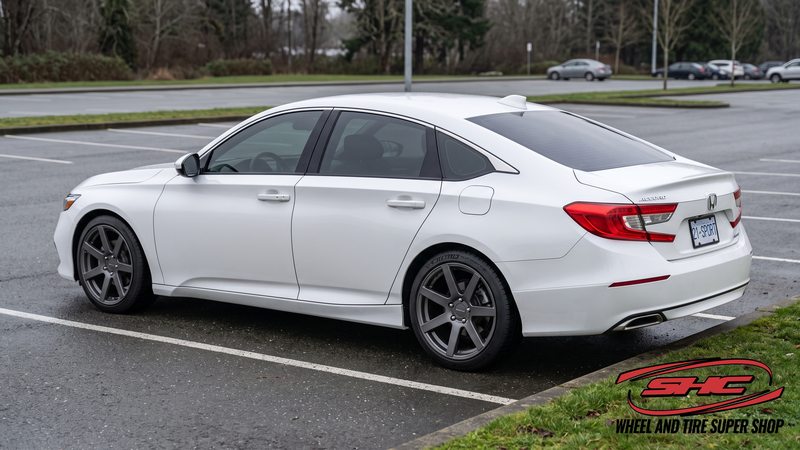
The most common mistake in window tint is assuming darker means cooler. It does not. Darkness and heat rejection are two different specifications, controlled by two different properties of the film, and you can buy a very dark film that does almost nothing about heat or a nearly clear one that does a great deal.
That distinction matters more in British Columbia than almost anywhere else, because our rules govern which glass can carry film and how dark it can be. When shade is constrained, the only variable left is what the film is actually made of.
The two numbers that are not the same thing
VLT - visible light transmission - is darkness. A 35 percent film lets 35 percent of visible light through. That is all it tells you.
Heat arrives mostly as infrared, which is invisible, plus some visible light and a little ultraviolet. A film's ability to reject infrared has nothing necessarily to do with how dark it looks. This is why a good clear or light ceramic film can outperform a cheap limo-dark dyed film on heat by a wide margin.
The number worth asking for is TSER - total solar energy rejected. That accounts for the whole solar spectrum. "Blocks 98 percent of infrared" is a marketing number, because infrared is only a portion of the energy hitting the glass. If a shop quotes IR rejection and cannot tell you TSER, that tells you something.
The four film technologies
Dyed - the cheap one
A dye layer absorbs solar energy. The film gets hot and re-radiates some of that heat, part of it inward, which is why dyed film is the weakest performer on heat despite often being the darkest looking.
It also fades. Dye breaks down under UV and dyed film characteristically shifts purple, then the adhesive fails and it bubbles and delaminates. Every purple, bubbling rear window you have seen on an older car is dyed film reaching the end.
Cheap up front, and it is the only film type on this list that reliably needs replacing.
Metallized - durable, but it interferes
A thin metal layer reflects heat rather than absorbing it, which works well and does not fade. Two problems. It has a distinctly reflective, mirror-ish look from outside that not everyone wants, and the metal layer interferes with radio signals - AM/FM reception, GPS, keyless entry, tire pressure sensors and phone signal inside the car can all be affected.
On a modern vehicle with sensors and connectivity built into the glass area, metallized film is a harder sell than it used to be.
Carbon - the sensible middle
Carbon particles reflect infrared without any metal in the film. No signal interference, no fading, no colour shift, and a flat matte-black appearance rather than a reflective one. Heat rejection is meaningfully better than dyed and short of ceramic.
For most cars, carbon is the point where the film stops being a compromise.
Ceramic - the top of the range
Nano-ceramic particles that are non-metallic and non-conductive. The best infrared rejection available at any given darkness - often 15 to 25 percentage points more IR rejection than a carbon film of the same VLT - along with up to 99 percent UV blocking, no signal interference, no fading, and the best optical clarity of the four.
It is the most expensive, and it is the only one where a light film can deliver serious heat performance.
What actually matters on this island
We do not get Phoenix heat, so the pure cooling argument is weaker here than the marketing suggests. Three things do matter:
- UV, which comes through cloud. Ultraviolet does not care that it is overcast, and it is what fades and cracks dashboards, door cards and leather. A car parked outside year round in Victoria takes a lot of it. This is the strongest practical argument for film here, and it is the one nobody leads with.
- Low-angle sun. Our winter sun sits low for months. That is glare straight through side glass at eye level in the morning and afternoon, and it is genuinely fatiguing on a commute.
- The two or three weeks in July when a dark interior in a parked car becomes unbearable. Ceramic earns its money in those weeks and on road trips off-island.
What tint costs here
- Compact cars, from $249
- Cars and trucks, from $295
- Vans, SUVs and wagons, from $349
- Headlight and taillight films, from $199 for two lights - clear, smoke, blue, yellow or red
Every tint job we do carries a lifetime film warranty and a lifetime install warranty for as long as you own the vehicle, covering both manufacturing defects and installation.
Why the install matters as much as the film
Most shops cut tint by machine from template files. It is fast and it leaves a small gap at the edge of every window, because the template is drawn slightly inside the real glass line. You see it as a thin uncut strip along the seal, and it is where film starts lifting years later.
We hand-trim every piece to the glass instead. It is slower and it is the reason our edges run right to the rubber. We have tinted over 20,000 vehicles here since 1991, which is a lot of practice at exactly that.
Which to buy
- Dyed: only if the car is a short-term keeper and the budget is genuinely fixed. Understand you are buying something that will need redoing.
- Metallized: hard to recommend on a modern vehicle. The signal interference is a real inconvenience.
- Carbon: the right default for most cars. Stable, no interference, good heat performance, sensible price.
- Ceramic: worth it if the car has a dark interior, if you park outside all year, if you drive off-island in summer, or if you simply want the best available and intend to keep the car.
Before we cut anything
British Columbia's rules govern which windows can carry aftermarket film and what is allowed on the windshield, and they are stricter than most people assume. We will walk you through exactly what applies to your vehicle before any film is cut, so nothing comes as a surprise later.
About SHC Auto
Window tint has been part of this business since the day we opened in 1991, and it is still one of the things we do most. SHC Autographx and Tires is at 474 Bay Street in Victoria - tint and films, ceramic coating and detailing, paint protection film, vinyl wrap and graphics, plus tires, aftermarket wheels, suspension and parts.
We are an independent shop, not a chain, which means we will tell you when carbon is enough for how you actually use the car rather than upselling ceramic by reflex.
SHC Autographx and Tires
474 Bay Street, Victoria, BC
Monday to Friday, 9:00 am to 5:30 pm
Come and look at the samples
Film shade is almost impossible to judge from a photograph, and the difference between carbon and ceramic is something you feel with your hand behind a sample under a heat lamp rather than something you read about. Bring the car by, look at the shades against your own glass, and we will tell you what each option would cost on your vehicle.