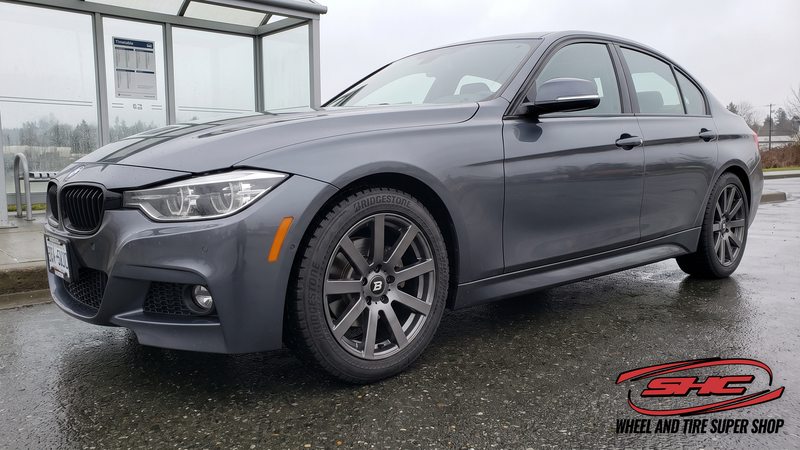
If your car came from BMW, Mini or a handful of other manufacturers, there is a good chance it left the factory on run-flats and without a spare wheel. When the first set wears out you have a decision to make, and most people make it by default - they replace what was on there, or they replace what is cheapest, without anyone explaining the trade.
Here is the trade.
What a run-flat actually does
A run-flat has a reinforced sidewall stiff enough to hold the weight of the car with no air in it. Lose all your pressure and the tire does not fold onto the rim - it keeps its shape well enough that you can keep driving, typically for around 80 km at speeds up to about 80 km/h. Your car's manual gives the exact figures, and they are worth knowing before you need them.
That is the whole benefit, and it is a real one. No changing a wheel on the shoulder of the Malahat in the rain. No waiting for a tow. You drive to a shop and deal with it there.
What it costs you
Ride quality. The stiff sidewall that holds the car up with no air is also stiff when the tire is properly inflated. Run-flats transmit more of the road surface into the car - sharper impacts over expansion joints, more noise on chip-seal. On Victoria's older streets it is noticeable.
Money. Run-flats commonly cost around double a comparable conventional tire, and the selection in any given size is much narrower.
Repairability. This is the one that catches people. Run-flats are generally not repairable - once one has been driven on while deflated, the sidewall has done work it was not designed to do twice, and manufacturers will not stand behind a plug. So a nail in a run-flat is usually a new tire, not a $40 repair. If the tire is not the newest on the car, you may end up replacing an axle pair to keep tread depths matched.
Wheels. A conventional tire's sidewall flexes and absorbs a pothole. A run-flat's sidewall is much less willing to, so more of that energy goes straight into the rim. Cracked and bent wheels are meaningfully more common on run-flat cars, and a wheel costs more than a tire.
The case for converting
For most people on this island, conventional tires are the better daily answer. You get a softer ride, a far wider choice of tires, roughly half the price per tire, and punctures become repairable again. Nothing about the wheel changes - run-flats and conventional tires mount on the same rim - and your TPMS keeps working exactly as before, since the sensors live in the wheel and do not care what kind of tire is around them.
The one thing you must not skip: if you convert, something has to go in the trunk. At minimum a decent plug kit and a 12-volt compressor, which will get you off the shoulder for most punctures. Better, if the car has the well for it, a proper spare with a jack and a wrench - and if your car has locking lug nuts, the key needs to live with them rather than in a drawer at home.
Driving a converted car with an empty trunk and no plan is how a $40 nail becomes a tow bill.
The case for keeping them
Keep run-flats if you drive alone at night regularly, if you spend time on rural Island roads with no shoulder and patchy cell coverage, or if you are simply not going to carry a kit and use it. The convenience is genuine, and it is worth paying for if the alternative is being stuck.
Also worth knowing: Bridgestone DriveGuard exists specifically for cars that did not come with run-flats, and rides noticeably softer than the first-generation run-flats most people remember. If you want the capability without the full harshness penalty, that is where to look.
What to buy either way
Staying with run-flats: look for the manufacturer's marking - Michelin uses ZP, Bridgestone RFT, Continental SSR, Pirelli Run Flat. Michelin Pilot Sport ZP for a performance car, Bridgestone Turanza or DriveGuard for a comfort-first daily, Continental SSR where the size is available.
Converting: the whole conventional market opens up. Michelin CrossClimate2 if you want one tire that handles a Victoria winter without a swap, Michelin Pilot Sport 4S for a performance car that gets a separate winter set, Continental ExtremeContact DWS06 Plus for a good all-season compromise, Bridgestone Potenza Sport for summer grip.
Winter is where conversion usually wins outright. Run-flat winter tires exist but the selection is thin and the prices are unpleasant. If you are building a dedicated winter set on a second set of wheels, going conventional for that set is an easy call even if you keep run-flats for summer.
One rule
Do not mix. Run-flats and conventional tires have very different behaviour when pressure drops, and a car with one of each on an axle - or one type front and the other rear - handles unpredictably in exactly the situation where you need it not to. Whichever way you go, go all four.
And if you are buying wheels at the same time, the run-flat decision is worth making first, because it changes which tires are available in the size you are considering. Our wheel builder will tell you what fits; we can tell you what is actually stocked in that size in both constructions.
What we can actually get you
Our website does not show everything we can order. SHC is an authorised dealer for over three hundred aftermarket brands - Michelin, BFGoodrich and Yokohama on the tire side, plus most of the wheel, suspension and brake names you would want - far more than the website lists. Those lines are missing from the site only because there is no data feed our catalogue can read, not because we cannot get them. If you cannot find a size or a construction online, call us.
About SHC Auto
The run-flat conversation happens at our counter most weeks, usually with a BMW or Mini owner who has just been quoted for one tire and wants to know why. SHC Autographx and Tires is a full wheel and tire shop at 474 Bay Street in Victoria, and we have been here since 1991 - tires, aftermarket wheels, suspension and parts, vinyl wrap, paint protection film and ceramic coating. We mount and balance in house, we inspect the bead seat on every wheel that comes off, and we will tell you plainly when converting is the right move and when it is not.
We are an independent shop, not a chain. Shipping is free anywhere on Vancouver Island.
SHC Autographx and Tires
474 Bay Street, Victoria, BC
Monday to Friday, 9:00 am to 5:30 pm
Not sure what you are on?
Look at the sidewall for a marking like ZP, RFT, SSR, RSC or Run Flat, or check whether your trunk has a spare well with nothing in it - that is usually the giveaway. Bring the car by and we will confirm it, tell you what the same tire costs in both constructions, and let you decide from there.