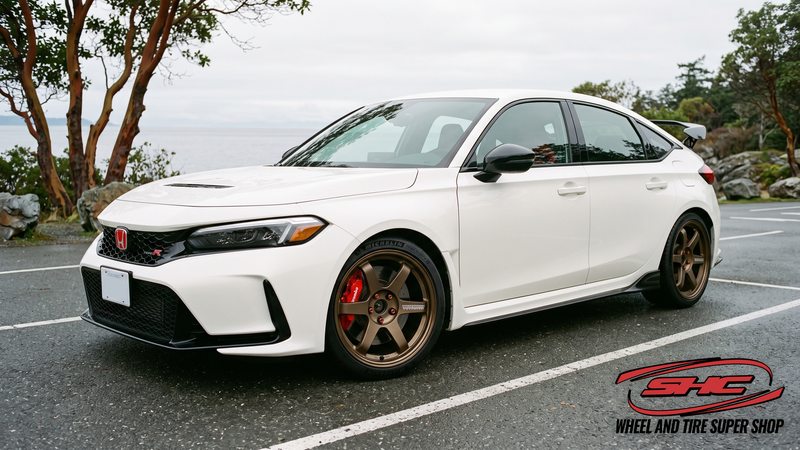
There is one fact that causes more wasted money on Civics than anything else, so it goes first: the Si and the Type R do not share wheels. The Si is 5x114.3 like every other Civic. The FK8 and FL5 Type R are 5x120, with bigger studs and a different torque spec. A set of wheels that fits one will not bolt to the other, and no amount of wanting it to will change that.
Everything else is a matter of degrees. Here is what actually bolts up, what sits flush, and where things start touching.
Factory specifications
| Model | Years | Bolt pattern | Hub bore | Stock wheel | Stock tire | Lug |
|---|---|---|---|---|---|---|
| Civic Si (FC) | 2017-2020 | 5x114.3 | 64.1 mm | 18x8 +50 | 235/40R18 | M12x1.5 |
| Civic Si (FE) | 2022 on | 5x114.3 | 64.1 mm | 18x8 +50 | 235/40R18 | M12x1.5 |
| Type R (FK8) | 2017-2021 | 5x120 | 64.1 mm | 20x8.5 +60 | 245/30R20 | M14x1.5 |
| Type R (FL5) | 2023 on | 5x120 | 64.1 mm | 19x9.5 +60 | 265/30R19 | M14x1.5 |
Two notes on that table. Factory offsets vary slightly by market and model year, so confirm against the stamping on your own wheel before you order - it is cast into the back of the spoke face. And the hub bore is 64.1 mm on all of them, while most aftermarket wheels are bored larger (73.1 mm is the common one) so they can serve several vehicles. That gap gets filled with hub-centric rings, not with the lug nuts.
Civic Si: the fitment window
The Si is an easy car to wheel. The factory 18x8 +50 sits noticeably inside the fender, so there is real room to work with.
- No-drama daily: 18x8.5 +45 on 235/40R18. Bolts on, no camber, no fender work, keeps the stock diameter almost exactly.
- Flush: 18x9.5 +45 on 235/40R18 or 245/40R18. This is where most Si builds land. At stock ride height it clears; lowered, expect to want a little negative camber.
- Aggressive: 18x9.5 +35. Now the tire is at the fender lip. Plan on around -1.5 to -2.0 degrees of camber and a rolled front lip, and understand that you will be replacing tires from the inside edge more often.
- Winter: 17x7.5 +45 on 225/45R17. Dropping an inch gets you more sidewall, cheaper winter tires and a wheel you do not mind salting.
A flow-formed 18x9.5 is the sweet spot for an Si - light enough to feel, strong enough for the potholes on Bay Street.
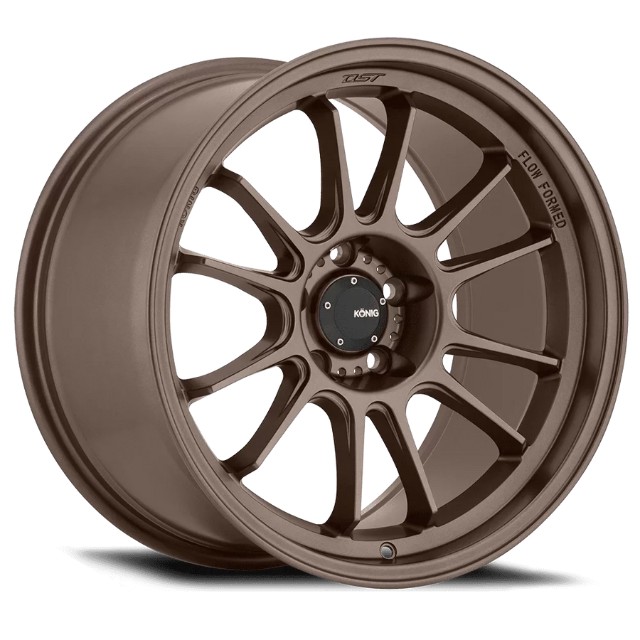
Konig Hypergram, flow-formed, available in 18x9.5 in both 5x114.3 and 5x120 - one of the few wheels on this page that suits the Si and the Type R.
Type R FK8: get it off the 20s
The FK8 left the factory on 20x8.5 +60 wrapped in a 245/30R20. It is a beautiful wheel and a terrible size for a road with a pothole in it - there is almost no sidewall to absorb anything, and replacement tires in that size are expensive.
The near-universal fix is an 18-inch setup:
- The standard swap: 18x9.5 +45 on 265/35R18. Clears the Brembos, sits flush at stock height, no fender work. This is the setup most FK8 owners end up on.
- More aggressive: 18x9.5 +38 on 255/35R18 or 265/35R18, with negative camber. 18x10 +40 on 275/35R18 is possible and needs attention at the rear arch.
- Do not go below 18 inches. The front Brembo four-piston caliper on a 350 mm rotor will not clear a 17. Spoke shape matters too - a wheel with a deep dish behind the spokes can foul the caliper even at 18.
One thing to know about diameter: 265/35R18 comes out about 25.3 inches tall against the stock 25.8, so you lose roughly two percent. That is inside the range where the speedometer and ABS stay happy, but it is worth knowing rather than discovering.
Type R FL5: already sensible, still improvable
Honda learned. The FL5 comes on 19x9.5 +60 with a 265/30R19, which is a far better starting point than the FK8's 20s.
- Direct bolt-on: 18x9.5 +45 on 265/35R18. Same rule as the FK8, and the diameter works out almost identically to stock - 25.30 inches against 25.26. Nothing to correct.
- Flush: 18x9.5 +40 wants about -1.5 degrees of camber; +35 wants around -2.0.
- Track: 18x10 +38 to +45 on a 275/35R18. Plan on -3.0 degrees or more of camber if you actually run it.
- Brakes: four-piston Brembo monoblocs on 350 x 32 mm two-piece rotors. Eighteen inches is the floor here too, and the wheel needs genuine caliper clearance rather than just diameter.
A forged 18x9.5 is the honest answer for an FL5 that sees track days - the unsprung weight saving is the one modification you feel everywhere.
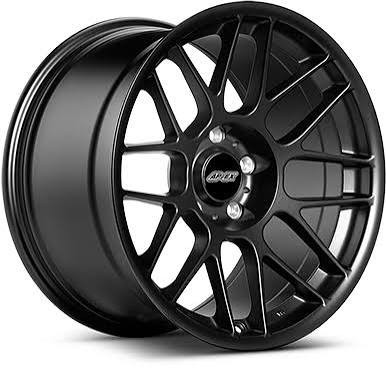
APEX ARC-8, a motorsport-focused flow-formed wheel available in 18x9.5 in both patterns, with the caliper clearance these cars need. APEX also builds a forged Sprint line for cars that see real track time.
The 5x120 trap
Type R owners discover quickly that 5x120 is also BMW's bolt pattern, and that the used market is full of cheap BMW wheels. Physically, many of them will bolt on. Practically, check three things first:
- Hub bore. BMW wheels are usually bored to 72.5 or 72.6 mm. The Type R hub is 64.1. You need a 72.5-to-64.1 hub-centric ring or the wheel will never centre properly, and you will chase a vibration forever.
- Offset. BMW offsets in the +30s and +40s on a wheel that was designed for a rear-drive car often put the tire somewhere the Honda's front strut does not want it.
- Seat type. BMWs use bolts; the Type R uses M14x1.5 ball-seat nuts. Match the seat to the wheel, not to whatever came in the box.
None of that makes it a bad idea. It makes it a thing to measure before you buy rather than after.
Tires: keep the diameter honest
Whatever you land on, keep the overall diameter within about two percent of stock. Outside that, the speedometer reads wrong, the ABS and stability systems are working from bad wheel-speed data, and on the Type R the adaptive dampers are calibrated around a known rolling radius. For reference, at stock the Si is 25.40 inches, the FK8 is 25.79 and the FL5 is 25.26.
For a winter set on either Type R, 18x8.5 +45 on 235/40R18 keeps you legal on diameter, clears the Brembos, and puts a narrower tire under the car - which is what you actually want in snow.
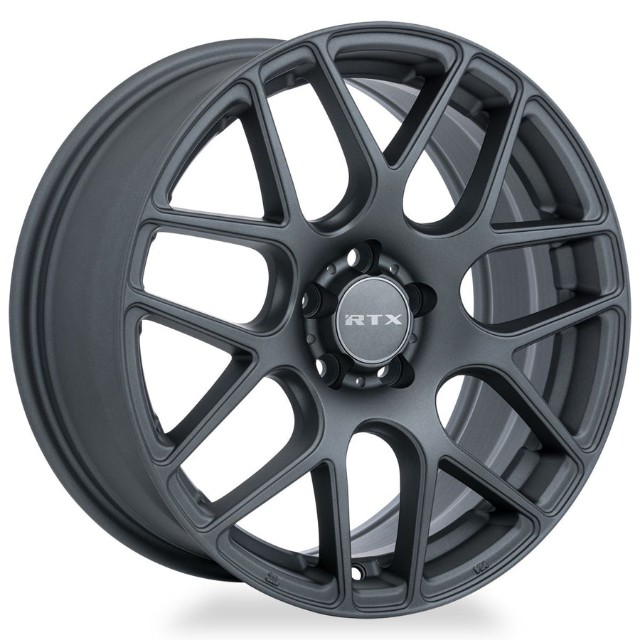
RTX Envy in matte gunmetal - the sort of cast, powder-coated wheel worth dedicating to a winter set rather than salting something expensive.
What we can actually get you
The wheel selection on our website is not the whole catalogue. SHC is an authorised dealer for over three hundred aftermarket brands - APEX, Konig, HRE, Vossen, Rays and Volk Racing, CCW and many more - far more than the website lists. Those brands are missing from the site only because there is no data feed our catalogue can read, not because we cannot get them. If you have a specific wheel and size in mind and cannot find it online, call us. There is a very good chance we can order it.
About SHC Auto
Fitment questions like these are most of what happens at our counter, and we have been answering them in Victoria since 1991. SHC Autographx and Tires is a full wheel and tire shop at 474 Bay Street - wheels, tires, suspension and aftermarket parts, vinyl wrap, paint protection film and ceramic coating. We mount and balance in house, we check bead seats on every wheel that comes off, and we will tell you when the setup you are asking about is going to rub before you buy it rather than after.
We are an independent shop, not a chain. Shipping is free anywhere on Vancouver Island, and we ship off-Island too - fitment does not stop at the water.
SHC Autographx and Tires
474 Bay Street, Victoria, BC
Monday to Friday, 9:00 am to 5:30 pm
See it on your car first
Before you commit to an offset, put it on the car on screen. Our wheel visualizer renders real wheels on your year, make and model, so you can see the difference between a +45 and a +35 rather than imagining it. The wheel builder will then confirm what actually fits.
Building something aggressive, or already have a set and want to know whether it will clear? Bring the car and the wheel. Measuring takes ten minutes and it is cheaper than a set of scrubbed tires.