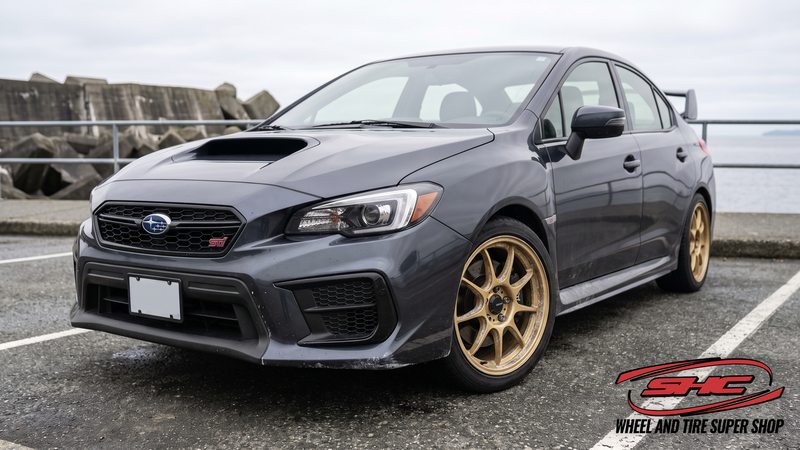
Wheels do not fail here the way they fail in Ontario. There is no six-week window of caked road salt and then a dry summer to recover in. On southern Vancouver Island the wheel gets a light, constant dose of salt from marine air, it almost never dries out completely, and the highways that do get brined - the Malahat, the Pat Bay, the connector over to Sooke - add a second source on top of the first. Mild and wet is a worse combination for aluminium than cold and dry.
That is why two identical cars, one in Kamloops and one in James Bay, can look completely different at the wheels after five years. The finish is doing all the work, and not all finishes are built the same.
What is actually happening to the wheel
Aluminium does not rust. It oxidises, and the oxide is a chalky white powder rather than orange flakes. Left exposed to open air, that oxide layer is self-limiting - it forms and then protects what is underneath. The problem is what happens when it forms under a coating.
Almost every modern wheel is aluminium with something on top: powder, paint, lacquer, or a deposited metal layer. Salt and moisture only need one breach to get beneath that layer - a kerb scuff, a stone chip on a spoke edge, a nick left at the bead seat during a tire change, or a past repair that was never properly sealed. Once water and chloride get under the coating, the aluminium oxidises there, the white oxide takes up more room than the metal it replaced, and it lifts the coating from below. It then creeps sideways in thin lines that the trade calls whiteworm or filiform corrosion.
Two things make it faster on the coast. Salt aerosol is present year round rather than seasonally, and the daily temperature swing between a cold morning and a warm afternoon pumps moisture in and out of the breach. It is a slow process that never gets a break.
Finishes, ranked by how they age near the ocean
1. Powder coat - the most durable
Powder is applied dry, electrostatically, and then baked. It flows into edges and recesses and cures into a film several times thicker than liquid paint, with no thin spots at spoke edges. It also has some flex to it, so a stone strike is more likely to dent the film than crack it. If you keep one set of wheels on the car all year on this island, powder coat is the finish to want.
The trade-off is repair. A chip in powder cannot be spot-touched invisibly - the honest fix is to strip and recoat the wheel. That is a real cost, but it is a cost you pay once every several years rather than a wheel you write off.
2. Full painted face with clear coat - very good
A gloss black, satin bronze or gunmetal wheel that is painted across the entire face, with clear over the top, is continuous - there is no bare metal anywhere on the show surface. The film is thinner than powder so it is a little easier to chip, but there is nothing exposed for salt to find. This is the finish most enthusiast wheels are sold in, and it holds up well here.
3. PVD chrome - good, with one rule
PVD stands for physical vapour deposition. A base coat goes on the wheel, a metal layer is vaporised and condensed onto it in a vacuum chamber, and a clear topcoat seals it. Critically, there are no copper and nickel plating layers underneath the way there are in traditional chrome. That matters because the classic chrome failure is salt finding a pinhole, attacking the nickel layer beneath, and lifting the chrome off in blisters. PVD does not have that layer to lose, and manufacturers generally warranty it for longer than plated chrome.
The rule with PVD: the topcoat is what is protecting it, and acid-based wheel cleaners strip topcoats. If you run PVD, pH-neutral cleaner only, no exceptions.
4. Polished or bare aluminium - high maintenance, but honest
An uncoated polished lip has nothing to fail. It oxidises openly and continuously, hazes over, and needs polishing to bring back. That is a chore, but it never blisters or peels, and a bad month does not destroy it. If you enjoy the maintenance, it is a legitimate choice. If you do not, it will look tired by February.
5. Machined or diamond-cut face - the one to avoid year round here
A diamond-cut wheel is machined on a lathe so the spoke faces are bare bright aluminium, then sealed with a thin lacquer. It looks superb and it is the most vulnerable finish sold. There is nothing between the lacquer and raw metal, the machined edge at the outer lip is a natural entry point, and once whiteworm starts under the lacquer it spreads across the face.
It is also the hardest to fix. Polishing does not touch corrosion that is under the lacquer - the wheel has to be re-cut on a lathe and re-lacquered, and every cut removes material. A wheel can only be re-cut a limited number of times before it is done. If you love a wheel that comes in a diamond-cut version, ask whether the same model is offered in a fully painted or powder-coated version and buy that one instead.
6. Traditional triple-plated chrome - the worst case on this coast
Copper, then nickel, then chrome, electroplated in sequence. Beautiful when new and genuinely bad in a salt environment, because the failure mode is pitting that undercuts the nickel and lifts the chrome in sheets. Once it starts peeling there is no repair short of stripping the wheel back and starting over. If someone is selling you plated chrome for year-round Island duty, that is a conversation worth having first.
The part nobody looks at: the bead seat
Everything above is about the face of the wheel, which is the part you see. The corrosion that actually costs people money is on the inside of the barrel, where the tire bead seals against the wheel.
That surface is hidden, it stays damp, and it collects salt and brake dust. When it corrodes, the bead no longer seats cleanly and the tire develops a slow leak - typically a wheel that is four or five psi down every couple of weeks with no puncture to find. People chase that leak with plugs and valve stems for months.
The only time anyone can see it is when the tire is off the rim. That is why we clean and inspect the bead seat on every wheel that comes through for a changeover, and why a seasonal swap is a free corrosion inspection twice a year whether you asked for one or not.
What actually helps
- Rinse the wheels more often than you wash the car. Plain fresh water, weekly through the winter. You are not trying to make them shiny, you are removing chloride before it finds a breach.
- pH-neutral wheel cleaner only. Acid-based cleaners are sold for a reason - they work fast on baked brake dust - and they will take the topcoat off PVD and eat into diamond-cut lacquer. Not worth it.
- Seal the face. A spray sealant needs reapplying every six to eight weeks. A proper ceramic coating lasts far longer, sheds brake dust, and makes the weekly rinse actually work - our wheel and caliper coating starts at $300 for four wheels and runs one to two years, and it is also included in both of our complete ceramic coating packages. The best time to do it is when the wheels are off the car anyway.
- Fix chips when they are chips. A stone strike on a spoke edge is a five minute touch-up in October and a stripped-and-recoated wheel in April.
- Run a second set in winter. The cheapest wheel protection there is: your good set spends five months indoors, dry, doing nothing.
Choosing a set that will survive here
The practical filter is simple - for a year-round Island wheel, buy the fully painted or powder-coated version of the wheel you like, not the machined-face version of it. Most manufacturers offer the same model both ways.
- RTX - most of the range comes in powder-coated satin and gloss finishes, and it is priced sensibly enough that a dedicated winter set is realistic.
- Konig - painted and matte finishes across the line, another sensible choice for a set that lives outside.
- APEX - forged and flow-formed wheels offered in durable painted and powder finishes, and a common answer for BMW and Honda platforms.
- Vossen - the Hybrid Forged range in gloss and satin painted finishes rather than machined faces.
- HRE - a full custom finish menu, so you can specify a satin or textured powder finish on a wheel that would normally be shown brushed.
One thing worth knowing: the wheel selection on our website is not the whole picture. SHC is an authorised dealer for over three hundred aftermarket brands - HRE, APEX, Konig, Vossen, Rays, CCW and many more - far more than the website lists. Those brands are missing from the site only because there is no data feed our catalogue can read, not because we cannot get them. If you have a wheel in mind and cannot find it online, call us. There is a very good chance we can order it, in whatever finish you want.
About SHC Auto
Wheel finishes are a daily conversation at our counter because we have been mounting wheels in this climate since 1991. SHC Autographx and Tires is a full wheel and tire shop at 474 Bay Street in Victoria, and wheels are only part of what we do - we also handle tires, suspension and aftermarket parts, vinyl wrap, paint protection film and ceramic coating. That last one matters here: our wheel and caliper coating is built for exactly this problem, and doing it with the wheels off the car during a seasonal swap is the easiest version of that job.
We are an independent shop, not a chain, which means we will tell you when the finish you are looking at is the wrong choice for where you park. Shipping is free anywhere on Vancouver Island.
SHC Autographx and Tires
474 Bay Street, Victoria, BC
Monday to Friday, 9:00 am to 5:30 pm
See it before you buy it
If you are weighing finishes, look at them on your own car first. Our wheel visualizer renders real wheels on your year, make and model, so you can compare a satin powder finish against a machined face on the exact vehicle instead of guessing from a product photo. When you have a shortlist, the wheel builder will confirm what fits.
Already have corrosion starting, or chasing a slow leak you cannot find? Bring it in. The bead seat is the first place we will look.