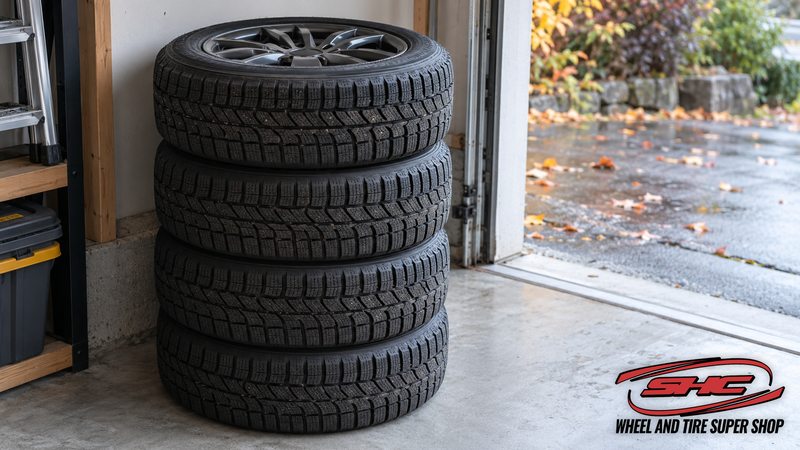
Every October the same conversation happens at the counter. Someone books a winter tire changeover, and somewhere in the middle of it we mention that mounting winter tires onto their own set of wheels usually costs less over a few years than swapping tires on and off the same rims twice a year. It sounds like an upsell. It is arithmetic, and it is worth walking through before the season starts.
What a seasonal swap actually involves
If you run one set of wheels, every changeover means breaking both beads on four tires, dismounting them, mounting the other set, balancing all four, and resetting the TPMS sensors. Twice a year, every year.
If your winters live on their own wheels, a changeover is unbolting four wheels and bolting on four others. Torque them, re-torque after 100 kilometres, done. It is a fraction of the labour and a fraction of the time you are sitting in the waiting room.
The wheels cost money up front. What they save is a mounting-and-balancing bill twice a year for as long as you own the car, and the difference typically evens out somewhere in the second or third season — sooner if you would otherwise be buying steel wheels anyway.
The part that actually costs people money
Repeated mounting is hard on things that are not the tire.
Bead seats. Every dismount scrapes the sealing surface of the wheel. On the coast that matters more than it does inland — salt air and winter road spray start corrosion in the bead area, and a corroded bead seat is the most common cause of a slow leak that nobody can find. We check bead corrosion at every swap for exactly this reason, and it is far more common on wheels that get mounted and dismounted twice a year.
TPMS sensors. The rubber grommets and valve stems on tire pressure sensors are consumables. Every dismount is a chance to disturb one, and a sensor is not a cheap part. On a dedicated winter set you can run a second set of sensors and simply leave them alone.
The tires themselves. Mounting stresses the bead. Twice a year for four or five years adds up to a lot of handling for a tire you are trying to get full life out of.
Steel or alloy for the winter set
Steel is cheaper, takes curb damage without drama, and looks like what it is. It is heavier, and if it rusts it does so cosmetically.
Alloy is lighter, which is real on a winter wheel because you are adding unsprung weight to a car in the worst grip conditions of the year. Modern painted and powder-coated alloys handle winter far better than their reputation suggests. Around here the deciding factor is often brake clearance — a lot of newer vehicles simply will not clear their calipers with a basic steel wheel, and an alloy is the only option that fits.
Either way, sizing down one inch from your summer setup is usually the smart move. A narrower tire on a smaller wheel cuts through slush rather than floating on it, gives you more sidewall to absorb a pothole, and generally costs less. If you run 19s in summer, an 18-inch winter package is often better in every way that matters in February.
Tires worth putting on them
For Greater Victoria, where the season is mostly cold rain with occasional snow, we most often fit the Michelin X-Ice Snow, the Bridgestone Blizzak WS90, the Continental VikingContact 7, the Nokian Hakkapeliitta R5 and the Toyo Observe GSi-6. All carry the three-peak mountain snowflake, which is what several BC highway routes require from October 1 through the end of March — the Malahat included. An M+S marking on its own does not satisfy that requirement.
If your car rarely leaves the city and never sees the Malahat in winter, a genuine all-weather tire like the Michelin CrossClimate2 carries the snowflake too and can stay on year-round. That is a legitimate choice here in a way it would not be in Ontario.
Getting it done before the rush
Book early. Every shop on the Island is flat out for the two weeks either side of the first cold snap, and the sizes people want are the sizes that sell out first. Ordering a winter package in September means it is sitting here waiting rather than backordered in October.
We also store seasonal sets, so the four wheels you are not using do not have to live in your garage.
Our wheel visualizer will show you winter wheel options on your exact vehicle. Worth knowing it only lists brands with a live data feed — a fraction of what we can order. We are an authorized dealer for a catalogue far wider than the website shows, hundreds of brands that never appear on our website, so ask us about anything you cannot find there.
About SHC Auto
Winter packages and seasonal changeovers are the busiest thing we do between September and December. SHC Auto is a wheel, tire and appearance shop at 474 Bay Street in Victoria, serving Greater Victoria and Vancouver Island. The website lists over forty aftermarket wheel brands, and through our distributors we can order a great many more than that, including brands that never appear online. We order every major tire brand and handle tint, paint protection film, wraps, ceramic coating, detailing and vehicle graphics under one roof. Tread-depth and sidewall checks are always free, no appointment needed, and we offer paid seasonal storage for your off-season set.
SHC Autographx and Tires — 474 Bay Street, Victoria BC — 250-360-2209 — Monday to Friday, 9:00 to 5:30
Build a Winter Package in our visualizer, or Call the Shop to get booked before the rush.