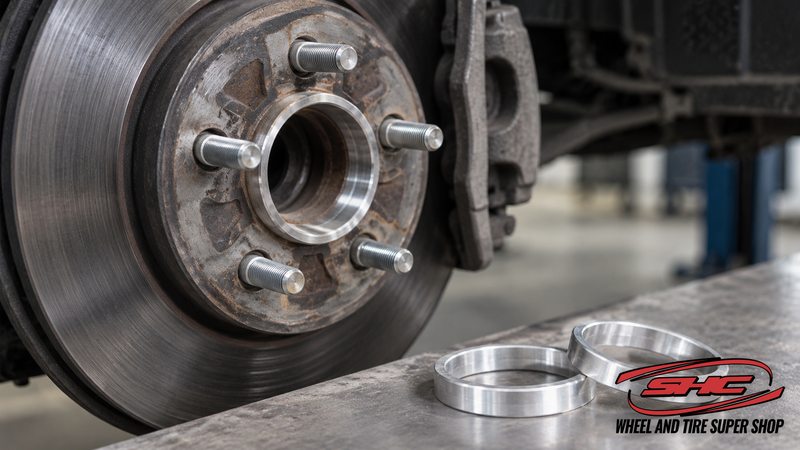
The question arrives most often as a photo on a phone: a set of wheels somebody found for sale, and the message “will these fit my car?” The bolt pattern usually matches, or they would not be asking. What decides it is a set of measurements nobody prints in the ad, and getting one of them wrong is how a perfectly good set of wheels ends up shaking at 100 km/h on the Pat Bay.
Bolt pattern: how many, and how far apart
Bolt pattern is written as two numbers — 5x114.3, 5x120, 6x139.7. The first is how many studs. The second is the diameter in millimetres of the imaginary circle those studs sit on, called the pitch circle diameter.
For an even number of studs, measuring is easy: centre of one stud straight across to the centre of the one opposite. For five studs there is no stud directly opposite, so the shortcut is to measure from the back edge of one hole to the centre of the hole two positions away.
The important part is that near enough is not good enough. 5x114.3 and 5x115 are seven-tenths of a millimetre apart, and there are wheels sold to bridge that gap. They will bolt on. They also load every stud off-centre, and studs that are loaded off-centre eventually snap. We do not fit them, and neither should anyone else.
Centre bore: the hole nobody checks
The centre bore is the large hole in the middle of the wheel that fits over the raised collar on your hub. Its job is structural, and it is the part of wheel fitment that gets misunderstood most.
On a factory wheel, that collar carries the weight of the car. The wheel sits on it, centred perfectly, and the lug nuts only clamp it in place. That is called hub-centric, and it is how every vehicle leaves the factory.
Aftermarket wheels are usually made with an oversized centre bore — big enough to clear the hubs of many different vehicles, because that is how one wheel design gets sold across dozens of applications. Bolt one straight on and the wheel is no longer sitting on the hub collar. It is hanging on the lug nuts, hoping the tapered seats pull it true.
Hub-centric rings: the twelve-dollar fix
A hub-centric ring is a plain machined collar that fills the gap between your hub and an oversized centre bore. It restores exactly what the factory intended: the wheel sits on the hub, the studs do nothing but clamp.
This is the single most common cause of a vibration on brand-new aftermarket wheels. The classic pattern: perfectly smooth around town, then a steady shake through the steering wheel between 90 and 110 km/h that no amount of rebalancing fixes. If a shop has balanced the same set three times and the vibration keeps coming back, check the centre bore before you replace anything else.
Rings come in aluminium and plastic. We use aluminium — it handles brake heat and does not deform, and the cost difference is a few dollars a set. Every aftermarket wheel we fit gets checked for this, and if rings are needed they go on. It is not an upsell, it is part of the job.
The rest of the checklist
Lug seat type has to match: conical, ball, or flat washer. A conical nut on a wheel machined for ball seats touches the wheel at a ring rather than across the seat, and it will loosen. Your factory nuts often will not suit aftermarket wheels — assume you need the correct hardware and be pleasantly surprised if you do not.
Thread pitch has to match too, and a stud can be M12x1.5 or M12x1.25 with no outward difference. Forcing the wrong nut a couple of turns destroys the stud.
Then there is offset, which decides where the wheel sits in the arch — that one has its own article on this blog. And a re-torque after 100 kilometres, which is free here and worth the five minutes.
Bring us the specs before you buy
Send us the bolt pattern, centre bore, offset and lug seat type from the listing and we will tell you whether the set fits your vehicle, and what hardware you will need. That costs nothing and takes a minute.
The wheel visualizer on our site is the fastest way to see options on your exact vehicle. One caveat worth knowing: it only shows brands that supply a live data feed, which is a fraction of what we can actually order. We are an authorized dealer for a catalogue far wider than the website shows — HRE, APEX, Vossen, Volk Racing, Konig, CCW, Vorsteiner and hundreds more that will never appear on our website. If you have found a set somewhere and cannot find it on our site, ask anyway.
About SHC Auto
Checking fitment before anyone spends money is the part of this job we care most about getting right. SHC Auto is a wheel, tire and appearance shop at 474 Bay Street in Victoria, serving Greater Victoria and Vancouver Island. The website lists over forty aftermarket wheel brands, and through our distributors we can order a great many more than that, including brands that never appear online. We order every major tire brand and handle tint, paint protection film, wraps, ceramic coating, detailing and vehicle graphics under one roof. Tread-depth and sidewall checks are always free, no appointment needed.
SHC Autographx and Tires — 474 Bay Street, Victoria BC — 250-360-2209 — Monday to Friday, 9:00 to 5:30
See Wheels on Your Vehicle in our visualizer, or Call the Shop with the specs and we will confirm the fit.