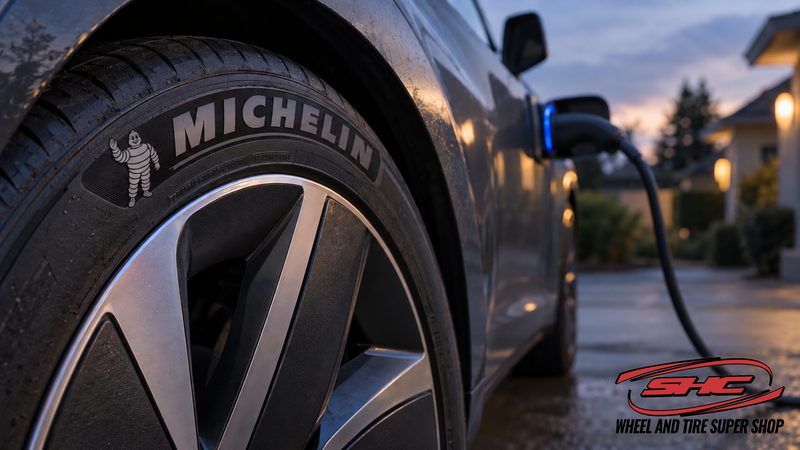
Every month we see another few EVs in the bays — Model 3s and Model Ys off Blanshard, Ioniq 5s from the Westshore, faithful old Leafs from Fernwood — and almost every owner asks the same question at the counter: why am I buying tires again already? It is not your imagination. EVs genuinely wear tires faster, usually 20 to 30 percent faster, and the reasons are baked into the vehicle. The fix is choosing rubber built for the job.
Why EVs eat tires
Weight. The battery adds hundreds of kilograms over a comparable gas car, and every kilogram presses tread into pavement full-time.
Instant torque. Full twist from zero RPM is the thing that makes EVs fun, and every brisk pull away from a light scrubs tread a gas car would deliver gradually.
Regenerative braking. Strong regen loads the driven tires in deceleration too — the tread works in both directions, all the time.
None of this is a defect. It just means tire choice, pressures and rotation matter more on an EV than on anything else in the driveway.
What to actually run (names, not vibes)
Tire makers now build EV-specific lines with stiffer casings for the weight, low rolling resistance for range, and foam liners that cut cabin noise — which you notice in an EV because there is no engine to mask it.
All-season/touring: the Michelin e-Primacy and Pilot Sport EV are the benchmarks; Hankook’s iON evo line was designed for EVs from scratch and prices well; Pirelli’s Elect-marked lines cover many Teslas from the factory. All are orderable in the common Model 3/Y, Ioniq 5 and Leaf sizes.
Winter: the Michelin X-Ice Snow and Nokian Hakkapeliitta R5 EV carry the loads properly and keep the quiet-cabin character. For a one-set-year-round Victoria approach, the Michelin CrossClimate2 in the correct load rating remains the honest answer, with a small range cost versus a dedicated low-rolling-resistance tire.
Whatever you choose, match the load index on the placard — EV sizes often carry HL or XL ratings, and a standard-load lookalike is not a substitute.
The habits that stretch a set
Rotate every 8,000 km without fail. On a single-motor EV the driven axle can wear dramatically faster; rotation is the difference between replacing two tires early and four together on schedule.
Check pressures monthly. EV weight punishes underinflation with heat, shoulder wear and lost range — the trifecta.
Mind the alignment. The extra mass makes EVs harder on suspension bushings; a small toe error erases millimetres of tread in a Victoria winter. Any new pull or inner-edge wear is worth a look immediately.
Quiet matters more than you think
Half of EV tire satisfaction is noise. A worn or aggressive tread that would be tolerable in a gas car drones in an EV. If your current set has gotten loud, that alone is a reason to look at the foam-lined EV lines above — the difference on the Pat Bay at 90 km/h is not subtle.
Victoria is actually a great EV tire market
No brutal heat, rare deep snow, short commutes — the South Island is easy on EV batteries and, with the right rubber, reasonable on tires too. The wrong part is the wet: all that torque on greasy pavement makes wet grip ratings worth paying for here.
Due for a set?
Call the Shop — we stock and order EV-rated sizes for Tesla, Hyundai, Kia, Nissan and the rest.
Start Your Quote Online — see EV-rated options in your size.