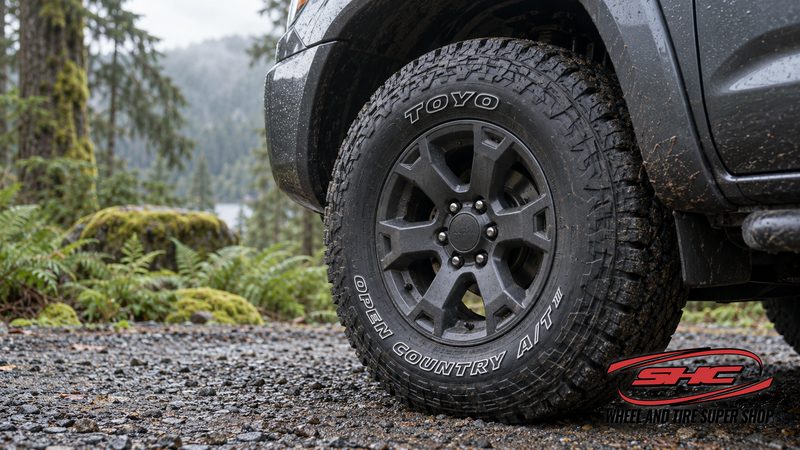
If the Island had an official vehicle, the vote would come down to two Toyotas. Tacomas and 4Runners are everywhere from Langford driveways to the West Coast Road pullouts, and a huge share of them wear some version of the same build: a modest lift and a set of all-terrains. Done right, that combination suits this place perfectly. Done from a forum thread, it rubs, wanders, drinks fuel and fails inspections. Here is the version that works.
The build that suits the Island
Be honest about the duty cycle: most Island Toyotas do pavement all week, gravel and forest service roads on weekends, maybe a beach run or a snowline trailhead in season. That profile calls for a 2 to 3 inch suspension lift and a quality all-terrain one or two sizes up — not the tallest kit on the internet. You gain clearance, approach angle and the stance, while the truck stays civil on the Malahat and inside BC’s legal envelope.
On that legal point: BC requires a designated-facility inspection once suspension height changes more than 10 centimetres from factory spec. The classic 2–3 inch lift sits comfortably under the line; the big builds do not. Decide which side of that line you want to live on before buying parts.
Tires: where the build succeeds or fails
A mid-size Toyota on a mild lift has excellent all-terrain options — the Toyo Open Country AT and Falken Wildpeak AT lines are the two we fit most, both available with the 3PMSF snowflake that keeps the truck legal on every designated BC winter route all season. That matters on a truck that exists to reach trailheads in January.
Sizing is where restraint pays. Going one size up usually fits cleanly; going two sizes up on a lifted truck can contact the fender liner at full lock, and the fixes — trimming, offset changes, wheel spacers — each carry their own trade-offs. We test-fit before we promise. And remember the scale creep: taller, heavier tires cost acceleration, braking and fuel; on the highway-heavy Island duty cycle, the difference between an aggressive AT and a mild one is real money every month.
The recalibration nobody skips twice
Taller tires make the speedometer and odometer read slow and change what the ABS and stability control think the truck is doing. Proper builds get the speedometer recalibrated and the systems verified — along with headlight aim after a lift and an alignment once the new geometry settles. This is the difference between a build and a collection of parts.
What we would spec, sight unseen
For a daily-driven Tacoma or 4Runner that plays outside on weekends: quality 2–3 inch suspension kit, snowflake-rated all-terrain one size up, alignment, recalibration, torque re-check after the first 100 km. It fits, it passes, it lasts, and it does the beach run and the November Malahat with equal composure.
Building one?
Call the Shop — lifts, wheels and tires specced together so everything fits the first time.
Start Your Quote Online — price all-terrains and lift packages for your Toyota.