How long film lasts, and what actually ends its life
Paint protection film does not wear out evenly and then stop. It fails in specific, recognisable ways, and knowing them tells you both what you are buying and when what you have is finished.
A quality thermoplastic polyurethane film generally gives five to ten years, with the best products claiming longer under good conditions. Cheap PVC-based film is a different material with a different life, commonly two to five years before it goes yellow and brittle. The gap between those two is the single largest variable in this purchase, and it is not visible on the day of installation, when both look like clear film on a clean car.
Yellowing
This is the failure people know about, largely because of what older film used to do.
Film carries ultraviolet inhibitors. Their job is to absorb UV before it reaches the polymer, and they are consumed doing it. When they are exhausted, UV starts working on the film itself and it discolours, then goes brittle, then cracks.
Modern TPU film resists this far better than the PVC generation did, and on a good film it should not be a visible problem within the warranty period. When you do see it, it is not a cosmetic complaint to live with. Yellowing means the UV package is spent, and a film past that point is getting harder and more difficult to remove cleanly with every additional month.
Yellowing also shows up unevenly, which is how you spot it early. The hood and the upper bumper see far more sun than the lower valance. If the horizontal surfaces have gone warm and the vertical ones have not, that is UV rather than staining.
Lifting edges, which is what usually kills film first
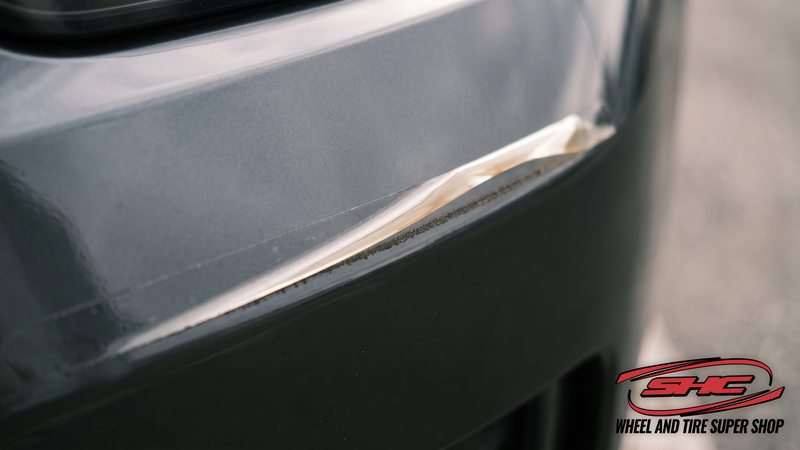
Most film does not die of old age. It dies at an edge.
Every piece of film has a perimeter, and the perimeter is where the adhesive bond is most exposed. Once an edge lifts even slightly, water and dirt get under it, and contamination breaks the bond far faster than sun ever would. What starts as a millimetre of lift at a bumper corner becomes a visible flap.
Three things drive it. Thermal cycling, which is unavoidable. Mechanical stress, mostly from automatic car washes, where the brushes catch a leading edge and pull. And installation, which is the part that is within anyone's control: whether the edges were wrapped around the panel where the geometry allows, or cut flat on the surface where they sit exposed.
Wrapped edges are slower and require more of the panel to be dismantled. They are also why one shop's film is still tight at year seven and another's started lifting at year three. It is worth asking how the edges will be finished before you book, on any car, with any installer.
Staining and what it means in a wet climate
Film sits outside and collects what the environment throws at it. On the South Island that is tree sap in the spring, bird mess year round, and the road film that comes off wet coastal pavement for eight months of the year.
Sap and bird droppings are acidic and will etch a film surface if left. On film this is generally recoverable where on paint it may not be, which is one of the quieter arguments for having it. But it is only recoverable if dealt with reasonably promptly, and film is not an excuse to stop washing the car.
What warranties cover, and the questions to ask
PPF warranties come from the film manufacturer, not from the shop, and they vary enormously. This is where to spend your attention when comparing quotes, because two installers can quote similar prices on films with very different backing.
A manufacturer warranty on premium film typically runs ten years and typically covers yellowing, staining, cracking, blistering and delamination. A five year warranty generally indicates a lower tier of film. That length is a reasonable proxy for how confident the manufacturer is in their own UV package.
We can source film from the established manufacturers, SunTek among them, and each one publishes its own warranty terms for each product in its range. Those terms are the manufacturer's rather than ours, they differ product by product, and they change. So rather than quote a figure here that may be out of date by the time you read it, ask us which film we are proposing for your car and we will give you that manufacturer's current warranty in writing before you commit to anything.
The questions worth asking any shop, including us, before you commit:
- Which film, by manufacturer and product name, is going on my car?
- What is the manufacturer warranty term, and what does it list as covered?
- Is the warranty transferable if I sell the vehicle?
- What is excluded? Impact damage, improper maintenance and pressure washing too close to an edge are common exclusions.
- How will the edges be finished, wrapped or cut on the surface?
- What is covered by the installation as opposed to the film, and by whom?
Any shop that cannot name the film going on your car and produce its warranty document is asking you to spend four figures on an unidentified product. That is a reasonable thing to decline.
What extends its life
Hand wash rather than automatic. This is the single biggest factor and it is mostly about the edges. Brush washes are what find a lifting corner and finish the job.
Deal with sap and bird mess promptly rather than at the next wash.
Rinse the salt off in winter, particularly around the lower edges and the wheel arches where it collects and sits.
Keep the pressure washer away from perimeters. Straight into an edge at close range will lift film that would otherwise have lasted years.
And a ceramic coating over the top helps genuinely: it adds a UV-resistant sacrificial layer and keeps contamination out of the edges, which is where the trouble starts.
About SHC Auto
Fitting film so the edges are still tight in year seven is the whole craft of this trade, and it is where thirty-plus years of doing it on Bay Street shows up rather than in anything visible on collection day. Since 1991 we have also been doing window tint, ceramic coating, vinyl wraps, paint correction and detailing, wheels and tires, suspension, caliper painting, chrome delete, and vehicle graphics and signage.
Our website lists far less than we can order. We are an authorized dealer for north of three hundred aftermarket brands, and much of it is missing from the site purely because there is no data feed for them. Ask us for what you actually want.
We are independent, not a chain, and this article gives you a list of questions designed to make any installer accountable, us included. Ask us all six. We would rather answer them than have you find out in year three.
SHC Autographx and Tires
474 Bay Street, Victoria, BC
Monday to Friday, 9:00 to 5:30. Closed weekends.
Free shipping anywhere on Vancouver Island.
Comparing quotes? Bring them to 474 Bay Street. We will go through what each one actually includes, including the film and its warranty, whoever you end up using.
Got film already and unsure how it is doing? Bring the car by and we will look at the edges and tell you honestly whether it has years left or is on the way out.