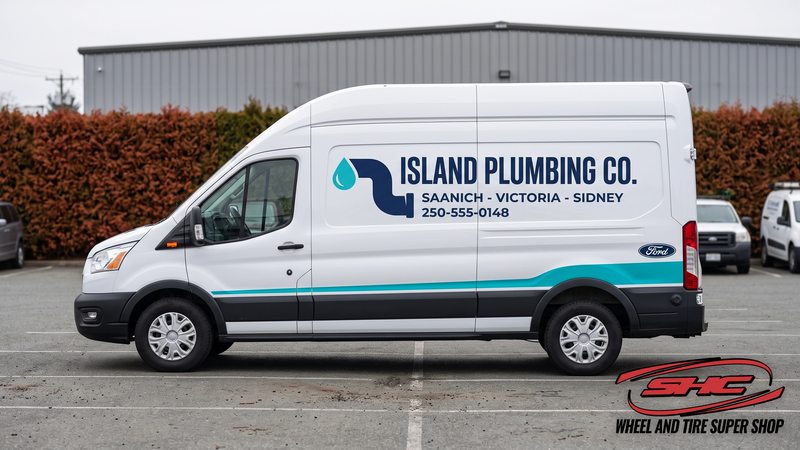
A work van in Victoria covers somewhere between 20,000 and 40,000 km a year, most of it in daylight, most of it in traffic or parked in front of a customer's house. That vehicle is already in front of thousands of people every week. The only question is whether any of them find out who you are.
This is the cheapest advertising a trade business has access to, and it is the one most often left undone because it feels like a project. It is not. Here is how to think about it.
Three levels, three budgets
Cut vinyl lettering
Your name, your trade, and a phone number, cut from solid coloured vinyl and applied directly to the panel. No background, no print - just the letters and any simple shapes in your logo.
It is the least expensive option by a wide margin, it looks clean and professional on a white or light-coloured vehicle, and it is trivially easy to update when your number or website changes. It also removes cleanly, which matters more than people expect.
For most trades with one to three vehicles, this is the right answer, and it is where we would start almost every conversation.
Partial wrap
Printed panels covering the doors, the lower body or the rear doors, usually with a colour block, a photograph or a pattern behind the lettering. Far more visual impact than lettering alone, and it lets you use a brand colour that is not the colour the van was built in.
The sweet spot for a business that wants to look larger and more established than the vehicle count suggests.
Full wrap
The whole vehicle as a printed surface. Highest cost, highest impact, and the only version where the vehicle stops being a van with graphics and becomes a piece of brand infrastructure. Our full colour-change wraps start at $3,499 and printed fleet work is quoted per design and vehicle.
Worth it when you have a distinctive brand, when the vehicle is highly visible, or when you have enough vehicles that a consistent fleet look starts doing real work.
What actually gets read
Most vehicle graphics fail for the same reason: they are designed to be looked at from three metres in a parking lot, and they are actually read from twenty metres at 60 km/h, for about two seconds, by someone who is also driving.
What survives that:
- What you do. "Plumbing." "Roofing." "Electrical." If a stranger cannot tell what you do in one word, nothing else matters.
- Your name, large enough to read at distance.
- One way to reach you, and make it the phone number. A phone number can be dialled from memory at a red light. A website is harder to retain, and an email address is essentially unreadable at speed - if it is on the van, it is decoration.
Three elements. High contrast. Nothing else. Every additional item on the panel reduces how much of it gets retained - a licence number, four service bullet points and three social icons are how a van ends up saying nothing at all.
Where to put it
- Rear doors and tailgate - the highest-value surface you own, because it is read by the driver sitting behind you at a light with nothing else to do. If you only letter one surface, letter this one.
- Front doors - the conventional place for the name, and what a customer sees when you pull into their driveway.
- Side panels - read in parking lots and while parked at a job. Good for a larger secondary message.
- Above the rub line. The lower 30 cm of any Island work vehicle takes constant gravel and road spray. Graphics down there get abraded and look tired within a year - keep the important content up.
Spec'ing for a vehicle that lives on gravel
Work vehicles here get treated harder than commuter cars, and the film specification should reflect that.
- Cast film, not calendered. Cast vinyl is thinner, more conformable and dimensionally stable; it goes into rivets, corrugations and curves and stays there. Calendered film is cheaper and shrinks back over time, which is what makes old lettering pull away from the corners.
- Laminate over anything printed. An overlaminate adds UV protection and abrasion resistance. On a truck that sees logging roads it is not optional.
- Keep detail above the splash zone, as above.
- Plan for pressure washing. Work vehicles get washed harder than cars. Edges and seams are where a lance lifts film - a good install tucks and seals them, and you keep the wand away from them.
The lease-end question
If your vehicles are leased, removability is a line item you should be asking about before the graphics go on, not after.
Cut vinyl lettering and quality cast film come off with heat, cleanly, leaving the paint as it was. Cheap calendered film left on a hot roof for five years bakes onto the paint and becomes a removal bill, sometimes with adhesive residue that needs correction afterwards.
Spec'ing properly at the start is what turns lease-end from a cost into a non-event - and it is why the cheapest quote is not always the cheapest job.
Consistency is the point of a fleet
Three vans with three slightly different layouts read as three small operators. Three vans with the same layout, the same colours and the same type read as a company. The design work happens once; applying it across the fleet is production.
It also makes adding a vehicle easy. When truck four arrives, the artwork already exists.
And the building
Vehicles are usually the first thing a trade business brands and the building is the second. We have been producing and installing business signage across Vancouver Island for more than three decades, so if the yard sign, the shop front and the trucks all want to match, that can be one conversation rather than three vendors.
About SHC Auto
SHC Autographx and Tires has been doing vehicle graphics in Victoria since 1991 - individual decals, business lettering, fleet graphics, full printed wraps and business signage, all designed and installed in house at 474 Bay Street. The same shop handles paint protection film, window tint, ceramic coating, and the tire, wheel and suspension side of the business, which means a work truck can get its graphics and its tires sorted in the same visit.
We are an independent shop, not a franchise, and we work with a lot of Island trades. If lettering is enough for what you are trying to do, we will tell you that rather than quoting you a full wrap.
SHC Autographx and Tires
474 Bay Street, Victoria, BC
Monday to Friday, 9:00 am to 5:30 pm
Getting an estimate
Tell us what you drive, how many of them, and what you want people to know. If you already have a logo we can work from your files; if you do not, we can design something that will actually read at distance rather than only look good on a screen.
Bring one vehicle in and we will mock it up. Once you like it on that one, the rest of the fleet is straightforward.