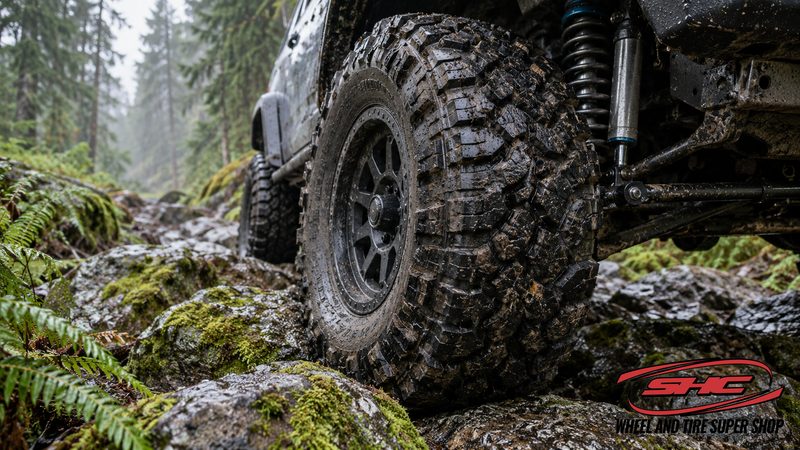
Sooner or later every Wrangler owner around Victoria has the same thought: this thing needs 35s. Fair enough — 35-inch tires transform how a Wrangler looks and what it can crawl over on the forest service roads past Sooke or up-island. But the tires are the easy part. What separates a well-built 35-inch Jeep from a frustrating one is everything that has to change around them. Here is the honest checklist we walk customers through at 474 Bay Street.
Why 35s need more than wheels and rubber
Most Wranglers leave the factory on tires in the 31-to-33-inch range, and the wheel wells, gearing and suspension are all built around that. Step up to a true 35 and you need clearance for full suspension compression and full steering lock — not just for the tire sitting still in the driveway. Some trims clear 35s with minimal work; most need a modest lift, and every one of them benefits from the supporting changes below.
The lift: two and a half inches, done properly
For 35s on a daily-driven Wrangler, a quality two-to-two-and-a-half-inch suspension lift is the sweet spot. Rough Country lift kits are the value leader and we install plenty of them. If ride quality on washboard gravel matters to you, pairing the lift with Fox shocks is the single best upgrade dollar in the build. We can source Rough Country, Fox, ReadyLIFT and most other major suspension brands through our distributors, so bring us a budget rather than a brand and we will find the right fit.
One BC-specific note: a suspension height change of 10 centimetres or more from stock currently requires an inspection at a designated inspection facility. A two-and-a-half-inch lift is roughly six centimetres — inside the line — but if you start stacking body lifts and taller tires on top, you can drift toward it. Build sensibly and the paperwork stays simple.
Gearing: the change nobody budgets for
Taller tires effectively raise your final drive ratio, and a Wrangler that felt eager on stock rubber can feel flat-footed on 35s — hunting for gears on the Malahat, sluggish away from lights, thirstier at the pump. The fix is regearing the axles to a shorter ratio matched to your transmission and tire size, and it is the difference between a Jeep that tolerates 35s and one that drives like it was built for them. Your speedometer also reads slow with taller tires, so recalibration is part of the job — worth doing right, since it is what your insurance and the radar gun disagree about.
Tires worth mounting
For dedicated trail rigs we reach for the BFGoodrich Mud-Terrain T/A KM3, the Toyo Open Country M/T and the Falken Wildpeak M/T. If the Jeep is your daily and the trails are occasional, a strong all-terrain like the BFGoodrich All-Terrain T/A KO2 or Toyo Open Country A/T III rides quieter and lasts longer. One island-specific caution: most true mud-terrains do not carry the mountain snowflake symbol, and winter-rated tires are required on several BC highway routes from October 1 — if your Jeep sees the Malahat in December, plan for a winter set or choose a snowflake-rated all-terrain.
The supporting cast
Thirty-fives add real unsprung weight, so expect slightly longer braking distances and a bit more effort from the steering — a steering damper upgrade calms things down noticeably. Higher lifts change driveshaft and control-arm angles, which is where cheap kits show their weaknesses. And after any lift: four-wheel alignment, headlight aim, and a full-lock rubbing check with the actual tires mounted. That is our standard process on every build that leaves the shop.
Building toward 35s in stages? That works too — plenty of customers do lift and tires one season, gears the next. Come talk through the order of operations before you spend anything.
Call the Shop or Start Your Quote Online to plan the build.