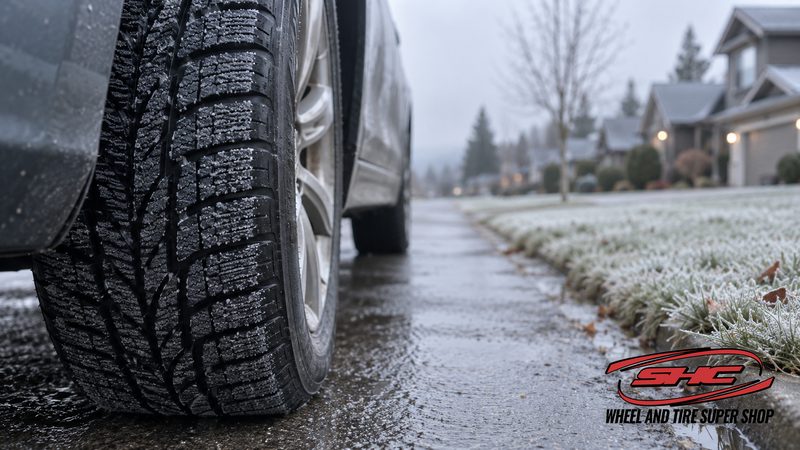
Langford has one of the mildest climates in Canada. It also produces more winter-tire customers than almost anywhere else on the South Island. Both things are true, and the reason is simple: Langford drivers don’t stay in Langford.
Here’s the honest answer to whether you need winter tires on the Westshore — and when the smarter money goes elsewhere.
The short answer
If your driving stays inside the Westshore and Greater Victoria, the law doesn’t require winter tires. City streets in Langford, Colwood and Victoria aren’t designated winter tire routes, and most winters bring only a handful of genuinely icy mornings.
The moment your winter includes the Malahat, the answer changes. Highway 1 over the Malahat is a designated winter tire route from October 1: your tires need an M+S or mountain-snowflake marking and at least 3.5mm of tread, or you’re looking at a fine and a turnaround at the bottom of the hill. For a huge share of Langford households — commuters, hockey parents, anyone with family in the Cowichan Valley — that’s not a hypothetical. That’s Tuesday.
You can check the current designated routes on the Province of BC’s winter tire routes page.
What Langford winter actually looks like
Forget the snowdrifts in tire commercials. A Westshore winter is wet pavement at 3°C, dark commutes, standing water after a week of rain, and two or three surprise snowfalls a year that melt by Thursday — plus a hill on almost every route out of your neighbourhood.
That last part matters more than people think. Langford is built on slopes. Bear Mountain, Happy Valley, the climbs off Sooke Road — when those few icy mornings do land, they land on grades where all-season tires simply don’t hold. The rest of the year, the job is cold-wet braking, and that’s a compound question: below about 7°C, regular all-season rubber stiffens and gives up grip exactly when the school run starts.
Three ways to buy, ranked honestly
All-weather tires — the right call for most of Langford. These carry the three-peak mountain snowflake, so they’re legal on the Malahat and every other designated BC route all year, no seasonal swap. Their softer compound keeps braking grip through the cold-wet months that make up ninety percent of a Westshore winter. The category leader’s technology is worth a read at Nokian Tyres, who invented it.
Dedicated winter tires — for the daily Malahat commuter. If you cross the summit every workday from November to March, or you ski, nothing matches a true winter tire on ice. It costs you a second set and two changeovers a year, and it’s worth it at that exposure level.
Staying on all-seasons — legitimate, with eyes open. If you genuinely never leave the core between October and March, decent all-seasons with healthy tread are a defensible choice. Just be honest about what “never” means, because the fine for guessing wrong on a designated route is real, and the traction on that January morning on the Bear Mountain Parkway is realer.
The tread depth trap
Whatever’s on your car right now, the marking on the sidewall is only half the law. Designated routes require 3.5mm of remaining tread — more than double the 1.6mm minimum for regular driving. Tires that are perfectly legal for the Langford school run can be illegal on the Malahat in December. We’ll measure yours free, walk-in, no appointment — it takes thirty seconds and settles the question with a number.
Timing: why October beats November
The requirement starts October 1. The first cold snap usually lands in November. Every Westshore driver who waits for the snap books the same week — and that week, stock in common sizes gets thin everywhere on the Island. Buying in late September or early October means full selection, no queue, and no white-knuckle morning spent wishing you’d booked.
One more Westshore-specific tip: if you’re running a second set on its own rims, store them clean and dry — or ask us about seasonal storage if the garage is already full of bikes and paddleboards, which in Langford it usually is.
The bottom line
Langford’s climate doesn’t force winter tires on you. Langford’s geography — a bedroom community with hills inside it and the Malahat beside it — usually does. For most households the answer is one good set of all-weathers; for daily Malahat commuters it’s a true winter set; and for everyone, it’s at least 3.5mm of tread before October 1.
Not sure which way to go?
Call the Shop — tell us where you actually drive and we’ll tell you what you actually need.
Start Your Quote Online — winter and all-weather pricing for your vehicle.